
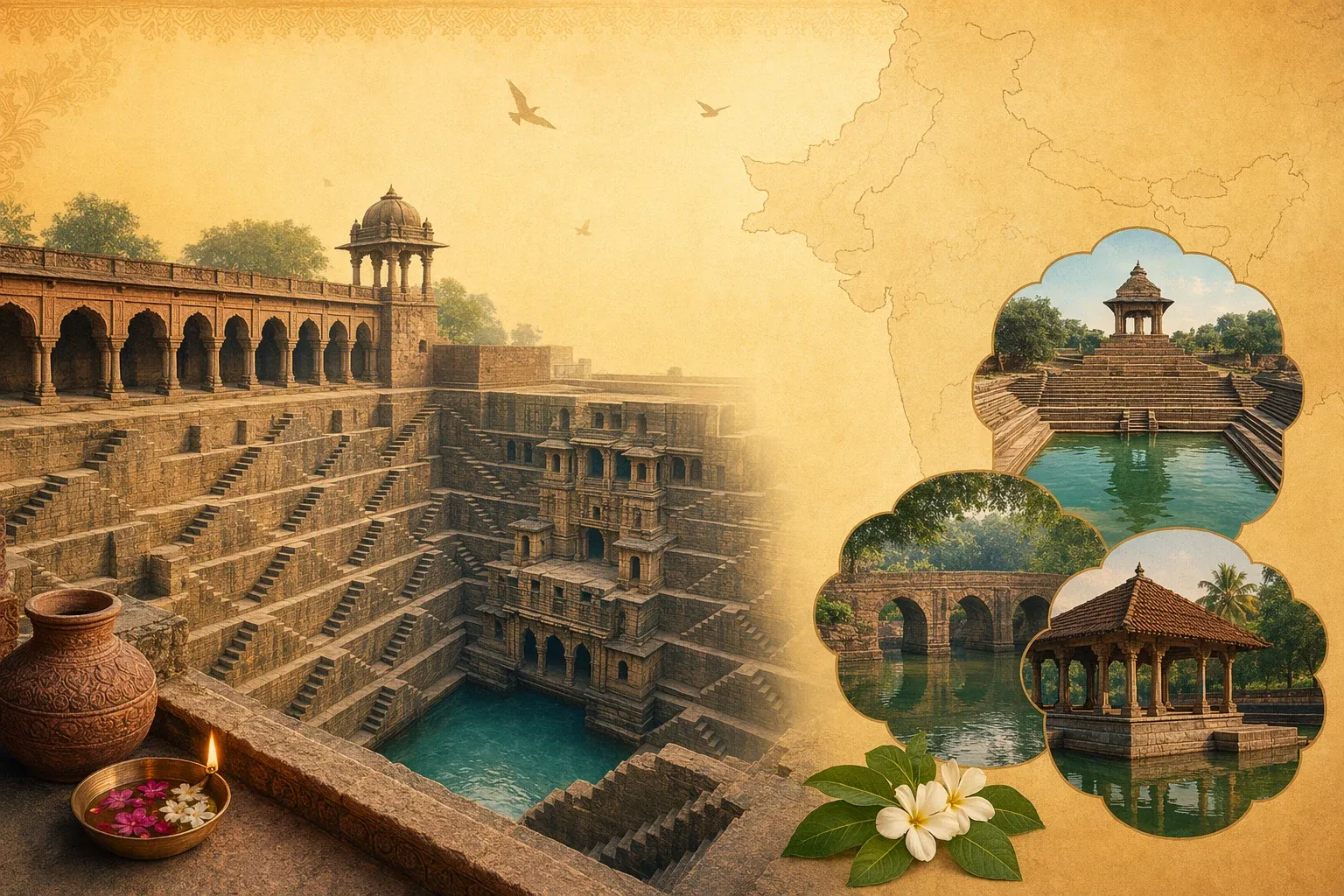
Stepwells are not only an Indian idea in the widest possible sense of “steps leading to water”, but India has the strongest, richest, and most famous stepwell tradition. When people say stepwell, they usually mean the Indian baoli, baori, bawdi, or vav: a built water structure with steps, landings, passages, and often a well shaft or reservoir. These are especially associated with western and northern India, with Gujarat and Rajasthan at the centre of public imagination.
The careful answer is this: India is the main home of the classic stepwell tradition, but related stepped water structures and connected forms can be found in nearby regions and in other cultures. We should compare them responsibly instead of claiming that every stepped tank in the world is the same as an Indian vav.
India’s core stepwell geography
Within India, stepwells are strongly linked with dry and seasonal regions. Gujarat has the vav tradition, with famous examples such as Rani ki Vav at Patan, Adalaj ni Vav near Gandhinagar, and Bai Harir or Dada Harir ni Vav in Ahmedabad. Rajasthan has dramatic baoris and baoris such as Chand Baori at Abhaneri. Delhi has baolis connected with older urban layers, including Agrasen ki Baoli.
Stepwell forms also appear beyond just these headline states. Historical and regional names include baoli, baori, baudi, bawdi, vav, vaav, barav, kalyani, and pushkarani, though each term may point to a slightly different local structure. A temple tank in the south, for example, should not automatically be treated as identical to a Gujarati vav. The shared idea may be stepped access to water, but the setting, ritual role, climate, and architecture may differ.
Why western India has so many famous examples
Western India had the right mix of need, skill, and patronage. Dry months and seasonal rainfall made water access urgent. Stone-building traditions made deep structures possible. Rulers, queens, merchants, local elites, and communities could sponsor public works. Over time, the stepwell became not only useful but also prestigious.
Rani ki Vav is a powerful example. It is associated with the Chaulukya period and Queen Udayamati, has multiple sculptural levels, and is listed as a UNESCO World Heritage Site. Adalaj and Bai Harir show how late medieval Gujarat developed deep, carved, socially active vavs. These monuments explain why India dominates the global image of stepwells.
Stepwells and the Indian subcontinent
Some descriptions of stepwells note that the tradition extends into select places in what is now Pakistan, especially in arid regions historically connected with western India and the wider subcontinent. This is not surprising. Cultural and architectural zones do not always stop at modern political borders. Water needs, trade routes, craftspeople, and older kingdoms crossed many boundaries.
So if someone asks, “Are there stepwells outside India?”, the responsible answer is yes, if we include the wider Indian subcontinent and related historical regions. But the largest living public memory, the most visited examples, and the strongest heritage identity remain in India.
Similar does not always mean the same
Many cultures have built stairs to water: wells, cisterns, baths, reservoirs, temple tanks, ghats, qanat access points, and underground storage spaces. Ancient and medieval societies across the world needed to store water and reach it safely. A staircase into a water structure is a practical solution that can appear in more than one place.
But an Indian stepwell usually has a specific combination: descending access, well shaft or tank, seasonal water logic, underground cooling, public use, regional vocabulary, and often elaborate architecture. If another country has a stepped reservoir, that does not automatically make it a baoli or vav. Comparison is useful, but flattening differences is not.
Where stepwells are found in India
If we speak broadly, stepwells are found especially in Gujarat, Rajasthan, Delhi, parts of Madhya Pradesh, Maharashtra, Haryana, and other regions with local variants. The exact list depends on how strictly one defines stepwell. Some scholars and heritage writers separate stepwells from temple tanks, ponds, ordinary wells, and stepped reservoirs. Others use a wider umbrella.
For a beginner, the safe map is simple: start with Gujarat and Rajasthan, then look at Delhi and other western or northern examples. After that, compare related stepped water structures in other regions, but pay attention to local names and functions.
Why the word names matter
Language gives clues. Vav or vaav points to Gujarat and related western usage. Baoli, baori, bawdi, and baudi appear in Hindi, Rajasthani, and north Indian contexts. Barav is used in Marathi contexts. Kalyani and pushkarani may refer to stepped temple tanks in southern traditions. These names are not just labels. They hold geography, community, and use.
Using local names respectfully prevents confusion. It also helps readers see India’s diversity. A student who learns only the English word stepwell may miss how each region understood water through its own language and practice.
Water wisdom across forms
Stepwells also belong to a wider Indian water family. Ordinary wells, tanks, ponds, johads, kunds, temple tanks, ghats, canals, and rainwater-harvesting systems all played roles in different landscapes. A johad in Rajasthan or Haryana, for example, is usually a community rainwater-harvesting or percolation pond that helps recharge groundwater. It is related to water wisdom, but it is not the same structure as a vav.
This wider view is important. India’s heritage is not one design repeated everywhere. It is many local answers to water, climate, settlement, worship, travel, and community need.
Questions people ask
Are stepwells only in India?
Classic stepwells are most strongly associated with India, especially Gujarat and Rajasthan. Related forms and some stepwell traditions also exist in the wider Indian subcontinent.
Where are stepwells found in India?
They are found especially in Gujarat, Rajasthan, Delhi, and parts of western and northern India, with related structures in other regions under local names.
Are there stepwells outside India?
Yes, some are reported in nearby historical regions of the Indian subcontinent, and other cultures have similar stepped water structures. But they should not all be treated as identical.
A balanced way to answer
If you want one sentence, say: stepwells are a major Indian contribution to water architecture, with the richest examples in western India, while similar stepped water ideas exist elsewhere. This respects India’s central role without turning heritage into a competition.
The deeper point is that water shapes culture. In India, that shaping produced vavs, baolis, baoris, temple tanks, johads, and many other systems. Studying where stepwells are found is therefore not only a geography question. It is a way of seeing how communities turned climate challenges into architecture, memory, and public responsibility.