
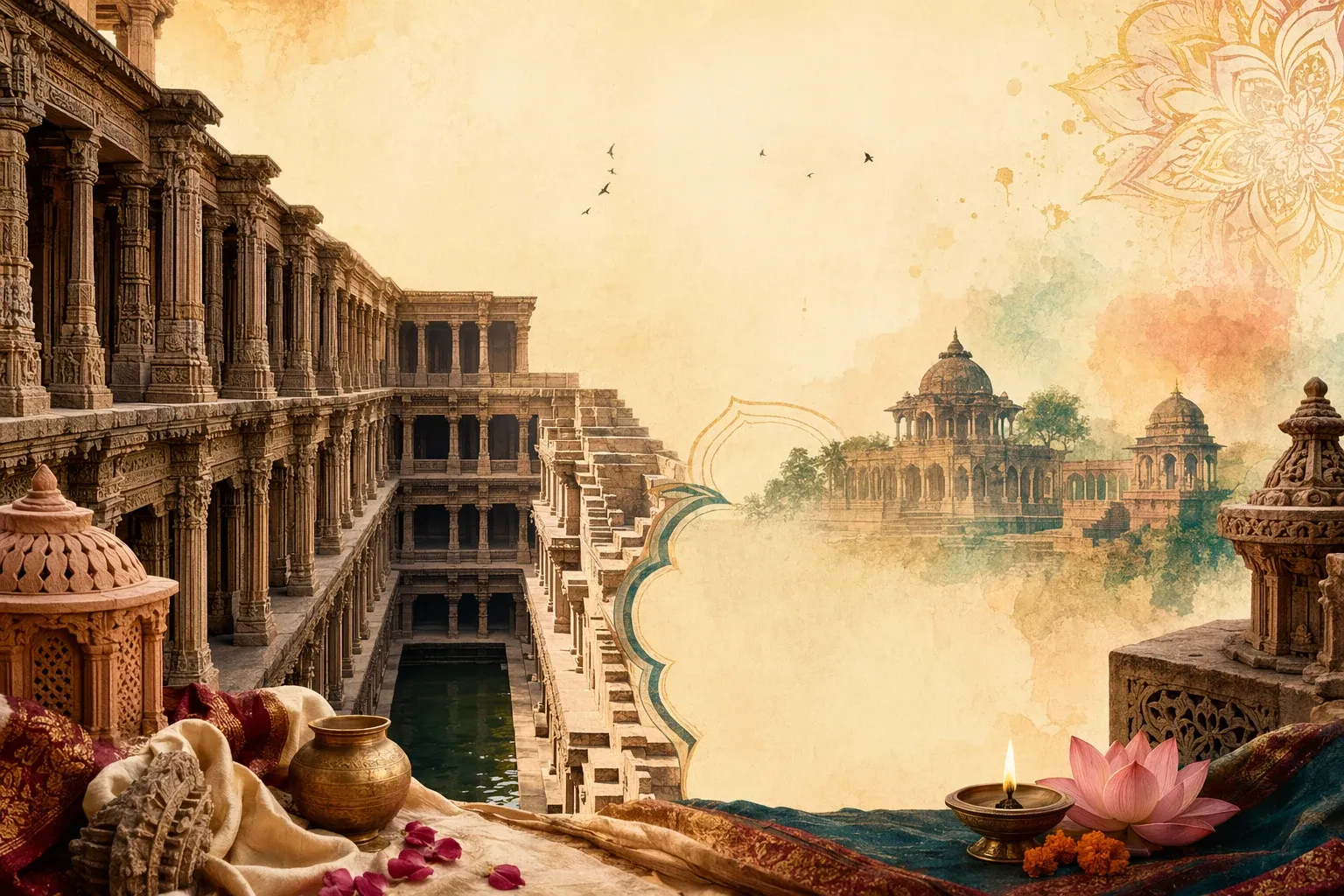
Gujarat is one of the best places to understand Indian stepwells because the local vav tradition is rich, practical, and deeply artistic. A vav is not only a well with stairs. It is a planned descent into the earth, built so people could reach water when the level changed through the seasons. In Gujarat, that practical idea often became an architectural experience, with corridors, landings, carved pillars, shaded galleries, inscriptions, and sometimes sacred imagery.
For many people today, the first image of a Gujarati stepwell is Rani ki Vav at Patan, Adalaj ni Vav near Gandhinagar, or Bai Harir ni Vav in Ahmedabad. These are famous because they are beautiful, but their beauty came from a real need. Gujarat’s climate, trade routes, towns, and dry months made water planning a serious public duty. The vav answered that duty in stone.
Why Gujarat became a strong home of vavs
Stepwells are found in several parts of India, but western India gave them a special architectural language. Gujarat’s semi-arid conditions meant that communities had to think carefully about monsoon water, groundwater, storage, and access during hot months. A simple well could draw water from above, but a vav allowed people to walk down toward water as it fell lower. That one design choice changed the whole experience.
The descent made the structure easier to use and maintain. It also created shade and rest. A person entering a vav could move from harsh light into a cooler underground space. Travellers, residents, water carriers, craft workers, and worshippers could encounter it differently. So the vav became both water infrastructure and public architecture.
Rani ki Vav at Patan
Rani ki Vav, the Queen’s Stepwell at Patan, is Gujarat’s most celebrated example. Gujarat Tourism describes it as a stepwell on the banks of the Saraswati River, with multiple levels, carved pillars, geometric patterns, and many sculptures, especially on Vishnu-avatar themes. It is often described as an inverted temple because the visitor descends into a sacred-feeling architectural space instead of rising upward like in a normal shrine.
Tradition and historical writing connect the monument with Rani Udayamati of the Chaulukya period, in memory of King Bhima I. A medieval Jain composition, the Prabandha-Chintamani, is often cited in this context. The monument was later buried under silt and restored in the twentieth century by the Archaeological Survey of India. It entered the UNESCO World Heritage list in 2014. This journey itself is a lesson: water heritage can disappear from daily sight and still return as cultural memory when protected with care.
Adalaj and the public life of a vav
Adalaj ni Vav, also known as Rudabai Stepwell, lies near Gandhinagar and Ahmedabad. It is commonly dated to the late fifteenth century and is known for its five-storey depth, carved surfaces, and graceful combination of practical and ornamental design. The story around Adalaj is popular, but readers should separate local tradition from what inscriptions and careful history can confirm.
What is clear is the function. In semi-arid Gujarat, such stepwells provided water for drinking, washing, bathing, resting, and social life. Some sources also mention festivals, rituals, travellers, and caravans connected with these spaces. This does not mean every vav was used in exactly the same way every day. It means the structure was flexible enough to serve several layers of community life.
Bai Harir ni Vav in Ahmedabad
Bai Harir ni Vav, often called Dada Harir Stepwell, is another important Ahmedabad-area example. Gujarat Tourism places it about 15 km from the centre of Ahmedabad and notes its five levels of carved stone columns. The same page also says that the wells are now often dry, and that the depths remain cool even on hot days. That detail is important because it reminds us that a monument may survive even when its original water condition has changed.
Historical references connect the stepwell with Dhai Harir or Bai Harir Sultani, associated with the time of Sultan Mahmud Begada. The site also has inscriptions and a mosque-tomb context nearby. This mix shows how Gujarat’s water architecture crossed simple categories. It can include Hindu craft vocabulary, Sultanate-period patronage, Persian or Sanskrit inscriptions, local memory, and shared public use.
Architecture shaped by water
A Gujarati vav usually makes the journey to water feel intentional. Stairs lead downward through levels. Pillars hold galleries. Beams, platforms, walls, and shafts keep the structure stable. Light enters from above, but the deeper levels become more shaded. Some vavs are long and corridor-like; others feel more like a sunken pavilion joined to a well shaft.
This is why stepwells should not be judged only as decoration. The carvings matter, but so do the retaining walls, drainage logic, masonry, and access paths. The craft is not only on the surface. It is in the way the earth is held, the way people move, and the way the structure responds to water.
Water, beauty, and public duty
Gujarat’s vavs also carry an ethical message. Building water access was public service. A patron might be a queen, noblewoman, ruler, merchant, community, or local authority, but the benefit reached ordinary users. In Indian terms, this connects naturally with dana, seva, and dharma: a gift becomes meaningful when it supports life.
That does not mean we should romanticise every old system. Stepwells required labour, maintenance, safe access, and clean water. Many later suffered from neglect, pollution, silting, falling water tables, or urban pressure. Their lesson is not that the past was perfect. Their lesson is that public welfare can be designed with seriousness and beauty.
Questions people ask
What are stepwells called in Gujarat?
In Gujarat, stepwells are commonly called vav or vaav. The word points to a stepped water structure that leads down toward a well or reservoir.
Which stepwells are famous in Gujarat?
Rani ki Vav at Patan, Adalaj ni Vav near Gandhinagar, and Bai Harir or Dada Harir ni Vav in Ahmedabad are among the best-known examples.
Are there stepwells in Ahmedabad?
Yes. Ahmedabad and its surrounding region have important stepwell heritage, including Bai Harir ni Vav in Asarwa and the nearby Adalaj ni Vav close to Gandhinagar.
How to look at a vav today
When visiting or reading about a Gujarati vav, look for three things together. First, notice the water logic: where is the shaft, where are the steps, and how would people descend? Second, notice the social logic: where could people pause, gather, rest, or perform small acts of devotion? Third, notice the craft: pillars, brackets, panels, inscriptions, geometry, and stone surfaces.
Seen this way, Gujarat’s stepwells become more than photo spots. They become reminders of how climate, craft, community, and memory were once built into the same space. A vav is Gujarat’s water wisdom made visible, and its survival asks us to treat heritage with both curiosity and responsibility.