
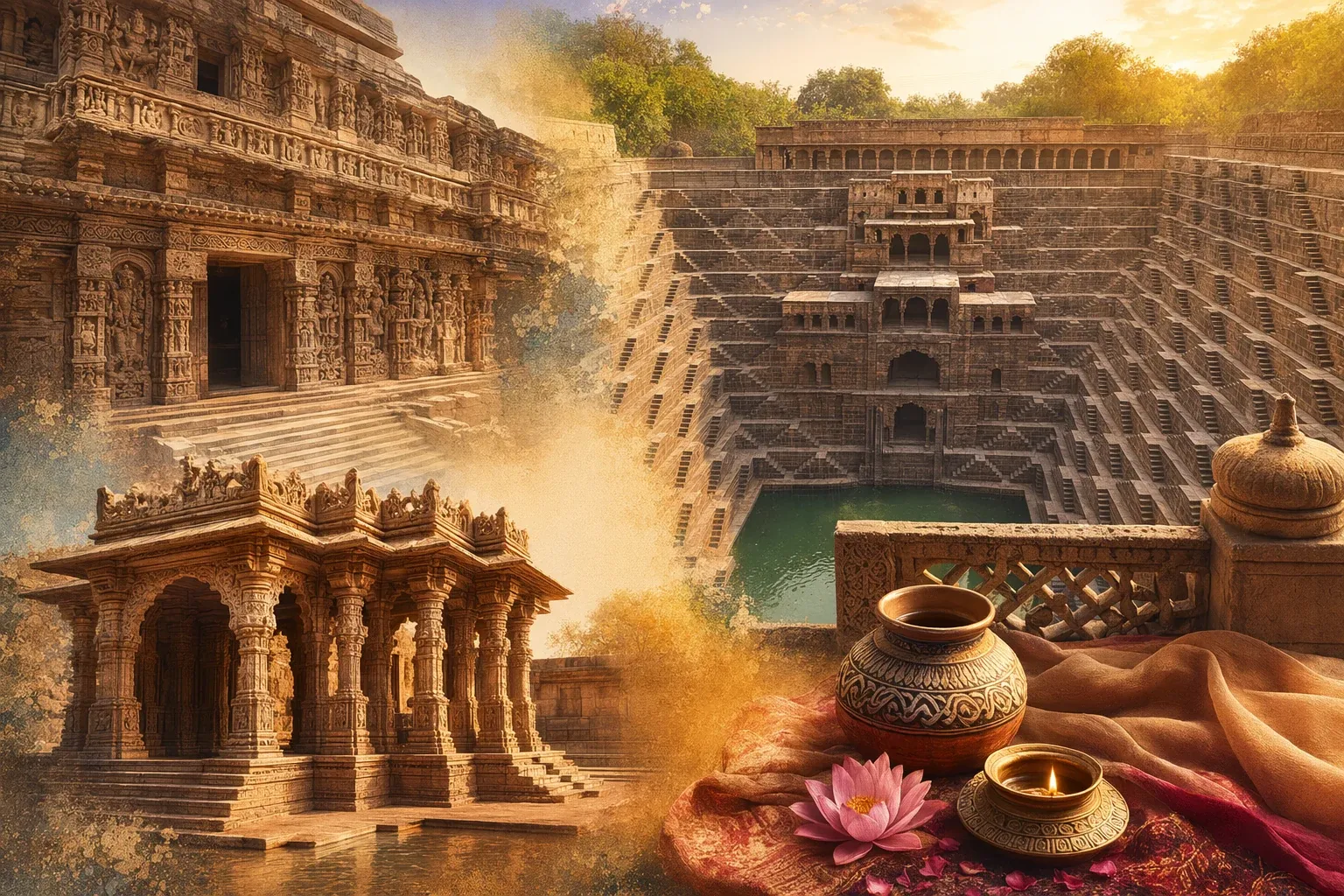
India’s famous stepwells are often remembered for their dramatic stairs and beautiful photographs, but their real story is deeper. They were built for water access, seasonal survival, shade, public welfare, ritual imagination, and local pride. A stepwell may look like architecture first, yet it began with a simple human need: how do people reach and manage water when the level changes through the year?
This guide introduces some major examples in a beginner-friendly way. It is not a ranking of “best” or “most mysterious” places. Stepwells do not need hype. Their quiet power comes from the way engineering, climate, craft, and community meet in stone.
Rani ki Vav, Patan, Gujarat
Rani ki Vav is among the most celebrated stepwells in India. Located at Patan in Gujarat, it is traditionally connected with Queen Udayamati of the Chaulukya dynasty and King Bhimdev I. Gujarat Tourism describes it as a multi-level stepwell with carved pillars, more than 800 sculptures, and an inverted-temple form. It has also been recognised as a UNESCO World Heritage Site.
What makes Rani ki Vav special is not only scale. It shows how a water structure could become sacred architecture. The descent into the vav is also a journey through sculptural panels, Vishnu themes, geometric patterns, and careful stonework. For students, it is a strong example of Gujarat’s vav tradition, where utility and devotion can appear in the same structure.
Chand Baori, Abhaneri, Rajasthan
Chand Baori at Abhaneri in Rajasthan is famous for its striking geometric steps. Rajasthan Tourism describes it as a stepwell built to conserve water and provide relief from intense heat, with 3,500 narrow symmetrical steps and a three-sided descent toward the water. The fourth side includes a pavilion with jharokhas, galleries, and balconies. The nearby Harshat Mata Temple adds another layer of cultural context.
The monument is often dated to the early medieval period and associated with King Chanda of the Nikumbha dynasty. Some sources also caution that direct epigraphic evidence about its construction is limited, so it is better to phrase the history carefully. Chand Baori matters because it makes the logic of a stepwell visible: many steps, cooling depth, water access, and community use in a dry region.
Agrasen ki Baoli, New Delhi
Agrasen ki Baoli stands on Hailey Road in New Delhi, close to Connaught Place and Jantar Mantar. It is widely known because it sits inside a modern city, making the old world of baolis suddenly visible among offices, roads, and urban noise. Public sources describe it as a protected monument and often give its size as about 60 metres long and 15 metres wide.
The name connects it with Agrasen tradition, but responsible history also notes uncertainty about the original builder and possible medieval rebuilding. That caution is important. We can admire the monument without pretending every story is proven. Its value today lies in showing how Delhi also had a culture of water structures, not only forts, tombs, and palaces.
Adalaj ni Vav, near Gandhinagar, Gujarat
Adalaj ni Vav, also known as the Adalaj Stepwell or Rudabai Stepwell, is another important Gujarati example. It is generally associated with the late 15th century and is known for its multi-storey form, carved details, and the word vav itself. Like Rani ki Vav, it reminds readers that Gujarat’s stepwells were not plain holes in the ground. They could be carefully planned spaces with beauty, shade, and social meaning.
Adalaj is often described as a place where water use, rest, and sacred or community practices met. A visitor may notice the stone carving first, but the deeper lesson is climatic intelligence. Semi-arid regions needed reliable ways to store and reach water. The vav answered that need while also becoming a place people remembered.
Other examples worth knowing
India has many more stepwells and stepped water structures. Delhi has other baolis besides Agrasen ki Baoli, including Gandhak ki Baoli and Rajon ki Baoli. Gujarat has Dada Harir ni Vav in Ahmedabad and many lesser-known vavs across old settlements. Rajasthan has baoris connected with forts, towns, villages, and travel routes. Maharashtra, Madhya Pradesh, Karnataka, and other regions also have wells, tanks, baravs, kalyanis, and pushkaranis that belong to India’s wider stepped-water heritage.
Not every example is equally documented in popular sources, so it is wise to avoid making quick claims about oldest, largest, or first. The better approach is to ask: where is it located, what name does the region use, what water need did it serve, what sources support its date, and how is it protected today?
Why famous stepwells matter
Famous stepwells matter because they help us understand ordinary problems at extraordinary scale. Water scarcity, heat, travel, public welfare, maintenance, and community gathering were not abstract ideas. They were daily realities. A stepwell turned those realities into a built solution. It made water accessible by stairs. It offered shade. It created a place where people could pause.
They also matter because they challenge a narrow idea of heritage. Indian heritage is not only kings and battles. It is also wells, tanks, inscriptions, paths, gardens, food systems, textiles, and community habits. A stepwell is civic memory. It tells us what earlier societies valued enough to build and maintain.
How to read a stepwell when you visit
Look beyond the Instagram angle. Notice the direction of the steps. See whether the structure is long like a corridor, deep like a tank, or attached to a shaft. Look for pillars, side galleries, carvings, inscriptions, shrines, signs of restoration, and safety barriers. Ask how sunlight enters and where people may have rested. Ask where water would have been in summer compared with the rainy season.
Also notice the local name. Baoli, baori, and vav are not decorative labels. They connect the monument to language and place. When a guide or signboard uses a regional word, keep it in your notes. It may tell you more than a generic English label can.
Questions people ask
What are some famous stepwells?
Famous stepwells include Rani ki Vav at Patan, Chand Baori at Abhaneri, Agrasen ki Baoli in New Delhi, and Adalaj ni Vav near Gandhinagar. Many other regional examples also deserve attention.
Which is the famous Indian step well?
Rani ki Vav and Chand Baori are among the most famous Indian stepwells. Rani ki Vav is known for sculptural architecture and UNESCO recognition, while Chand Baori is known for its dramatic geometry.
Where is the Queen's stepwell?
The Queen’s stepwell usually refers to Rani ki Vav, located at Patan in Gujarat. It is traditionally linked with Queen Udayamati and the Chaulukya period.
Which is the largest stepwell in the world?
Chand Baori is often described in public sources as one of the largest and deepest stepwells, but claims about “the largest” should be handled carefully unless a specific source and measurement are given.
A good way to remember them
Rani ki Vav teaches sculptural devotion and Gujarat’s vav tradition. Chand Baori teaches geometry, depth, and Rajasthan’s dry-region water wisdom. Agrasen ki Baoli teaches urban memory inside Delhi. Adalaj ni Vav teaches how beauty, shade, and practical water access could live together.
Together, these famous stepwells show a dharmic idea in stone: society should build for shared life. Water was not treated as a private luxury alone. It was managed, approached, named, and honoured. That is why stepwells still deserve attention, not as frozen ruins, but as lessons in thoughtful public design.