
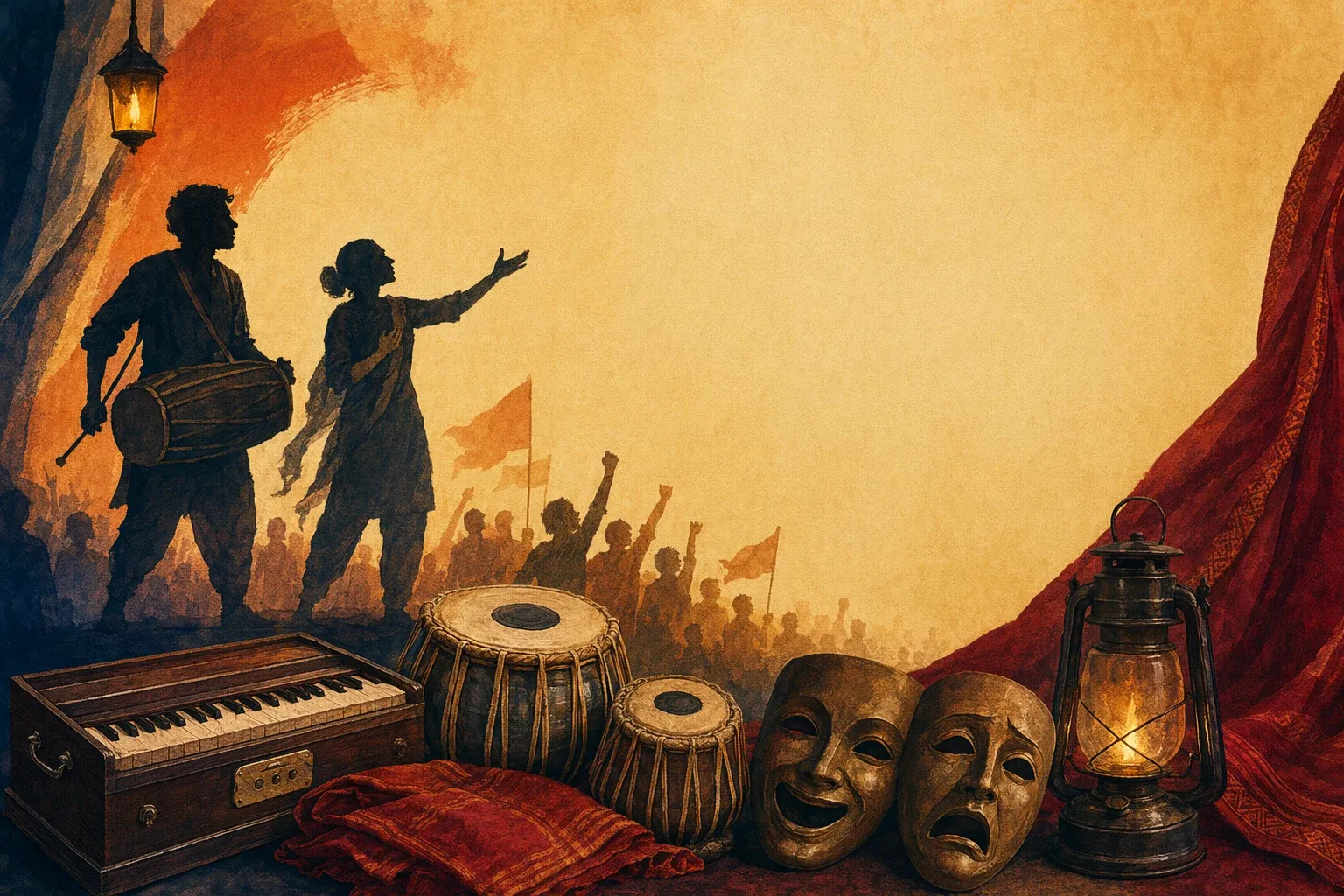
The Indian People’s Theatre Association, better known as IPTA, is one of the most important cultural movements in modern Indian theatre. It began in the 1940s, a time when India was still under British rule, the Second World War was shaking the world, the freedom movement was intense, and the Bengal famine had exposed terrible human suffering. IPTA tried to answer a powerful question: can theatre, songs, and performance speak directly to the people about the life around them?
Its answer was yes. IPTA did not imagine theatre only as an elite evening inside a formal hall. It saw theatre as a public art that could travel to workers, students, farmers, neighbourhoods, and political gatherings. Its plays and songs carried social feeling, anti-colonial energy, and sympathy for ordinary people. That is why IPTA is remembered not only as an association, but as a people’s theatre movement.
The meaning of people’s theatre
“People’s theatre” sounds simple, but it has a deep meaning. It suggests theatre that belongs to common people, speaks in languages they understand, and responds to their worries. It does not mean the art has to be crude or careless. Many IPTA-linked artists were highly talented writers, actors, musicians, and filmmakers. The point was that art should not be locked away from public struggle.
In India, this idea was especially powerful because performance traditions had long lived among communities: folk songs, devotional storytelling, village dramas, street performance, seasonal festivals, and local satire. IPTA brought a modern political urgency to that older public energy. It used songs, plays, skits, processions, and cultural squads to make art mobile and collective.
Why the 1940s mattered so much
IPTA took shape in a decade of crisis. The Quit India movement had shaken colonial rule in 1942. The Bengal famine of 1943 caused massive suffering and became a moral wound in public memory. The Second World War created fear, shortages, and ideological battles across the world. Indian artists and writers were asking what their role should be in such a moment.
In 1943, IPTA was formed at a national gathering in Bombay, now Mumbai. Its roots were connected with progressive cultural groups, writers, musicians, and theatre workers who wanted art to become socially awake. Some accounts also connect its early energy to cultural work around the Bengal famine, including songs and performances that drew attention to hunger and injustice.
Artists, songs, plays, and a larger cultural family
IPTA attracted many remarkable names from theatre, literature, music, and cinema. Figures often associated with its wider history include Balraj Sahni, Prithviraj Kapoor, Bijon Bhattacharya, Ritwik Ghatak, Utpal Dutt, Khwaja Ahmad Abbas, Salil Chowdhury, and others. The exact involvement of each person varied by time and place, but the larger pattern is clear: IPTA became a meeting ground for socially conscious artists.
One famous example from this cultural atmosphere is Bijon Bhattacharya’s Bengali play Nabanna, linked with famine-era suffering and peasant life. IPTA also had music at its heart. Songs could travel faster than full plays. A song could be learned, repeated, translated, and carried into a meeting or march. This made performance feel close to public life.
Modern Indian theatre before and after IPTA
Indian theatre did not begin with IPTA. There were classical, folk, devotional, courtly, colonial, commercial, and regional theatre worlds long before it. But IPTA changed the modern imagination of what theatre could do. It made social themes central. It encouraged artists to think of audiences beyond the paying urban middle class. It strengthened the link between performance and public debate.
This influence can be seen in later street theatre, political theatre, worker and student theatre, and socially engaged cinema. The direct organisation had its ups and downs, and different regions developed differently. Still, the idea remained: performance can question power, grieve with people, educate, entertain, and organise feeling.
IPTA and modern Indian cinema
One reason IPTA still appears in cultural discussions is its connection with cinema. Several artists who moved through IPTA circles later contributed to Indian films as actors, writers, composers, and directors. Their work often carried concern for class, labour, rural life, migration, hunger, and dignity. This does not mean every socially sensitive film came from IPTA. But IPTA helped create an environment where art and public responsibility could meet.
For young readers, this is a useful bridge. If you enjoy films that talk about society rather than only romance or spectacle, you are already close to the questions IPTA artists cared about. Who gets represented? Whose pain is visible? Can songs carry protest? Can humour expose injustice? Can art make us less indifferent?
Tradition, ideology, and historical care
It is important to speak carefully about IPTA. It had strong links with progressive and left cultural politics, and many of its artists were influenced by anti-fascist, anti-colonial, socialist, and people-centred ideas. That historical context should not be hidden. At the same time, IPTA should not be reduced only to a political label. It was also a creative space of music, acting, writing, travel, friendship, disagreement, and experiment.
Different people remember IPTA differently. Some celebrate it as a golden moment of committed art. Some study its limitations, internal politics, and changing relevance after Independence. A balanced view allows both respect and inquiry. The safest statement is that IPTA made a major contribution to people-oriented theatre and public culture in twentieth-century India.
Why IPTA still matters today
IPTA matters because the questions it raised have not disappeared. India still has inequality, migration, labour struggles, language debates, communal tensions, and questions of justice. Artists still ask whether they should entertain quietly or respond to the times. Audiences still need spaces where difficult realities can be felt, not only reported.
Today, people’s theatre may happen through street plays, college performances, protest music, community theatre, documentary theatre, and digital recordings. The form has changed, but the basic impulse remains close to IPTA: art should be alive to the people around it.
What is IPTA in simple words?
IPTA is the Indian People’s Theatre Association, a cultural movement formed in the 1940s that used theatre, songs, and performance to speak about freedom, social justice, hunger, labour, and public life.
What was Indian theatre in World War II?
During the Second World War period, some Indian theatre groups became more openly political and socially engaged. IPTA grew in this atmosphere, responding to colonial rule, famine, anti-fascist feeling, and the freedom struggle.