
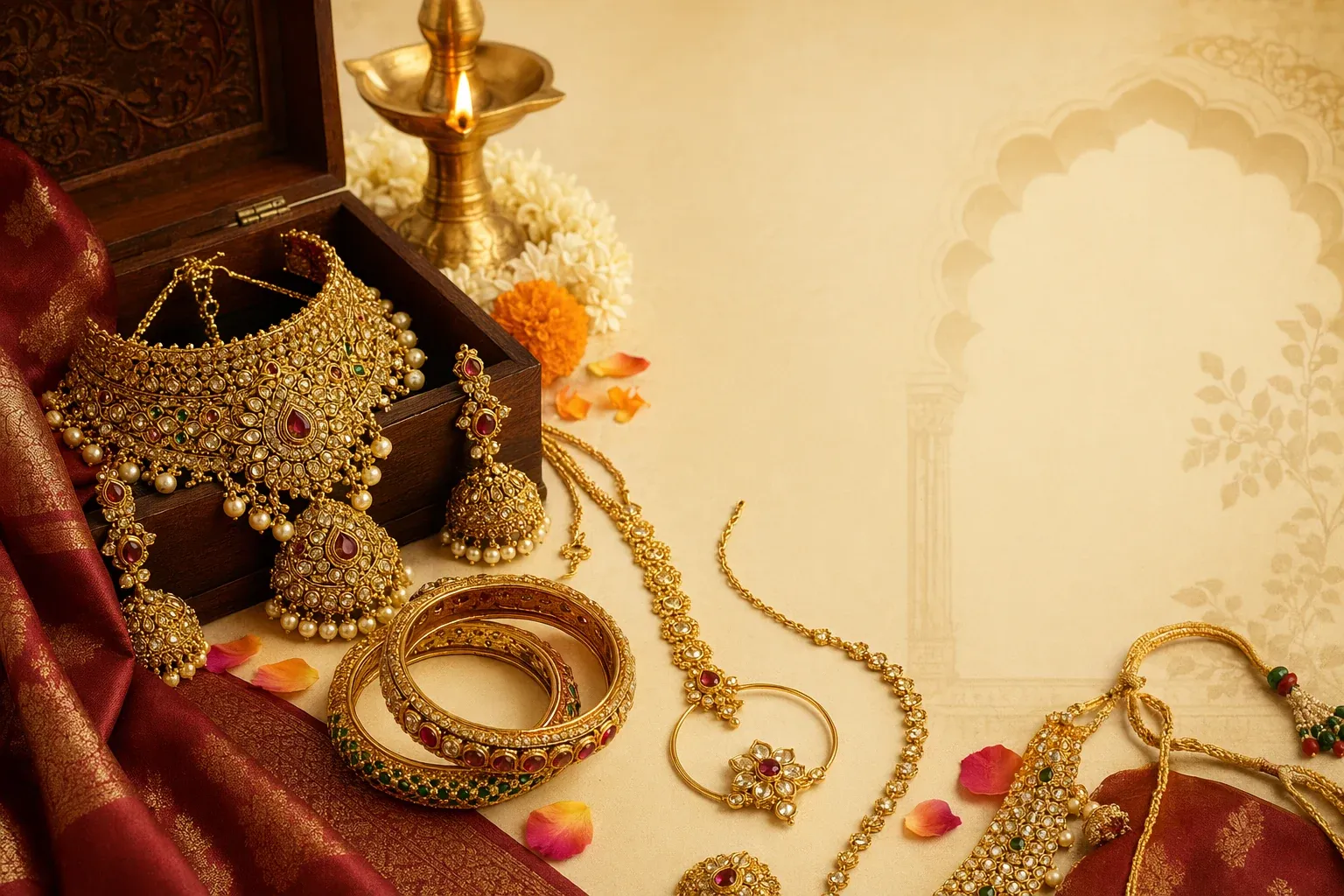
Indian bridal jewellery is beautiful, but its real power is not only sparkle. In many families, a bride’s jewellery carries blessings, memory, craft, status, region, and emotion. Some pieces are tied to marriage rituals. Some come from the mother, grandmother, or in-laws. Some are chosen simply because the bride loves how they look. A thoughtful guide should make space for all of this, because India does not have one single wedding jewellery language.
From Tamil tali designs to Maharashtrian nath, Punjabi chooda, Bengali shakha-pola, Rajasthani borla, Hyderabadi pearls, and temple jewellery in the South, bridal adornment changes with community and place. Even the same ornament can mean different things in different homes. So this guide explains common pieces without pretending that every Indian bride wears all of them or that every meaning is universal.
For a wider map of ornament names, read What Is Traditional Indian Jewellery? A Beginner Guide and Types of Indian Jewellery Explained Simply. Specific bridal pieces become clearer with Indian Forehead Jewellery Explained: Maang Tikka, Matha Patti, and Bindi Links, What Is a Kundan Necklace? Meaning, Making, and Wedding Use, and What Is Indian Temple Jewellery? Meaning, Motifs, and History.
The necklace close to the wedding vow
For many Hindu communities, the mangalsutra or its regional equivalent is one of the most recognised marriage ornaments. The word is often explained through mangala, meaning auspicious, and sutra, meaning thread. In several traditions the groom ties it during the wedding ceremony, and the ornament becomes a visible reminder of marriage. In South India, the sacred marriage pendant may be called tali or thali, and its form can change by community, deity tradition, and family custom.
The black beads seen in many mangalsutra designs are commonly associated with protection from negative forces, while gold is connected with auspiciousness and prosperity. But modern brides may choose short chains, diamond pendants, regional pendants, or minimal everyday designs. The important cultural point is not that one design is “correct”, but that the object links jewellery with ritual, relationship, and memory.
Forehead ornaments and the centre line
The maang tikka sits on the centre parting of the hair and rests on the forehead. It frames the face and draws attention to the bride’s expression. In wedding language, the central line of the hair is already meaningful because sindoor is applied there in many Hindu ceremonies. The tikka therefore becomes both decorative and symbolic: it highlights the bride’s central presence in the ritual moment.
There are many styles. A single pendant maang tikka is common in North Indian bridal looks. A matha patti adds side chains across the forehead. A Rajasthani borla has a round pendant form. South Indian netti chutti designs often create a graceful line across the forehead. These differences show how bridal jewellery follows regional aesthetics, not just social media trends.
Nose jewellery, beauty, and regional identity
The nath or nose ornament is another striking bridal piece. In Maharashtra, a curved pearl-studded nath is deeply associated with festive and wedding dress. In parts of North India, brides may wear a large hoop with a chain linked to the hair. In other regions, the nose ornament may be a small stud, a ring, or absent altogether. It can mark beauty, marital symbolism, family tradition, or simply the chosen bridal style.
Because nose jewellery is so visible, it often becomes a strong regional marker. A student looking at wedding photographs can learn a lot by noticing shape, size, pearls, stones, and placement. Still, it is better to say “this style is associated with” a region or community than to make hard rules about what every bride must wear.
Bangles, chooda, shakha-pola, and hands that bless
Hands are central to wedding rituals: holding garlands, offering grains, touching elders’ feet, receiving blessings, and joining the partner’s hand. That is why bangles and hand ornaments feel so alive in wedding imagery. Punjabi brides may wear red and ivory chooda, often blessed by maternal relatives. Bengali brides may wear shakha and pola, white conch-shell and red coral bangles, along with iron or gold elements depending on custom. In many communities, glass, gold, lac, ivory-like, or metal bangles are chosen for colour, sound, and auspicious feeling.
The haath phool, a hand ornament connecting rings to a bracelet, adds a floral shape across the back of the hand. It is not necessary in every tradition, but it has become popular in many bridal looks because it photographs beautifully and echoes the mehendi-covered hand. Again, the meaning depends on family and region; the shared idea is adornment of hands that perform sacred and social gestures.
Waist belts, anklets, toe rings, and movement
Jewellery below the neck is just as important. A kamarbandh or oddiyanam holds the waist area and can give structure to a sari or lehenga. In South Indian bridal dress, temple-style waist belts may include forms of Lakshmi, floral motifs, or sacred geometry. Anklets add sound and movement. Toe rings, often called bichiya in North India, are connected with marriage in many Hindu communities, though customs vary.
These pieces remind us that bridal jewellery is designed for a moving body. A bride walks, sits for rituals, bends for blessings, circles the sacred fire in some ceremonies, dances, and greets relatives. Good jewellery must balance beauty with comfort. Heavy ornaments may look royal, but families also think about weight, safety, and how long the bride must wear them.
Kundan, meenakari, temple jewellery, and pearls
Some wedding jewellery is best understood through craft techniques. Kundan setting uses highly refined gold to set stones, often creating rich surfaces associated with royal and courtly taste. Meenakari adds enamel colour, sometimes hidden on the reverse of a piece like a private painting. V&A material on traditional Indian jewellery making highlights how specialised Indian jewellery work can be, with different artisans handling different stages.
Temple jewellery, especially associated with South Indian dance and bridal traditions, often uses images of deities, lotuses, peacocks, and auspicious forms. Hyderabadi and Deccani looks may highlight pearls. Polki, kundan, gold, diamonds, silver, glass stones, and imitation pieces all appear in modern weddings. The value of a piece is not only its market price; it may also lie in workmanship, family memory, and cultural fit.
How to read bridal jewellery respectfully
When you see Indian bridal jewellery, avoid reducing it to “too much gold” or “costume”. A layered bridal look often follows a visual grammar: forehead, ears, nose, neck, wrists, waist, ankles, and feet all become part of the ritual body. At the same time, avoid forcing sacred meaning onto every single design. Some pieces are deeply ritual; others are fashion choices; many are both.
If you are choosing jewellery for a wedding, ask elders about family customs, check comfort, match the outfit neckline and fabric, and choose secure clasps. If you are a student learning from photos, identify the region if possible, name the pieces carefully, and notice materials and craft. The most respectful approach is simple: see the bride not as a mannequin for ornaments, but as a person carrying family, community, taste, and joy into a major life moment.