
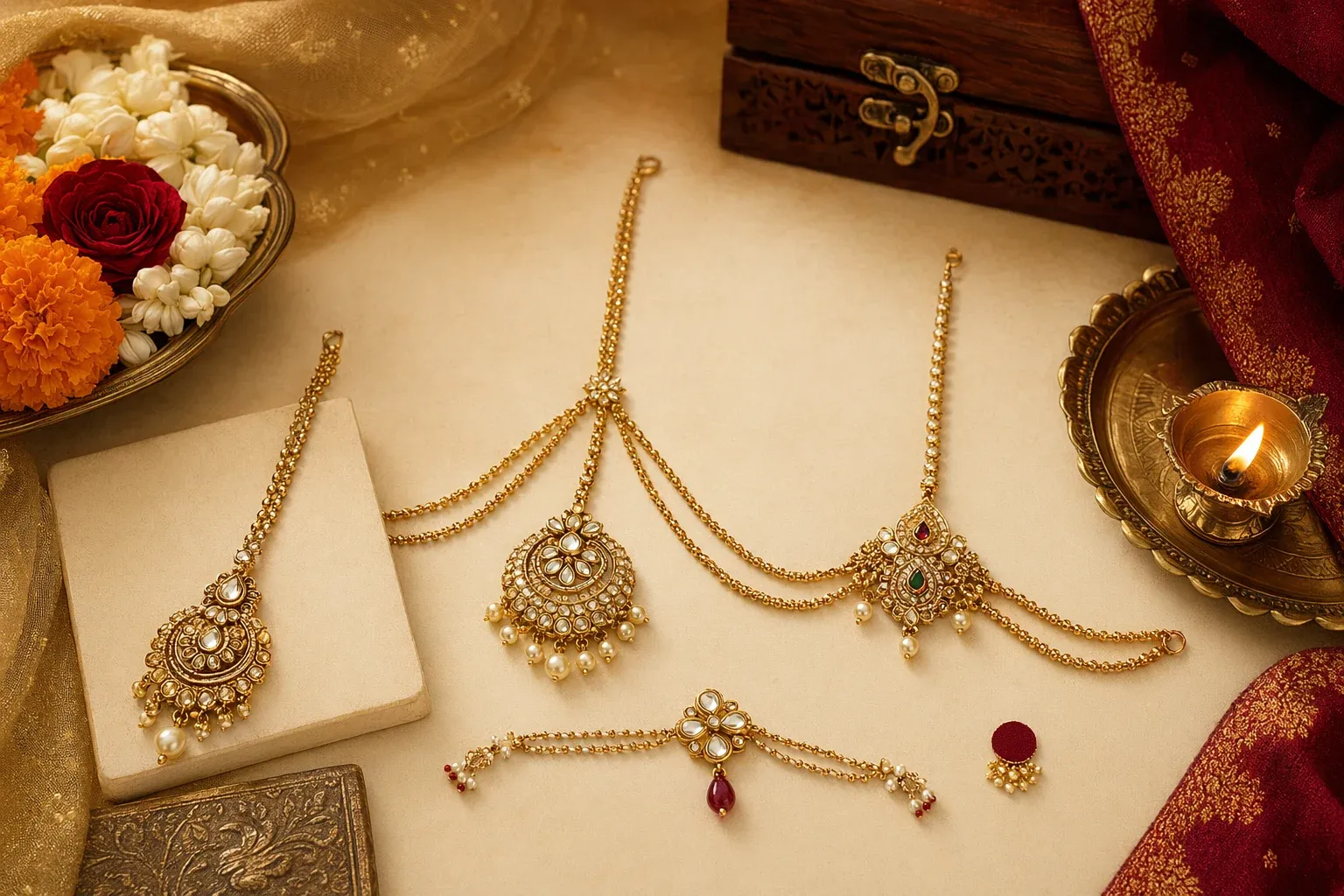
Indian forehead jewellery often creates the most memorable line in a bridal or festive look: a pendant at the centre, chains along the hairline, or a side ornament near the temple. The names can be confusing because different regions and occasions use different forms. This guide explains maang tikka, matha patti, passa, jhoomar and their relationship with bindi and sindoor without mixing up jewellery, ritual marks and fashion styling.
For more context, read this alongside Types of Indian Jewellery Explained Simply, What Is Traditional Indian Jewellery? A Beginner Guide, and Hindu Symbols in Tattoos, Jewellery, and Clothing: A Respectful Beginner Guide especially when you want to separate ornament names from broader symbols, clothing choices and respectful use.
The ornament people notice first
Indian forehead jewellery is often the first thing people notice in a bridal look or classical costume. A shining pendant sits at the centre of the forehead. Fine chains frame the hairline. A side ornament falls near the temple. A small bindi completes the face. To someone seeing it for the first time, all of this may look like one category. In Indian vocabulary, however, the pieces have different names, placements, histories, and moods.
The most common answer to “what is Indian jewellery on the forehead called?” is maang tikka. But depending on the design, it may also be a matha patti, borla, passa, jhoomar, sheeshphool, or part of a wider bridal head set. The bindi is related visually because it also sits on the forehead, but it is not the same as a metal head ornament.
Maang tikka: the central forehead piece
A maang tikka usually has a hook or chain placed along the central hair parting, with a pendant resting on the forehead. The word maang refers to the parting of the hair, and tikka suggests a mark or ornament. It may be tiny and delicate, or large and bridal. It may use gold, pearls, Kundan, Polki, diamonds, coloured stones, or imitation materials. The basic idea remains the same: centre line, forehead pendant, face-framing elegance.
In many Hindu wedding looks, the maang tikka is linked with solah shringar, the traditional sixteen adornments of a bride. Some modern explanations connect its placement with the ajna chakra, the “third eye” area associated with wisdom, focus, and inner awareness. Treat such meanings as tradition and interpretation, not as a scientific guarantee. The cultural truth is strong enough: the ornament marks the face as ceremonial, blessed, and ready for an important moment.
Matha patti: when the forehead gets a frame
A matha patti is like an expanded maang tikka. It normally includes the central pendant plus side chains that run across the hairline or forehead toward the ears. Some versions have one side chain; others have multiple layered chains. Bridal matha pattis can be delicate with pearls or very grand with Kundan, Polki, kundan-style stones, and floral units.
The effect is different from a simple tikka. A maang tikka draws the eye to the centre. A matha patti frames the whole upper face. It suits open hairstyles, buns, veils, and dupattas, but comfort matters. If the piece is too heavy or poorly pinned, it can pull the hair and become distracting. Good bridal styling is not only about photographs; the bride has to move, smile, bow, and sit through long ceremonies.
Passa and jhoomar: the side ornament
A passa, also called jhoomar or side tikka in some contexts, is worn on one side of the head, usually near the temple. INTACH’s heritage archive describes passa jewellery as a side head ornament traditionally worn by Indian brides, particularly in northern India, with Mughal-period associations. It may be fan-shaped or crescent-like, made in gold or silver, and decorated with uncut diamonds, pearls, or hanging elements.
The passa changes the whole mood of a look. Because it sits to the side, it feels different from the central symmetry of a maang tikka. It is common in North Indian, Punjabi, Muslim, Pakistani, and Mughal-inspired bridal styling, though fashion now mixes boundaries freely. A bride may wear a maang tikka and passa together, but the pieces should be balanced so the face does not look overcrowded.
Bindi, sindoor, and jewellery are not the same thing
A bindi is a mark or decorative dot worn on the forehead, traditionally with many regional, religious, marital, and fashion meanings. Sindoor is vermilion applied in the hair parting by many married Hindu women, especially in North Indian traditions. A maang tikka may sit along the same parting line, and wedding rituals may bring these elements close together, but they are not identical. One is jewellery, one is a mark, and one is a marital substance in specific traditions.
This distinction matters because Indian adornment is layered. The same forehead can carry beauty, faith, marriage, identity, fashion, family custom, and personal choice. Not every woman who wears a bindi is married. Not every bride wears a maang tikka. Not every region uses the same names. A respectful explanation leaves space for variation.
Regional names and visual clues
A borla is a rounded forehead ornament strongly associated with Rajasthan and parts of North India. A sheeshphool may refer to a head ornament or hairpiece with floral styling. South Indian bridal and dance looks may include central head ornaments, sun and moon pieces, and hair jewellery arranged differently from North Indian matha patti styles. Classical dancers may wear head jewellery to frame expression and complete the costume grammar of the form.
If you are trying to identify a piece in a photo, look at placement first. Centre pendant only: likely maang tikka. Centre plus side chains: matha patti. One-sided fan or crescent near the temple: passa or jhoomar. Round pendant near the forehead with Rajasthani styling: possibly borla. Dot or sticker-like mark on skin: bindi. Red powder in hair parting: sindoor.
How to choose and wear forehead jewellery
For styling, match the ornament to face shape, hairstyle, outfit, and comfort. A small tikka works well for simple festive wear. A matha patti suits bridal outfits, lehengas, and looks where the dupatta frames the head. A passa looks beautiful with side-parted hair or Mughal-inspired styling. If your earrings, necklace, and nose ring are already heavy, choose a lighter headpiece.
Secure the hook carefully with hairpins. Check the pendant position before photographs. Avoid placing heavy jewellery on freshly styled hair without support. If the piece has deity imagery or family religious meaning, treat it with respect. If it is imitation fashion jewellery, still care for it: keep it dry, wipe after use, and store chains untangled.
The beauty of the centre line
Indian forehead jewellery works because it understands the face as sacred geometry. The centre line, the eyes, the hair parting, the brow, and the smile all become part of the ornament. Whether it is a tiny maang tikka, a grand matha patti, or a side passa, the piece does not merely decorate the forehead. It announces that the moment is special.
That is the real charm. A forehead ornament can be personal, regional, bridal, devotional, fashionable, or inherited. Learn its name, wear it with balance, and remember that Indian style is rarely just about looking pretty. It is about carrying meaning gracefully.
Common questions
What is the Indian jewellery on the forehead?
The Indian jewellery on the forehead is most often called a maang tikka. If it has side chains, it may be a matha patti; if worn to one side, it may be a passa or jhoomar.
What is Indian style jewelry called?
Indian style jewelry includes many names: Kundan, Polki, Meenakari, temple jewellery, jhumkas, bangles, anklets, nose rings, maang tikka, matha patti, passa and regional silver ornaments.
Which jewellery is famous in India?
A maang tikka sits in the centre parting with a forehead pendant. A matha patti adds chains across the hairline, while a passa or jhoomar is a side head ornament near the temple.