
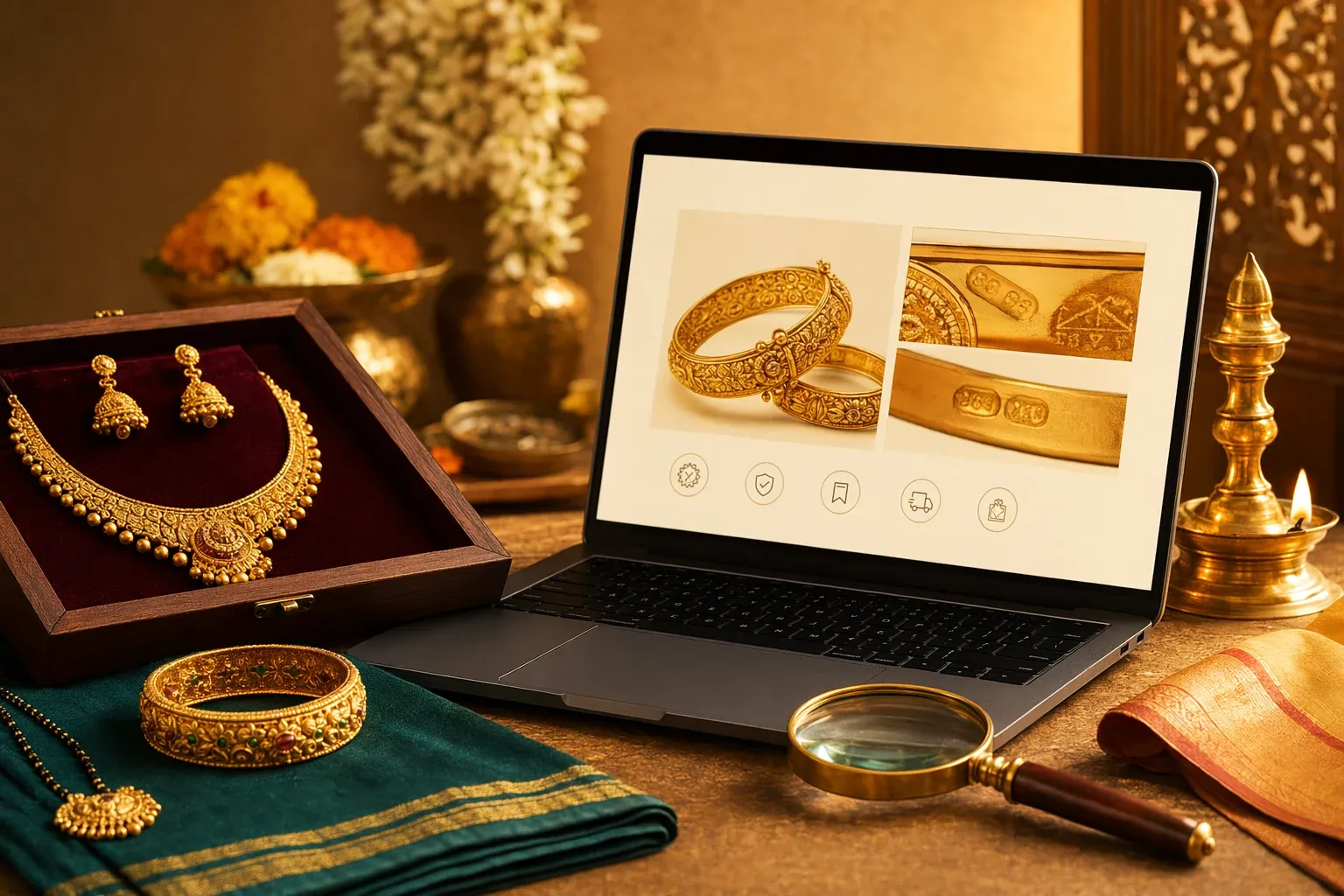
Buying Indian gold jewellery online can be convenient, especially when you want a specific style such as temple jewellery, antique-finish bangles, mangalsutra chains, coins, or lightweight daily wear. But gold is expensive, and online photos can hide important details. Authenticity is not about trusting a pretty product image. It is about checking purity, certification, seller identity, return terms, and the documents that come with the piece.
This guide is for cautious beginners. It does not promise that one trick can prove everything. Instead, it gives you a sensible checklist. If a seller is genuine, they should be able to answer basic questions clearly. If the answers are confusing, rushed, or emotionally pressuring, step back.
For style vocabulary before you buy, keep this checklist beside What Is Traditional Indian Jewellery? A Beginner Guide, Types of Indian Jewellery Explained Simply, What Is a Kundan Necklace? Meaning, Making, and Wedding Use, What Is Indian Temple Jewellery? Meaning, Motifs, and History, and Traditional Indian Necklace Types: Chokers, Haar, Kundan, and More.
Purity marks before the design
Gold jewellery is usually sold by karat. Pure gold is 24 karat, but it is too soft for most jewellery, so ornaments are commonly made in 22K, 18K, or 14K depending on design, budget, and strength. In Indian buying language, 22K is often shown as 916, meaning 91.6 percent gold. 18K is shown as 750, and 14K as 585. These numbers are purity or fineness marks.
Online listings should clearly mention the karat and, ideally, the fineness mark. Do not assume that yellow colour means high purity. Gold-plated, gold-filled, imitation, brass, copper alloy, and fashion jewellery can look golden in photos. Words like “traditional”, “bridal”, “ethnic”, or “antique finish” describe style, not purity. Read the material line slowly.
BIS hallmark and HUID in India
For gold jewellery sold in India, the Bureau of Indian Standards hallmark is the most important official consumer-protection clue. BIS information says that hallmarked gold jewellery now carries three key marks: the BIS logo, the purity or fineness mark, and a six-character HUID, which stands for Hallmark Unique Identification. The HUID is intended to make each hallmarked item traceable.
This matters because an online seller may say “hallmarked”, but you should still ask what exactly is marked on the item. The listing or customer support should mention BIS hallmarking, purity, and HUID where applicable. If a seller only uses vague phrases such as “premium quality gold” or “guaranteed Indian jewellery” without hallmark details, that is not enough for a serious purchase.
BIS Care app and HUID verification
BIS promotes the BIS Care mobile app as a way for consumers to verify HUID details. A buyer can use the Verify HUID feature to check the code and see details connected to the article. This is especially useful after delivery, before you remove tags, alter the piece, or pass the return window. If the HUID does not verify, contact the seller immediately and keep all packaging and invoice records.
Remember that checking HUID is not the same as judging design quality. It helps with hallmark traceability and declared purity. It will not tell you whether the clasp is comfortable, whether the necklace suits your outfit, or whether the making charges are fair. For those, you still need product photos, weight, measurements, reviews, and return terms.
Ask for weight, making charges, and a proper bill
A trustworthy jewellery invoice should separate important details: gross weight, net gold weight if stones or beads are involved, karat or fineness, rate used for gold, making charges, stone charges if any, taxes, and seller details. This matters because two pieces with the same “gold jewellery” label can have very different actual gold content. A heavy-looking necklace may include stones, lac, enamel, pearls, beads, or hollow work.
Making charges are the labour and craft cost added to the gold value. Intricate designs such as filigree, kundan-style work, temple motifs, or detailed bangles may have higher making charges than a simple chain. Higher charges are not automatically dishonest, but they should be visible. If the final price is far lower than the gold value suggested by weight and purity, ask why. Deep discounts on real gold deserve careful checking.
Check the seller before you check the style
Online shopping tempts us to fall in love with the design first. For gold, reverse the order. First check the seller’s legal name, registered address, customer support channels, return policy, exchange policy, shipping insurance, and review history. Look for clear photos of the actual product or at least clear sample photos from multiple angles. For expensive items, ask whether the seller can show close-ups of hallmarks, clasp, back side, stone setting, and scale.
Be extra careful with social media-only sellers who have no clear invoice system, no physical or registered business details, and only chat-based payment requests. Many small sellers are honest, but a serious purchase needs records. Pay through traceable methods. Avoid being pushed into instant bank transfers because “price will increase in one hour”. Gold should not be bought under panic.
Understand antique, kundan, polki, and temple-style claims
Indian jewellery words can be confusing online. “Antique” may mean genuinely old, or it may simply mean an antique-finish polish on a new item. “Temple jewellery” may refer to South Indian deity and motif-inspired designs, but it can be made in real gold, silver, gold-plated metal, or imitation materials. “Kundan” and “polki” are often used in bridal marketing, but listings should still specify the base metal, stone type, gold purity if any, and whether it is fine jewellery or fashion jewellery.
Do not pay real-gold prices for vague craft words. Ask direct questions: Is this 22K, 18K, silver, gold-plated, or imitation? What is the net gold weight? Are the stones natural, lab-created, glass, or synthetic? Is the certificate from a recognised body? Can the item be returned if the received details differ from the listing?
Red flags that deserve a pause
Some warning signs are simple. The seller refuses to give a bill. The listing hides weight and purity. The product title says gold, but the material section says alloy or plated. The seller uses stolen-looking photos from many brands. The price is dramatically below normal gold value. Reviews mention wrong weight, colour fading, delayed refunds, or no hallmark. Customer support avoids HUID questions. The return policy excludes almost everything even when the item is misdescribed.
Another red flag is emotional pressure: “last piece”, “family emergency sale”, “customs problem”, “pay now”, or “no need to verify, trust us”. Real gold sellers know that careful buyers ask questions. A patient seller is not proof of authenticity, but impatience is a useful warning.
After delivery, inspect before wearing
When the parcel arrives, record an opening video if the item is costly. Check that the invoice, certificate, product description, weight, purity, and HUID details match what you ordered. Inspect the clasp, links, stones, enamel, screws, and back side. Use the BIS Care app for HUID where relevant. If something is wrong, raise the issue quickly and in writing. Do not resize, polish, wear heavily, or alter the piece before the problem is documented.
The safest habit is not suspicion for its own sake; it is dharmic fairness. A buyer should pay honestly for real craft, and a seller should describe honestly what is being sold. Authentic Indian gold jewellery deserves that respect. The design may carry beauty and tradition, but the purchase should rest on clear marks, clear documents, and clear communication.