
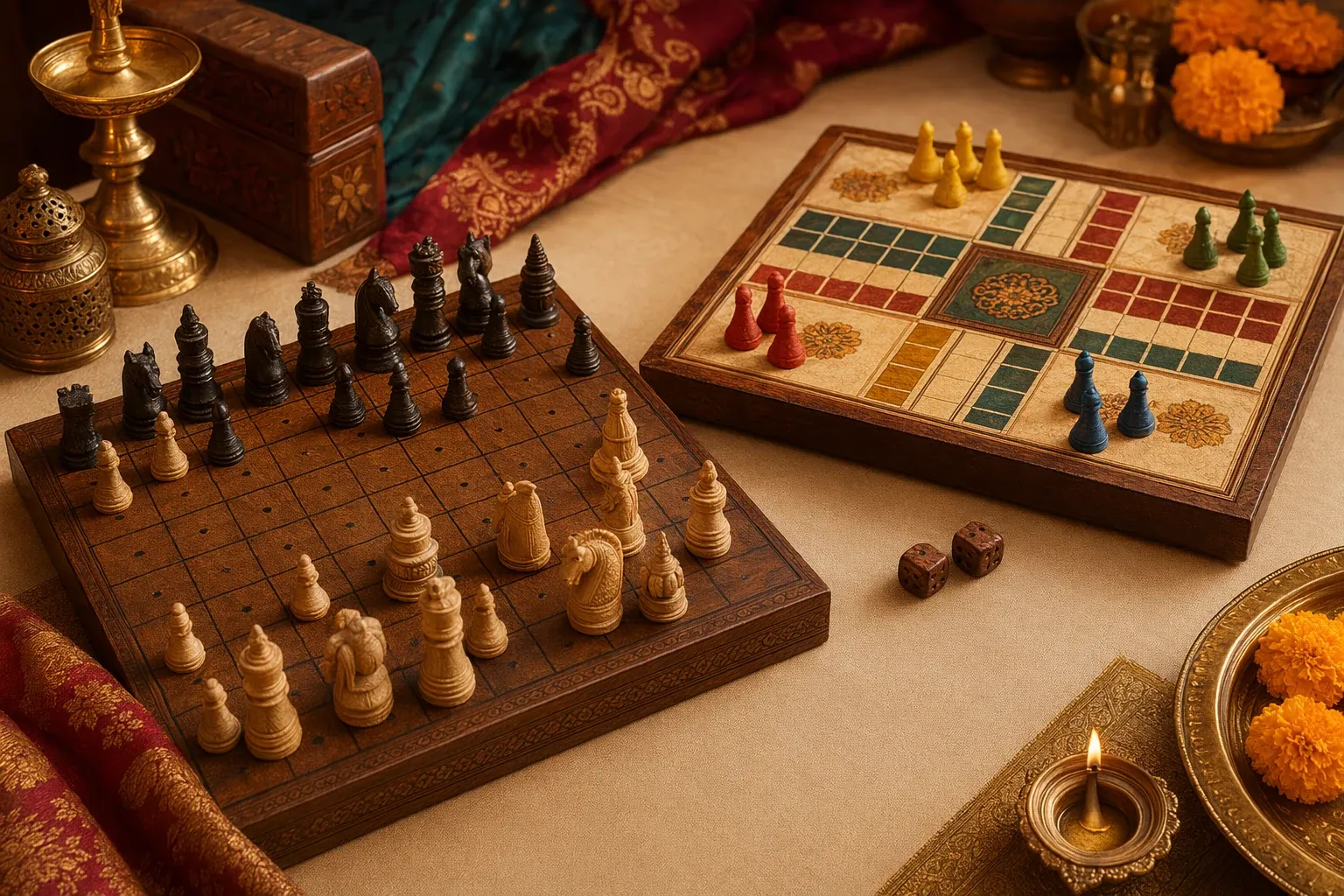
Chaturanga and Pachisi are two names that often appear whenever people ask about classic Indian board games. They are both important, but they are important in different ways. Chaturanga is usually discussed in relation to the history of chess and strategic war-game thinking. Pachisi belongs to the world of race games, cowrie throws, movement, risk, and social play. If we place them side by side, a beginner can see how wide Indian board-game culture really is.
The first thing to remember is caution. Old games do not always come to us with one perfect rulebook, one fixed date, and one neat origin story. Traditions preserve memory. Historians look for references, boards, pieces, art, and reliable descriptions. A respectful article should hold both together: pride in the richness of Indian games, and honesty about what evidence can safely prove.
Two classics, two different moods
Chaturanga feels like a battlefield made quiet. The name caturaṅga means four-limbed or four-part, and in Sanskrit and epic usage it is linked with the four divisions of an army: elephants, chariots, cavalry, and infantry. On the board, that idea becomes a test of planning. Pieces have roles. Position matters. A small careless move can weaken the whole side.
Pachisi feels more like a lively journey around a shared space. It is commonly described as a cross-shaped race game in which players move pieces according to throws of cowrie shells. The name is connected with paccīs, meaning twenty-five, an important high throw in a common form. Instead of pure calculation, Pachisi mixes chance, movement, timing, and social judgement.
Chaturanga in simple words
Chaturanga is an early Indian strategy game usually placed by chess historians in early medieval India, with clear references around the seventh century. It is widely discussed as part of the ancestry of chess-family games, moving through Persia as chatrang or shatranj and later influencing other forms. But the exact rules of the earliest Chaturanga are not known with complete certainty, especially for some pieces such as the elephant.
That uncertainty should not make the game less interesting. In fact, it makes the story more human. We can still understand the core idea: a board becomes a field of disciplined thought. The player must protect the king, use different units wisely, and think beyond the next move. The old military language shows how Indian thinkers could transform the idea of an army into a mental game.
Pachisi in simple words
Pachisi is a race game played on a symmetrical cross-shaped board. Traditional descriptions mention pieces moving according to cowrie-shell throws. The throw introduces chance, but the player still chooses which piece to move, when to advance, and when to play safely. That is why it is not only luck. It is luck plus judgement.
Many people today understand the broad family through Ludo-like games, but Pachisi should not be reduced to modern Ludo. Traditional materials, cowries, cloth boards, team play, and older social settings give it a different personality. At Fatehpur Sikri, the Mughal emperor Akbar is famously associated with a large courtly version of Pachisi, which shows how a game could become royal spectacle as well as everyday amusement.
Strategy and chance are both teachers
Chaturanga teaches planning. A player must notice lines of movement, weak squares, threats, and long-term consequences. It rewards patience and pattern recognition. You cannot win only by excitement. You must see how one piece supports another.
Pachisi teaches a different wisdom. The throw may be lucky or unlucky, but your response still matters. Do you move a piece near safety? Do you risk capture? Do you bring a new piece into play? The game quietly teaches that life contains both daiva, the given situation, and purushartha, human effort. We do not control every throw, but we are responsible for the choice after the throw.
What each game shows about Indian culture
Together, Chaturanga and Pachisi show that Indian play culture was not one-dimensional. It could be strategic, mathematical, social, symbolic, and joyful. Chaturanga reflects order, hierarchy, planning, and the imagination of conflict without actual violence. Pachisi reflects movement, counting, suspense, conversation, and shared laughter around a board.
Both also show how games travel. A game may begin in one cultural environment, change through courts and households, take new names in other languages, and return to us in forms that look familiar but are not identical to the old versions. That movement is normal. Culture is not a glass box; it is a living river.
Tradition, history, and interpretation
Tradition may say a game is ancient and beloved. History asks what evidence survives. Interpretation asks what the game can mean for us now. We should not mix these three carelessly. For example, Indian epics contain famous dice scenes, especially the Mahabharata’s warning about gambling, pride, and humiliation. But that does not automatically prove the exact rules of Pachisi in that story.
The mature lesson is balance. We can admire old Indian games without making unsupported miracle claims. We can also learn from them without pretending that every modern version is unchanged from ancient times. Respect means being excited and careful at the same time.
How beginners can try the ideas today
If you want to feel the Chaturanga side, learn chess and then read about how older pieces and names differed. Notice the idea of roles: elephant, horse, chariot, foot-soldier, king, and adviser. Ask how each piece changes the shape of the board.
If you want to feel the Pachisi side, play a legal, family-safe version of a cross-and-circle race game. Better still, learn why cowrie throws, cloth boards, and team movement mattered. Do not treat it as only a quick phone game. Sit with people, take turns, and notice how quickly a simple board creates emotion.
Questions people ask
What is the classic board game of India?
There is no single answer for all contexts. Chaturanga is a classic name for strategy and chess history, while Pachisi and Chaupar are classic names for Indian race-game culture.
What popular board game was made in India?
Chaturanga is strongly associated with India in the history of chess-family games. Pachisi also originated in Indian board-game culture and influenced later cross-and-circle games such as Parcheesi and Ludo-like forms.
Are Chaturanga and Pachisi the same type of game?
No. Chaturanga is a strategy game based on opposing forces and planned movement. Pachisi is a race game where pieces move around a cross-shaped path through cowrie-shell throws and player choices.
A simple takeaway
Chaturanga and Pachisi are classic because they show two different strengths of Indian games. One asks, “Can you think ahead?” The other asks, “Can you respond wisely to chance?” Together they remind us that play is not a waste of time. Played with fairness and attention, it can train the mind, soften the ego, and bring people together.