
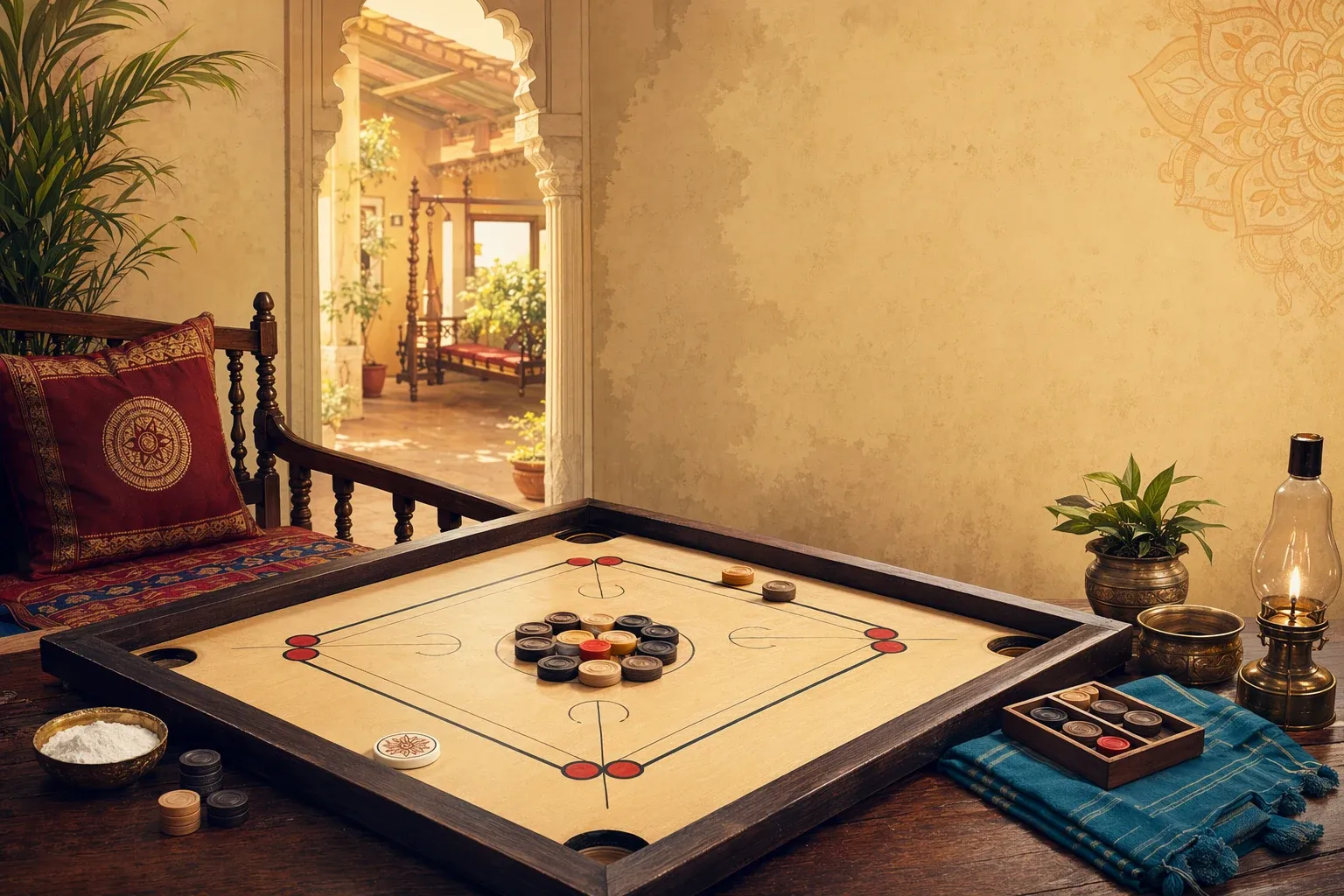
Carrom is one of those games that many Indians do not remember as a “heritage topic” first. They remember a board in the house, powder on the surface, cousins leaning forward, someone calling a foul, and the sharp sound of a striker hitting a coin cleanly into a pocket. That everyday memory is exactly why carrom matters. It is culture not as museum display, but as living play.
At a basic level, carrom is a tabletop game of Indian origin in which players flick a striker to pocket small discs, usually called carrom men. The red piece is the queen, and it has special value. The board has four corner pockets, and the game uses angle, touch, rebound, focus, and patience. It looks simple when a skilled player plays, but anyone who has missed an easy shot knows how much control it needs.
The popular Indian table game
When people ask, “What is the popular Indian table game?” carrom is one of the strongest answers. It is familiar across India and South Asia, especially in homes, clubs, hostels, school spaces, community rooms, and family gatherings. Unlike a sport that needs a large ground, carrom only needs a board, pieces, striker, and a few people ready to sit together.
This made it easy for the game to spread through ordinary life. A carrom board could come out after dinner, during holidays, in a hostel common room, or at a neighbourhood club. Children could watch older players and slowly join. A beginner could learn the aim quickly, while a serious player could spend years improving.
How the game works, without becoming a rulebook
A standard carrom set has white and black carrom men, one red queen, and a striker. Players use the striker to hit their own pieces into the pockets. The queen usually needs to be pocketed and then covered by pocketing one of the player’s own carrom men on a following valid shot. Exact rules can vary in homes, but organised carrom follows formal rules under bodies such as the International Carrom Federation.
The board itself matters. The surface must be smooth enough for the pieces to glide. Fine powder is often used so the pieces slide cleanly. The corners have pockets, and the wooden frame creates rebounds. This is why carrom sometimes reminds people of billiards or pool, though it has its own technique and culture.
Skill hides inside a small movement
The most beautiful thing about carrom is that the motion is tiny, but the thinking is deep. A player places the striker, measures the angle, controls finger pressure, and imagines the rebound. Too much force can ruin the position. Too little force may leave the piece near the pocket for the opponent. A straight shot, a cut, a rebound, or a defensive touch can all change the board.
This is why carrom builds focus. It teaches hand-eye coordination, patience, and emotional steadiness. A player who becomes angry after one miss usually plays worse. A player who stays calm can recover. In that sense, carrom is not only about pocketing coins. It is also about learning how the mind behaves under pressure.
Homes, clubs, hostels, and tournaments
Carrom’s popularity in India comes partly from its flexibility. In a home, it can be a family game where grandparents, parents, and children play together. In a hostel, it becomes a social centre. In clubs, it becomes sharper and more competitive. In tournaments, it becomes a mind sport with discipline, rules, ranking, and practice.
Modern organised carrom has formal institutions. The International Carrom Federation was formed in Chennai in 1988, and formal rules for the Indian version were published that year. This shows how a familiar household game also became a structured competitive activity. The same game can hold both laughter and serious skill.
Why it became easy to love
Carrom does not demand expensive clothing, a large team, or a fixed season. It works in summer afternoons, rainy evenings, festivals, family visits, college hostels, and quiet Sundays. A board can be stored under a bed or against a wall. That simple practicality helped it become part of middle-class and community life.
It also has quick emotional rewards. The sound of a clean pocket is satisfying. A clever rebound feels like magic even when it is just geometry. The queen creates drama. Team play creates banter. A close finish keeps everyone leaning over the board. These small pleasures make people return to the game.
Culture in the way people play
Carrom also reveals character. Do players wait their turn? Do they accept fouls honestly? Do they mock a child who misses? Do they teach a beginner how to hold the striker? The culture of the game is not only in the object, but in the behaviour around it.
In a dharmic sense, even a casual carrom game can teach fairness, restraint, respect, and alertness. Winning is enjoyable, but winning by cheating damages the spirit of play. Losing is disappointing, but losing gracefully is a life skill. A board game becomes meaningful when it trains both skill and conduct.
Carrom and Indian memory
Many Indians associate carrom with family evenings and childhood holidays because it creates a shared table. Phones, television, and private screens pull people apart. Carrom pulls people toward a centre. Everyone sees the same board. Everyone reacts to the same shot. Even the person waiting for a turn is mentally involved.
That shared attention is rare and valuable. It explains why carrom remains loved even when digital games are everywhere. A phone game may be fast, but it rarely gives the same feeling as a room full of people gasping at a near miss.
Questions people ask
What is the popular Indian table game?
Carrom is one of the most popular Indian tabletop games. It is played with a striker, carrom men, a red queen, and four corner pockets on a smooth square board.
Is carrom only a children’s game?
No. Children can learn it, but skilled carrom needs aim, angles, touch, planning, and mental calm. Adults play it casually at home and competitively in clubs and tournaments.
Why do families like carrom?
Families like carrom because it is compact, social, easy to begin, and fun across ages. It creates conversation, friendly rivalry, and shared memories without needing a large space.
A simple takeaway
Carrom became popular in India because it fits Indian social life beautifully. It is small enough for a home, serious enough for a tournament, simple enough for a child, and subtle enough for a master. Its real charm is not only the board or the striker. It is the way people gather around it, learn patience, test skill, and laugh together.