
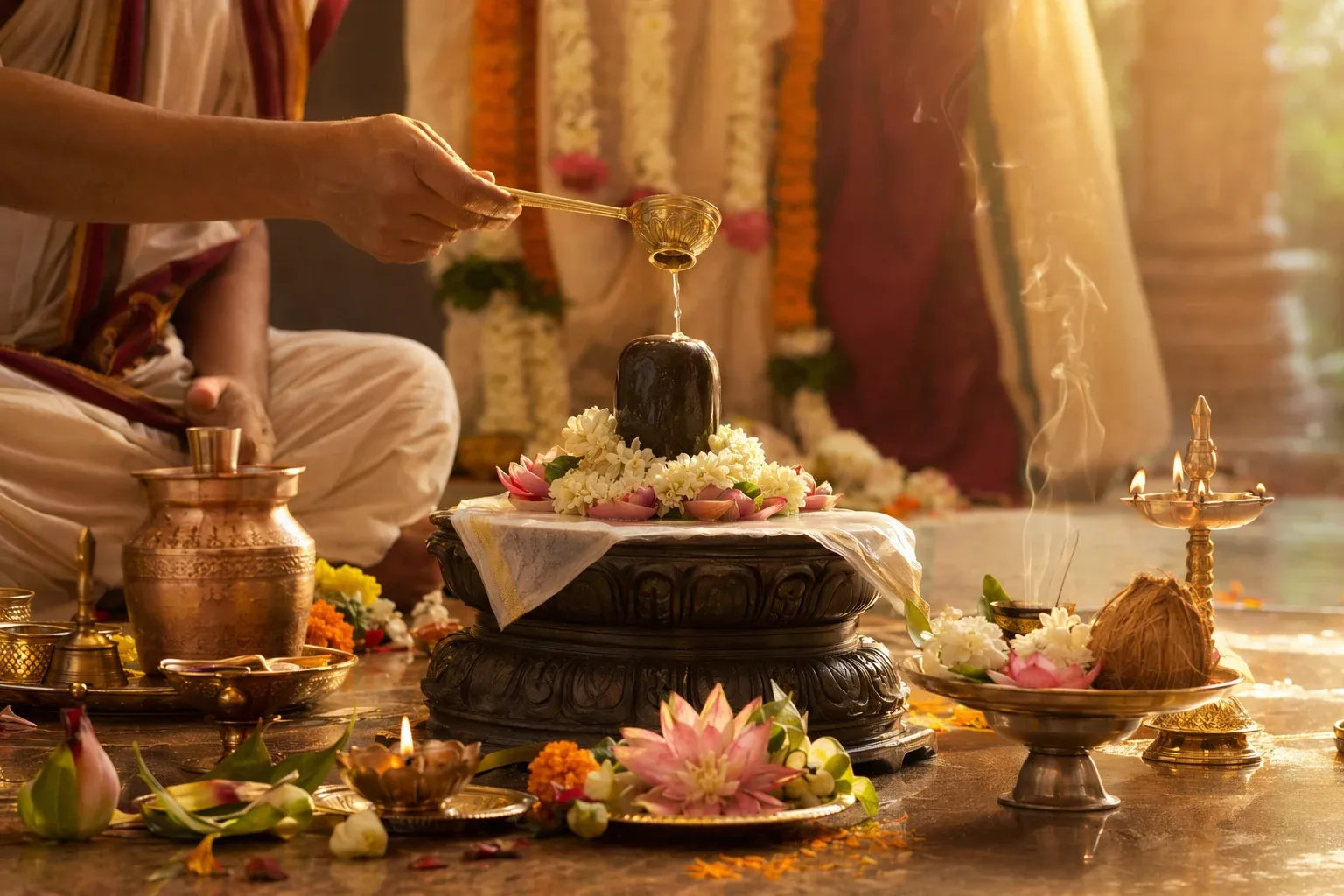
Seeing the ceremony as a sacred welcome
Prana Pratishtha can look complex to a first-time observer. There may be priests chanting, vessels of water, fire offerings, flowers, lamps, grains, cloth, bells, conch sounds, and many carefully timed acts. Yet the heart of the ceremony is simple: the deity is being respectfully welcomed into a form chosen for worship.
This overview explains the broad meaning of what may happen. It is not a manual for performing the rite. Prana Pratishtha belongs to living traditions, and details are guided by trained priests, acharyas, temple customs, Agama or Tantric sources, regional practice, and the deity being worshipped.
Preparation of the place and image
Before the main consecration, the temple or worship space is prepared. The area is cleaned, decorated, and ritually purified. The murti or sacred form may be placed in its intended location or kept nearby until the proper moment. Priests may prepare kalashas, which are vessels filled with sanctified water and often decorated with leaves, cloth, thread, and coconut.
This preparation teaches an important lesson: sacred presence is welcomed with care. Just as a home is cleaned before receiving an honored guest, the space is made worthy of worship. The physical actions also help the community shift from ordinary busyness into reverence.
Sankalpa: stating the sacred intention
Many Hindu rites begin with sankalpa, a solemn statement of intention. The priest names the purpose of the ceremony, the place, the time according to the ritual calendar, the sponsors or community, and the deity. This is not a casual announcement. It places the action within dharma, tradition, and responsibility.
For devotees watching, sankalpa shows that Prana Pratishtha is not done for display alone. It is undertaken with a clear religious purpose: to establish a form for worship, darshan, and ongoing service.
Purification and invocation
Purification rites may include sprinkling sanctified water, reciting mantras, invoking protective deities, and honoring directions, guardians, teachers, and ancestors of the tradition. The exact names and sequences differ widely.
The purpose is not to suggest that the world is impure in a crude sense. Rather, the ceremony marks a movement from ordinary use to sacred use. Water, sound, fire, and intention help create a space where the community can relate to the deity with steadiness and humility.
Fire offerings and mantra recitation
A homa or havan may be part of the ceremony. Offerings are made into sacred fire while mantras are chanted. Fire is seen as a purifier, witness, and carrier of offerings. In many Hindu rituals, Agni connects human devotion with the divine.
Mantras are central, but they are not treated as bare sound clips. Their role depends on pronunciation, tradition, the authority of the officiants, the deity, and the larger ritual setting. A careful beginner explanation is available in Prana Pratishtha mantras.
Nyasa and the honoring of the form
Some traditions include acts often described as nyasa, where sacred presence is ritually associated with parts of the image or with the worshipper's own body before worship. The idea is that the form is not handled as decoration. Every part is honored as meaningful.
A beginner may see priests touching the murti with flowers, kusha grass, water, or specific gestures. Rather than trying to decode every motion from a distance, it is better to understand the overall principle: the form is being ritually awakened to worship and treated with deep respect.
The moment of consecration
Different traditions describe the central moment differently. There may be a significant mantra, a ritual touching of the heart or eyes of the murti, the use of sanctified water, the unveiling of the deity, or the first public darshan. In some ceremonies, the opening of the eyes of the deity is especially meaningful.
This moment often feels emotional for devotees. Bells may ring, conches may sound, lamps may be waved, and people may fold their hands. The community recognizes that the murti is now to be approached as a living center of divine presence.
Offerings, arati, and first darshan
After consecration, the deity is offered clothing, ornaments, flowers, food, incense, lamp light, and prayers. Arati may be performed, and devotees receive darshan. This first darshan is not only the end of a ceremony; it is the beginning of regular worship.
In a temple, daily seva continues from this point onward. The deity may be awakened, bathed, dressed, offered meals, honored with music and lamps, and given rest according to the temple's tradition. For what follows, read what happens after Prana Pratishtha.
Why ceremonies differ
A Shiva temple, Vishnu temple, Devi temple, Ganesha shrine, village temple, and large pilgrimage temple may not follow identical practice. Regional customs also matter. Some ceremonies last a few hours, while others continue over several days with preliminary rites and concluding worship. For timing and types, see types of Pratishtha.
This variety is normal. Hindu ritual life is not one single template. The shared thread is reverence, invocation, offering, and the establishment of a sacred relationship.
Frequently asked questions
Can visitors attend Prana Pratishtha?
Often yes, especially in public temples, though access may vary. Some inner rites may be limited to priests, while public darshan and arati are open to devotees.
Is the ceremony the same everywhere?
No. The deity, sampradaya, region, temple rules, and priestly tradition all shape the details.
Why are there so many offerings?
Offerings express hospitality and devotion. They also represent the dedication of body, senses, food, light, fragrance, sound, and mind to the divine.
Should beginners memorize every ritual element?
Not necessary. A respectful beginner can understand the ceremony as a sacred welcome and ask local priests or elders for tradition-specific explanations.