
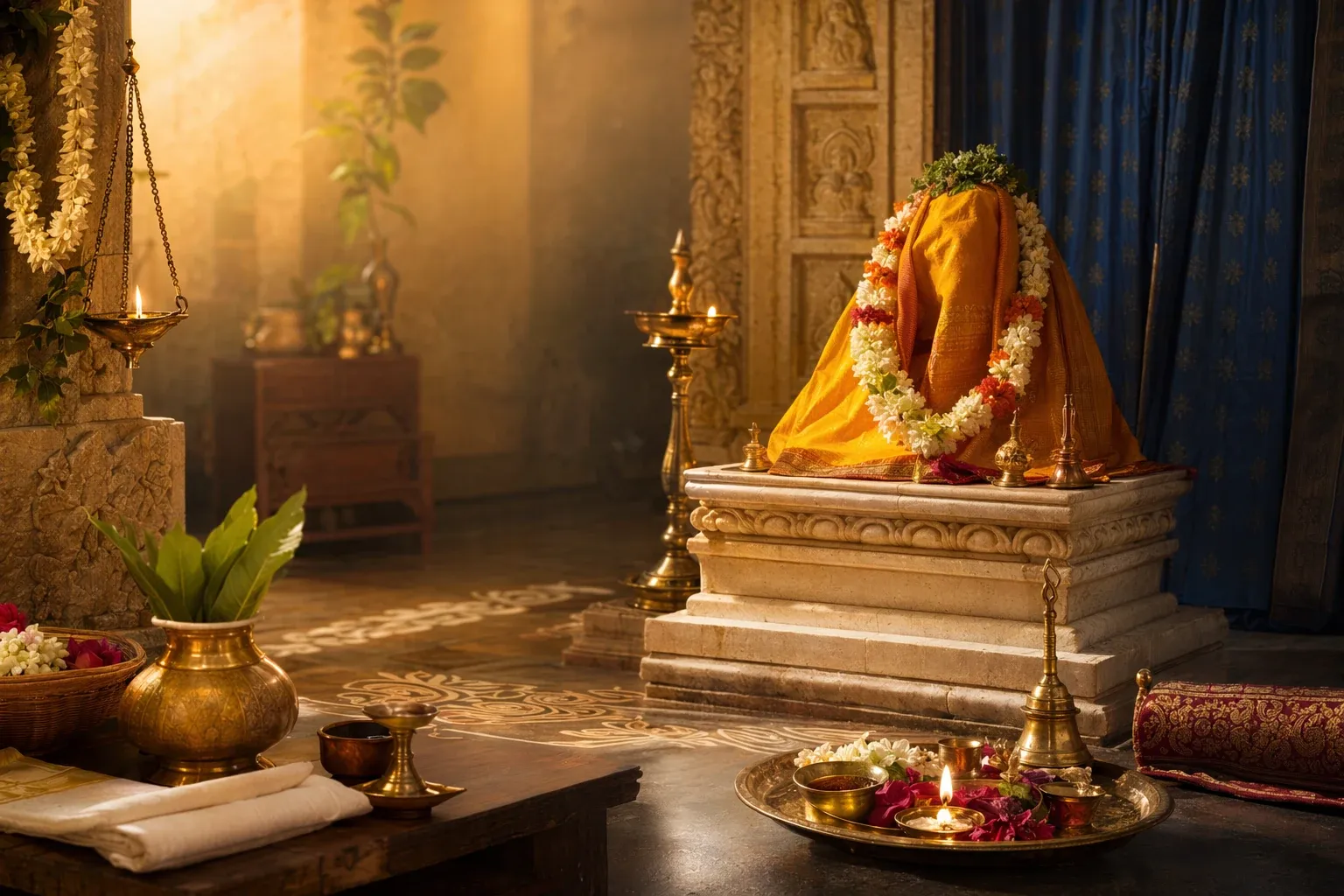
The ceremony begins a relationship
Prana Pratishtha is often remembered for its grand ceremony, but its real significance becomes visible afterward. Once a deity form has been consecrated, the community or household does not simply admire it and move on. Daily care begins. Worship becomes regular. Darshan becomes available. The sacred form is treated as a living focus of divine presence.
This is why elders often say that Prana Pratishtha is not only an event. It is the beginning of seva, or service. The ceremony welcomes the deity; the days afterward show how that welcome is honored.
Daily worship in a temple
In many temples, the daily rhythm is carefully maintained. The deity may be ceremonially awakened, bathed, dressed, adorned with flowers and ornaments, offered food, worshipped with lamps and incense, and later given rest. The exact routine depends on the deity, temple tradition, region, and available priests.
Devotees may see only a small part of this rhythm: morning darshan, arati, prasada, festival decoration, or evening lamps. Behind the visible moments is a disciplined pattern of care. After Prana Pratishtha, the murti is not a symbol left unattended. It becomes the heart of temple life.
Darshan: seeing and being seen
Darshan is one of the most important experiences after consecration. Devotees come before the deity, fold their hands, offer prayers, and receive the sight of the sacred form. In Hindu devotion, darshan is not merely looking. It is often understood as seeing the deity and being seen by the deity.
This is why temple doors, curtains, decoration, lamps, and timings matter. The opening of the shrine is not like opening a museum room. It is a moment of encounter. People may stand silently, chant names, offer flowers, or simply bow.
Offerings and prasada
Food offerings after Prana Pratishtha are made with care. Fruits, cooked dishes, sweets, water, milk, or other items may be offered according to tradition. After offering, devotees may receive prasada, understood as food blessed by its relation to the deity.
The meaning is not that the deity needs food in a human biological way. Offerings express love, gratitude, surrender, and hospitality. They also remind devotees that daily life, including cooking and eating, can be connected to the sacred.
Cleanliness and respect
A consecrated form is treated with cleanliness and dignity. The altar, sanctum, vessels, cloth, flowers, and offerings are handled carefully. Shoes, casual behavior, careless touching, and disorder are avoided. In many temples, only priests may enter the inner sanctum or touch the murti.
This respect is not meant to push devotees away. It protects the sacred atmosphere and maintains the tradition. Just as one behaves differently in a classroom, home, court, or hospital, one behaves with special attention in a consecrated shrine.
What happens in a home?
Home worship after formal consecration is usually simpler than temple worship, but responsibility remains. Families may be advised to offer daily prayer, keep the altar clean, light a lamp, offer water or food, and observe particular rules given by the priest or family tradition.
If a family cannot maintain a formal routine, it may be better to keep devotional images without full consecration. This is not a failure. It is a wise match between devotion and capacity. For a balanced discussion, see Can Prana Pratishtha be done at home?
Festivals after consecration
Once the deity is established, festivals become especially meaningful. A temple may celebrate annual days connected with the deity, the anniversary of consecration, major Hindu festivals, or local community traditions. Decorations, processions, special food offerings, music, recitation, and extended darshan may be arranged.
These festivals renew the community's bond with the deity. They also bring generations together. Children learn by watching elders offer lamps, sing, bow, distribute prasada, and serve visitors.
If the murti is damaged or worship stops
Questions sometimes arise when a consecrated murti is damaged, a temple is renovated, a family moves, or worship becomes difficult. Traditions generally do not advise casual disposal or neglect. A priest or knowledgeable elder should be consulted.
There may be prescribed rites for repair, re-consecration, temporary relocation, or respectful conclusion. The answer depends on the deity, material, degree of damage, and tradition. For related questions, see types of Pratishtha and second Prana Pratishtha.
The emotional life of a consecrated shrine
After Prana Pratishtha, a temple often becomes part of people's memories. Someone may remember receiving prasada as a child. Another may come before an exam, marriage, illness, grief, or new beginning. A community may gather there during festivals and difficult times.
This emotional life matters. The consecrated form becomes a steady presence in changing human lives. The purpose is not to promise that every prayer will be answered in a specific way. It is to create a sacred relationship in which devotion, strength, humility, and gratitude can grow.
Frequently asked questions
Does worship have to happen every day?
In temples, daily worship is usually expected after formal Prana Pratishtha. In homes, the expected practice depends on the rite performed and the guidance received.
Can anyone touch a consecrated murti?
Often no, especially in temples. Touching may be limited to priests or authorized caretakers. Devotees can still receive darshan and blessings respectfully.
What if a family travels?
Families should follow the guidance given by their priest or tradition. Some maintain simple prayer before leaving; others request temporary care from relatives.
Is the anniversary important?
Many temples observe the anniversary of consecration with special worship. It is a way of renewing gratitude for the deity's presence and the community's responsibility.