Mandalas and Indian folk art are often mixed together online, but they are not the same. This guide explains the difference with context and respect. This article introduces the subject in clear language for readers who want cultural context, visual clues, and practical appreciation.
Two words that are often blended
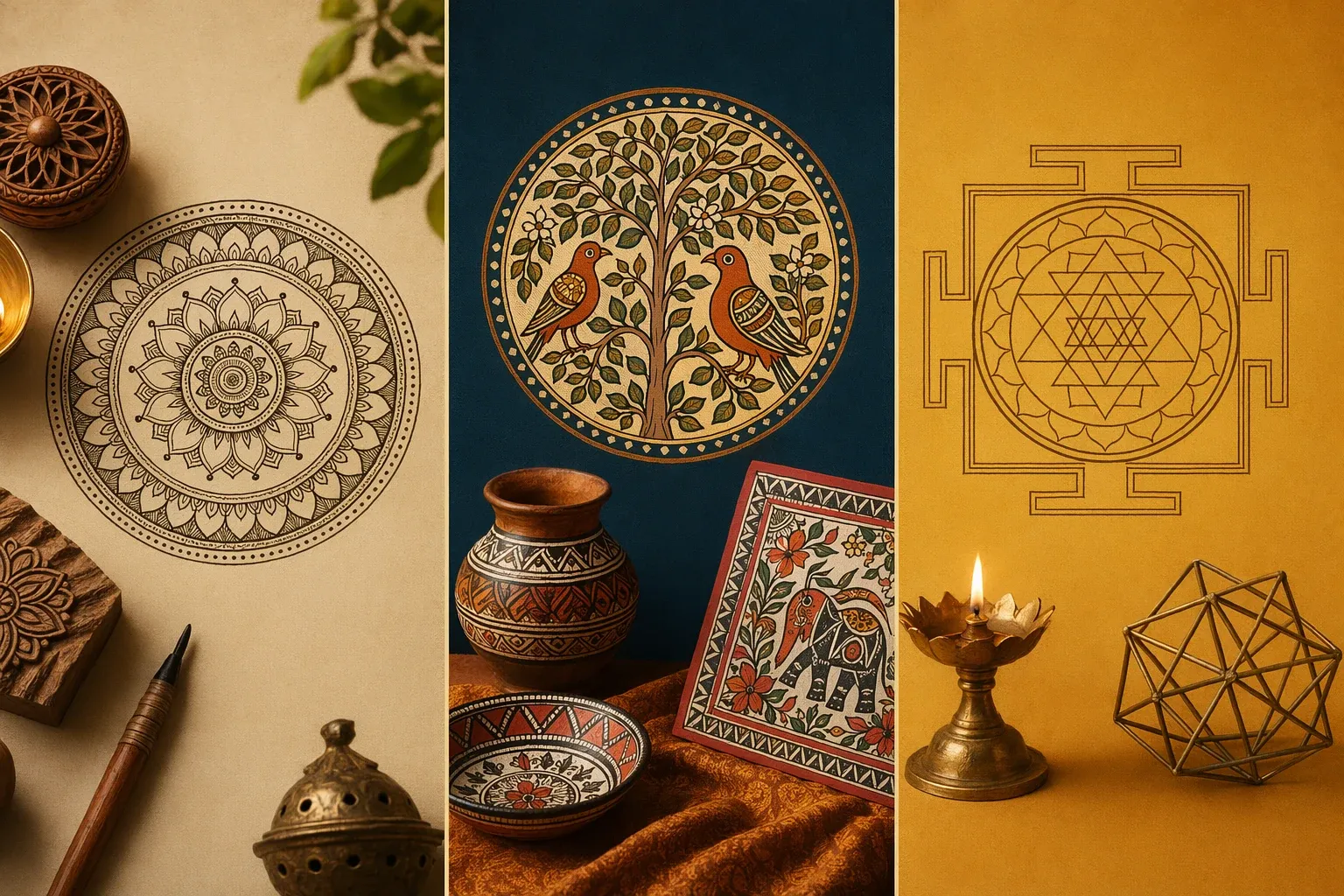
Mandalas and Indian folk art are frequently placed together in modern design language, especially in colouring books, wall prints, and social media captions. The overlap can be visually tempting because both may use circles, symmetry, repetition, and devotional feeling. Still, they are not the same category. A mandala is usually a structured sacred or meditative diagram, while Indian folk art refers to many community-rooted visual traditions with regional histories, materials, and social uses.
What a mandala means
The word mandala generally points to a circle, centre, enclosure, or sacred diagram in Indian and wider Asian religious contexts. Mandalas appear in Hindu, Buddhist, Jain, and tantric traditions in different ways. Some are used for meditation, ritual visualization, temple planning, cosmology, or symbolic representation of divine order. A mandala is not simply any circular pattern. Its meaning depends on tradition, structure, deity, purpose, and method of use.
What Indian folk art means
Indian folk art is broader and more varied. It includes Madhubani, Warli, Gond, Pattachitra, Phad, Pithora, Kalamkari, Mata ni Pachedi, Kalighat, Kolam, Aipan, Mandana, and many more forms. These traditions may be devotional, domestic, narrative, seasonal, ritual, or decorative, but they are tied to communities and regions. For a wider foundation, see Indian folk art meaning.
Where the confusion begins
Confusion begins when any repeated circular design is called a mandala, and any colourful handmade-looking pattern is called folk art. A round Madhubani composition may be labelled a mandala even if it is actually a fish, lotus, wedding, or deity design arranged in a circle. A decorative mandala may be sold as tribal art without connection to a community tradition. These labels flatten meaning and make different histories seem interchangeable.
Geometry is not the whole story
Both mandalas and folk arts can use geometry, but geometry alone does not define them. Warli uses triangles and circles to build people and animals. Kolam uses dots, loops, symmetry, and mathematical rhythm at thresholds; Bhaktilipi’s guide to kolam mathematics explores this beautifully. A mandala may use concentric circles and squares. The question is not whether geometry appears, but what the geometry is for.
Sacred use and community use
Some mandalas are sacred diagrams used in formal religious practice. Some folk art forms are also sacred, such as shrine cloths, ritual wall paintings, or festival floor designs. The difference is not sacred versus non-sacred. The difference lies in the system of meaning. A Buddhist mandala, a Pithora wall painting, and a kolam at a doorstep may all be sacred in some sense, but their makers, methods, occasions, and interpretations are distinct.
The circle in folk art
Circles appear in Indian folk art for many reasons. A Warli dance circle can show community movement. A lotus medallion can mark auspicious beauty. A round border can organize a composition. A sun or moon can witness a scene. These circles may feel mandala-like to modern viewers, but they should be read through their own tradition first. Not every circle is a mandala, and calling it one may erase local meaning.
The mandala in modern wellness culture
Modern wellness culture often uses mandalas for relaxation, colouring, focus, and interior design. This can be meaningful for many people, but it can also detach the form from its religious and philosophical roots. When a mandala becomes only a pretty pattern, its depth may be reduced. The same thing happens when folk art is used without naming artists or regions. Beauty deserves context.
Decorative fusion can be thoughtful
Fusion is not automatically wrong. Artists have always adapted, borrowed, and reimagined visual forms. A contemporary artist may create a mandala using Madhubani-inspired motifs or a circular Gond-style animal composition. The thoughtful version names the influences and avoids pretending the result is a traditional ritual object. The careless version uses sacred and community signs as interchangeable decoration. The difference is honesty.
How to label your own work
If you draw a circular pattern inspired by symmetry and meditation, call it a mandala-inspired design. If you use fish, lotus, and dense line work after studying Mithila painting, call it Madhubani-inspired. If you combine both, say so clearly. Good labels are not restrictive; they help viewers learn. They also show respect for the communities and religious traditions behind the visual language.
Home decor choices
For home decor, ask what you want the piece to do. A mandala print may create a calm focal point. A Madhubani painting may bring narrative abundance. A Warli artwork may add earthy movement and community rhythm. A Pattachitra may hold devotional storytelling. Our home decor guide explains how to choose art without reducing it to a trend.
A simple comparison
A mandala is often centred, symbolic, and cosmological. Indian folk art is a family of regional traditions, many of which tell stories, mark rituals, decorate homes, or celebrate nature and community. Mandalas can be Indian, but not all Indian circular art is a mandala. Folk art can be geometric, but not all geometric Indian art is a mandala. This simple distinction prevents many misunderstandings.
Why context protects meaning
Context does not make art less enjoyable; it makes enjoyment deeper. When you know that a pattern is a threshold kolam, a Mithila marriage motif, a tantric diagram, or a Warli dance scene, you see more. The image becomes connected to people, place, and purpose. Without context, everything becomes a pattern. With context, the pattern becomes a doorway.
The respectful takeaway
The difference between mandala and Indian folk art is not a competition. Both can be beautiful, sacred, disciplined, and inspiring. The important thing is to avoid lazy naming. Learn the tradition, notice the purpose, credit the source, and use words carefully. A circle may calm the eye, but context gives it a heart.
Continuing the journey
For related reading, see Indian folk art meaning. Let the next artwork you see become a patient conversation with region, maker, material, symbol, and use. Indian folk art rewards slow attention, and every careful question adds depth to the first moment of visual delight.