
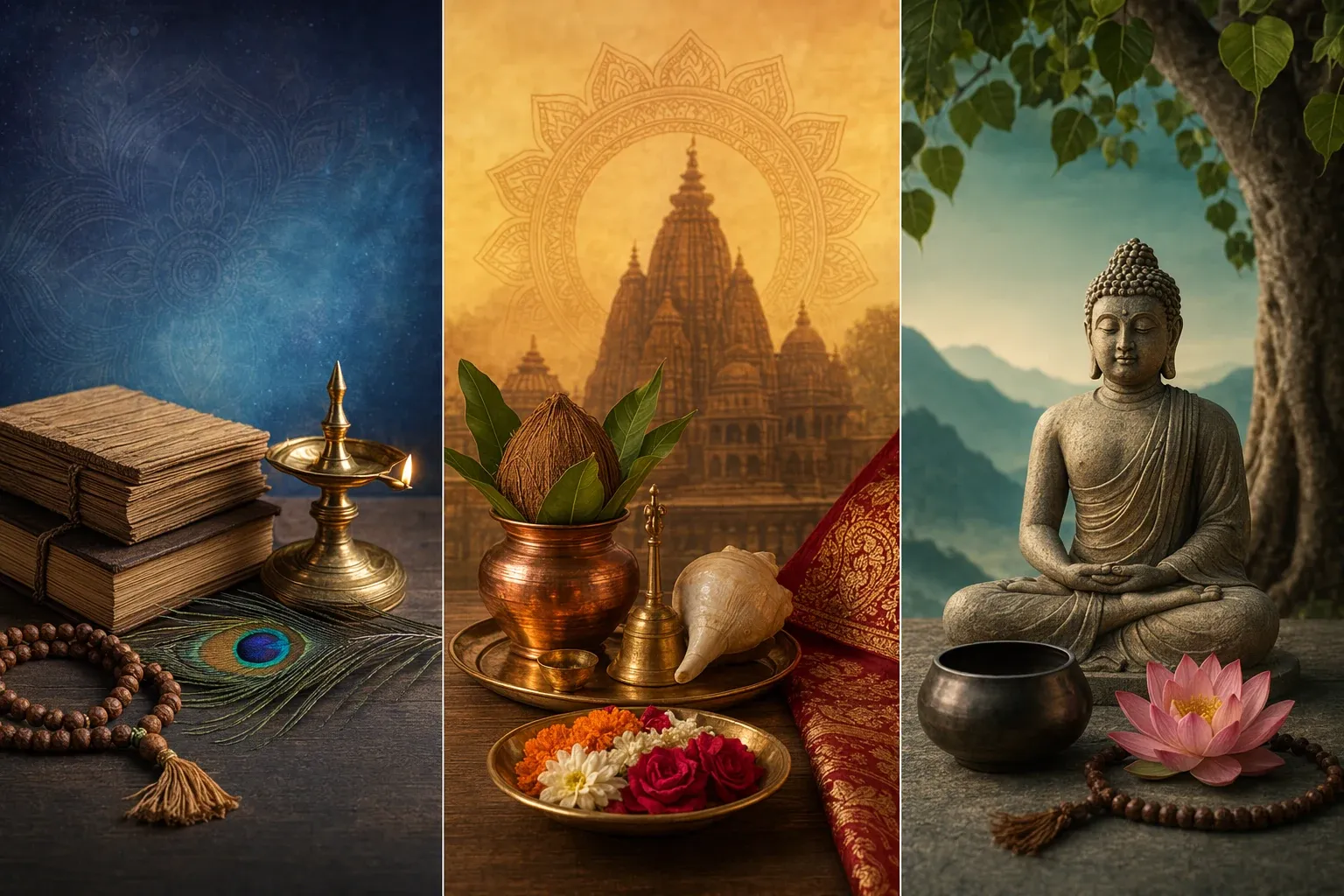
Hindu philosophy, Hindu religion, and Buddhist philosophy grew in overlapping Indian worlds, but they are not the same thing. A respectful comparison should avoid two mistakes: flattening everything into one vague “spirituality,” or ranking traditions as if one simple scoreboard can explain them.
Simple answer
Hindu religion includes lived practices such as worship, festivals, pilgrimage, vows, stories, family traditions, temple life, and devotion. Hindu philosophy focuses on questions of reality, self, knowledge, ethics, liberation, and the meaning of life. Buddhist philosophy shares some Indian vocabulary, such as karma and liberation, but it often gives different answers, especially on permanent selfhood and ultimate reality.
So the clean answer is: these traditions overlap historically and conceptually, but they should be compared carefully. Similar words do not always mean identical doctrines.
Philosophy and religion are related but different
Religion is lived by communities. It includes songs, rituals, sacred spaces, festivals, food practices, family memory, and devotion. Philosophy asks deeper questions through concepts and arguments: What is real? Who am I? How do we know? What causes suffering? What is freedom?
In Hindu life, these two are often connected. A temple story may carry a philosophical idea; a philosophical school may shape a practice; a family ritual may point to dharma, karma, or moksha. But they are still different lenses.
Indian philosophy and Hindu philosophy
Indian philosophy is the larger umbrella. It includes Hindu darshanas, Buddhist thought, Jain thought, materialist debates, and other intellectual currents. Hindu philosophy is an important part of Indian philosophy, but it is not the whole of it.
This distinction matters because Buddhism and Jainism also developed in India and participated in deep debates with Hindu schools. Calling every Indian idea “Hindu” can erase that diversity.
Where Hindu and Buddhist ideas overlap
Both traditions discuss karma, rebirth, suffering, discipline, meditation, liberation, ethics, and the training of the mind. Both can take desire, ignorance, and attachment seriously. Both also produced monastic, philosophical, devotional, and practical teaching traditions across centuries.
These overlaps are real, but they do not make the systems identical. Shared vocabulary is like a shared language family: the same word may carry different meaning in different schools.
Important differences
Many Hindu schools, especially Vedanta traditions, discuss Atman, Brahman, and the deeper Self in different ways. Many Buddhist traditions question the idea of a permanent independent self and speak about anatta or anatman. Hindu schools may describe liberation through realization of the Self or union/relationship with the Divine, while Buddhist paths often focus on awakening from ignorance, craving, and clinging.
This is a simplified map, not a full academic comparison. Each tradition contains multiple schools, so beginners should avoid claiming “Hinduism says only this” or “Buddhism says only that.”
For helpful background, you can also read our related Bhaktilipi guides: Main Teachings of the Upanishads and What Is Karma?.
How to compare respectfully
- Use careful words like “many traditions” or “some schools” when needed.
- Do not use one quote to represent an entire civilization of thought.
- Compare concepts, not stereotypes.
- Let each tradition speak in its own language before forcing similarities.
A careful beginner comparison
A useful way to compare these traditions is to begin with questions rather than labels. Ask what each tradition says about self, suffering, action, liberation, and practice. Then ask how those answers are lived: through meditation, devotion, ethical discipline, study, ritual, community, or renunciation. This prevents the comparison from becoming a shallow list of “same” and “different.”
For example, karma appears in both Hindu and Buddhist discussions, but it is not always explained in the same metaphysical frame. Liberation is also a shared concern, but the language of moksha, nirvana, Atman, anatman, Brahman, ignorance, craving, and awakening needs careful handling. Beginners should learn the vocabulary slowly and avoid treating one English translation as final.
The most respectful attitude is intellectual humility. Hindu traditions are internally diverse, and Buddhist traditions are also internally diverse. A comparison between Advaita Vedanta and Theravada Buddhism will not sound exactly like a comparison between devotional Vaishnava thought and Mahayana Buddhism. The more specific the comparison, the fairer it becomes.
What students should remember
If you are writing notes for school or self-study, keep three columns: lived religion, philosophical concepts, and historical interaction. Lived religion includes temples, festivals, family customs, monks, sanghas, vows, and pilgrimage. Philosophical concepts include self, reality, causation, liberation, and knowledge. Historical interaction includes debate, borrowing, disagreement, translation, and regional exchange.
How to use this guide
Use this article as a starting point, not as the final word. Read the main idea, note the terms that feel new, and then compare the topic with a reliable book, teacher, or longer source. Cultural knowledge becomes stronger when curiosity is joined with patience, humility, and careful reading.
For younger readers, the practical question is simple: what does this teach me about thinking better, acting with more responsibility, and respecting the tradition without turning it into a slogan? That question keeps the learning useful beyond exams or search results.
How to keep learning with balance
The best beginner attitude is neither blind acceptance nor careless dismissal. Hindu philosophy asks for shraddha, attention, inquiry, and practice. Read with respect, but also with patience. If a term feels difficult, do not rush to replace it with a modern slogan. Sit with it, compare explanations, and notice how the idea appears in different texts and teachers.
It also helps to connect study with conduct. Philosophy becomes stronger when it changes how we listen, speak, choose, and respond to pressure. A student who reads about dharma but becomes more arrogant has missed the spirit of learning. A reader who becomes more thoughtful, humble, and responsible has understood something important.
For Bhaktilipi readers, the practical goal is simple: build cultural confidence without losing nuance. Learn the map, respect the tradition, ask clean questions, and avoid turning deep ideas into social-media shortcuts.
Final takeaway
Hindu philosophy, Hindu religion, and Buddhist philosophy are connected by history, geography, debate, and shared questions. Their differences are not a problem; they are part of the richness of Indian thought.