
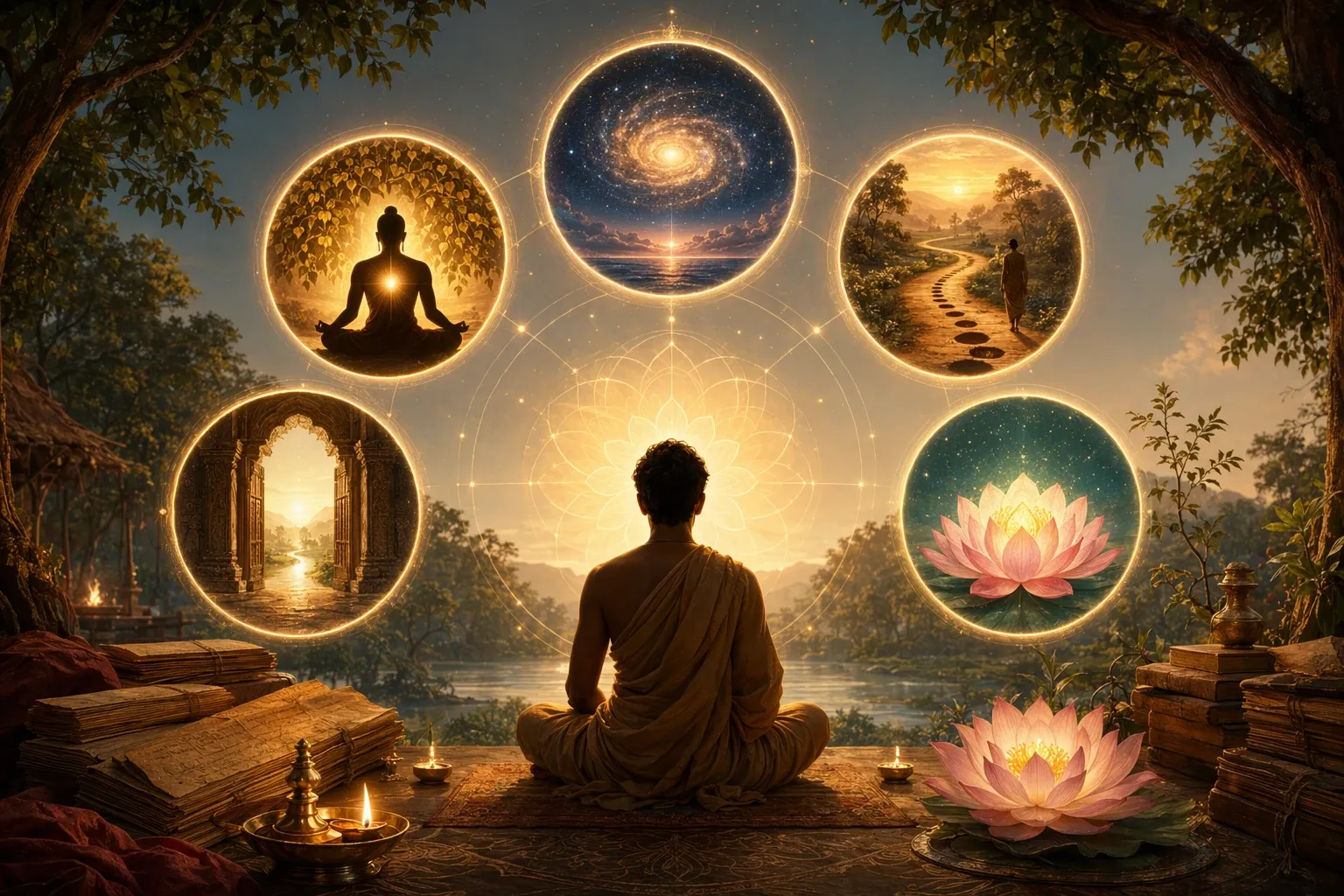
If you searched for 'what upanishads teach us', this guide is for you. Bhaktilipi will keep it simple, respectful, and beginner-friendly.
Related search angles behind this guide include: what upanishads teach, what upanishads contain, what upanishads tell us, what is the main concept of the upanishads, what are the concepts of the upanishads.
Reader questions answered here: What do the Upanishads teach?; What are the main concepts of the Upanishads?; What do the Upanishads say about the self, God, and liberation?.
Quick answer
The main teachings of the Upanishads include Atman, Brahman, the search for self-knowledge, karma, rebirth, moksha, meditation, and the importance of a teacher. Their central mood is: look deeper than the surface of life.
They do not present one simple “ten rules” list. They teach through questions, dialogues, metaphors, and direct insights.
Atman: the deeper Self
Atman is often explained as the inner Self. It is not just personality, body, mood, marks, social media identity, or temporary thoughts. The Upanishads invite us to ask what remains when all changing labels are seen clearly.
Different Vedanta schools interpret Atman in different ways, but all take the question seriously: who are we at the deepest level?
Brahman: ultimate reality
Brahman is the deepest reality behind or within all existence. The Upanishads use careful language because ultimate reality cannot be captured like an ordinary object.
Some passages speak in grand statements; others use silence, negation, or metaphor. The point is not to win an argument, but to move the mind toward truth.
Atman and Brahman
One of the most famous Upanishadic themes is the relationship between Atman and Brahman. Statements such as “Tat tvam asi” are discussed in Vedanta because they suggest a profound connection between the inner Self and ultimate reality.
Different traditions explain this relationship differently: identity, qualified unity, dependence, or devotion-filled relation. A beginner should learn the theme without pretending all schools say exactly the same thing.
Karma, rebirth, and moksha
The Upanishads connect action, knowledge, desire, and rebirth in deep ways. Karma is not just “instant punishment.” It is the moral and spiritual logic of action and its results.
Moksha means freedom or liberation. In the Upanishadic context, it is freedom from ignorance and bondage, not merely getting whatever we want.
Knowledge with discipline
Upanishadic knowledge is not trivia. It requires sincerity, self-control, reflection, and guidance. Many stories show students approaching teachers with humility and patience.
For young readers, the lesson is powerful: real learning changes how you live. Wisdom is not decoration; it is transformation.