
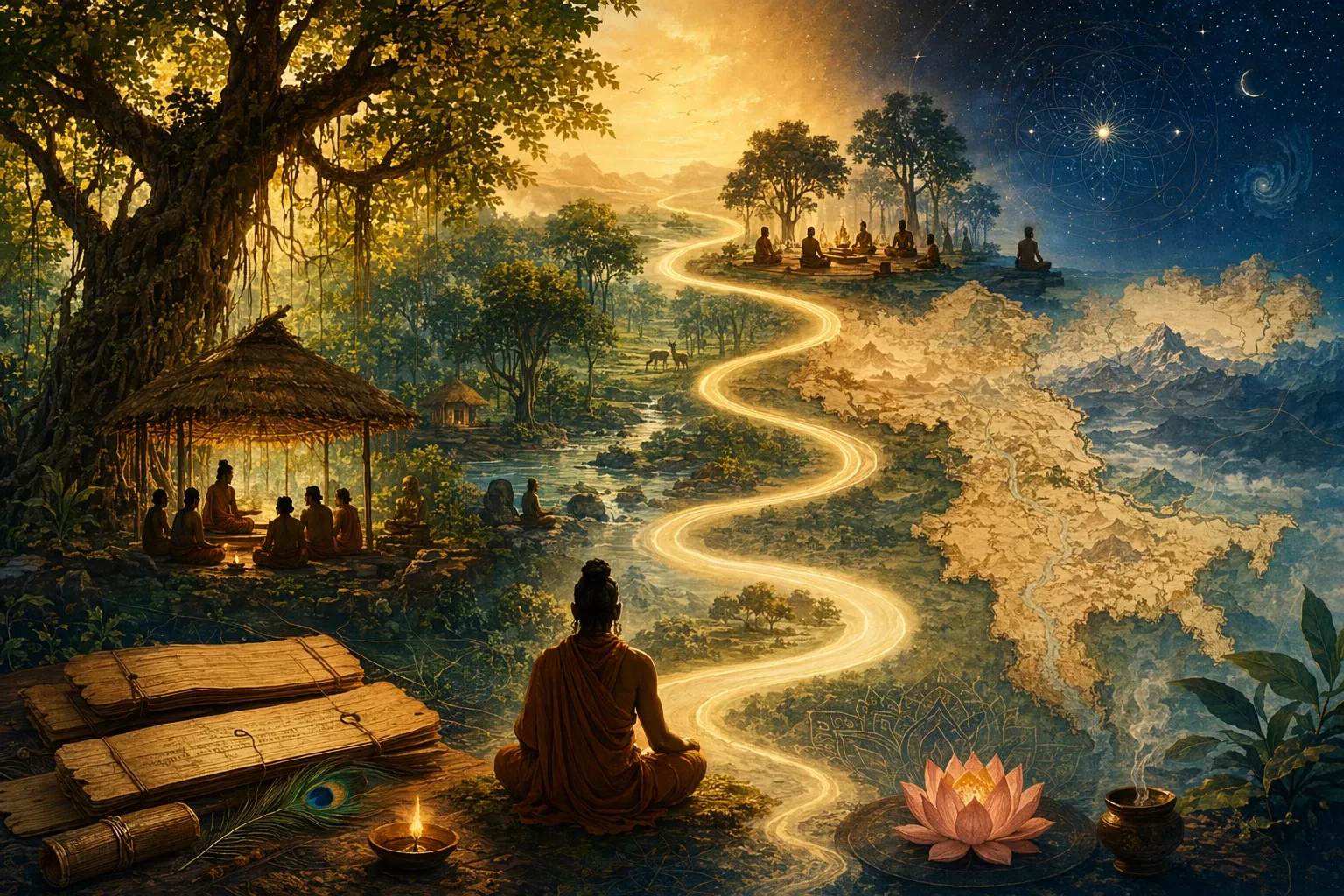
If you searched for 'when were upanishads written', this guide is for you. Bhaktilipi will keep it simple, respectful, and beginner-friendly.
Related search angles behind this guide include: when upanishads were written, when were upanishads composed, where did upanishads originate, where were upanishads written, where are the upanishads found.
Reader questions answered here: When were the Upanishads composed?; Where did the Upanishads originate?; Where are the Upanishads found in Hindu tradition?.
Quick answer
The earliest major Upanishads are generally placed by scholars in the later Vedic period, roughly in the first millennium BCE, though exact dates are debated. They were preserved orally before being written down in manuscripts.
They emerged in ancient Indian Vedic learning contexts, especially in northern Indian cultural regions connected with Vedic schools. But reducing them to one city, one year, or one author is misleading.
Composed, taught, and written are different
When people ask “when were the Upanishads written?” they often mix three things: when teachings arose, when they were orally transmitted, and when manuscripts were physically written.
In Indian sacred learning, oral teaching came first. Writing was important later, but the tradition did not begin as a printed textbook.
A careful timeline
A beginner timeline is: Vedic hymns and ritual traditions; later forest and philosophical reflections; early major Upanishads; development of Vedanta interpretation; manuscript copying; printed editions and modern translations.
This is more accurate than saying “the Upanishads were written in one year.” Different Upanishads belong to different periods.
Where did they emerge?
The Upanishads grew from Vedic schools in ancient India. Many discussions are connected with teacher lineages, royal courts, forests, hermitages, and learning spaces where serious questions could be asked.
Geographically, early Upanishadic culture is often connected with regions of north India, but the wisdom later spread widely across the subcontinent and beyond.
Traditional view and academic dating
Traditional Hindu understanding treats the Upanishads as sacred Shruti, not merely human-authored philosophy. Academic study tries to date layers by language, ideas, and historical clues.
Bhaktilipi’s tone should not mock either side. We can say: tradition honours them as timeless sacred wisdom; historians study their development in ancient India.
If this topic interests you, continue with When Were the Puranas Written? Time Period and Historical Context and When Were the Vedas Written? Vedic Period, Origin, and Oral Tradition.
Why exact certainty is risky
Ancient texts rarely come with modern-style publication records. Manuscripts are often much later than the oral material they preserve. Also, “the Upanishads” is a group of texts, not one document.
So the most honest beginner answer uses careful ranges, not fake precision.