
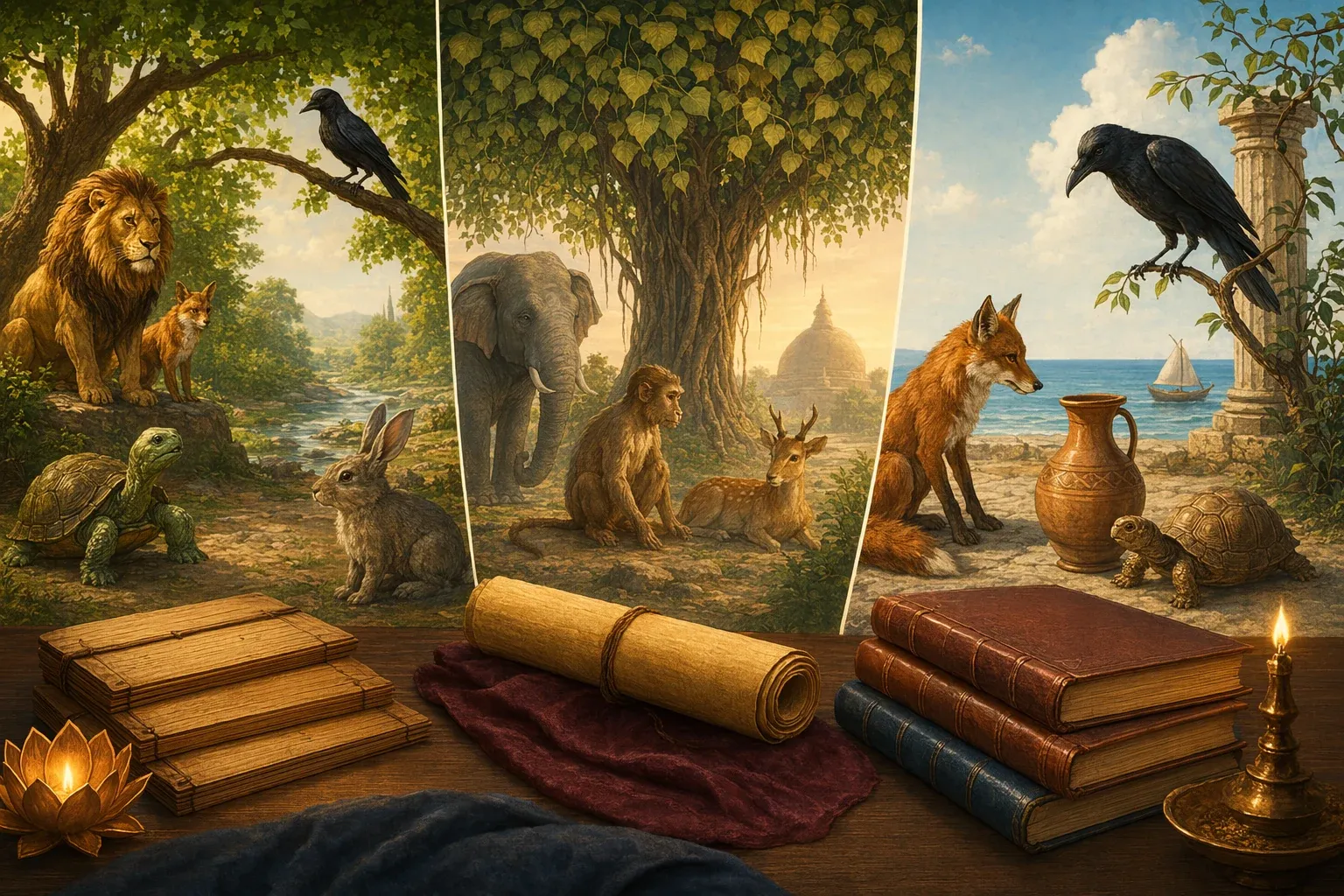
Panchatantra, Jataka tales, Aesop’s fables, and Hitopadesha are often mentioned together because all of them use short stories to teach wisdom. They share animals, memorable endings, clever turns, and simple situations. But they are not the same collection, and they do not always aim at the same kind of lesson.
A beginner can compare them by asking four questions: where does the collection come from, what kind of wisdom does it value, how are the stories arranged, and what feeling remains after the ending? Once we use those questions, the difference becomes much easier to see.
Panchatantra: practical intelligence through linked stories
The Panchatantra is an Indian collection of teaching stories often framed as instruction for young princes. Its focus is practical wisdom: how to choose friends, handle enemies, avoid rash action, recognise flattery, and think before trusting advice. The stories are famous for animals who behave like human beings, but the real subject is social judgement.
One special feature of the Panchatantra is its layered structure. A main story may contain another story, and that story may contain yet another example. This “story inside a story” style trains the reader to compare situations. The lesson is rarely only one sentence. It is often a pattern: notice motive, timing, speech, weakness, and consequence.
Jataka tales: moral memory around the Buddha’s past lives
Jataka tales belong to Buddhist storytelling. They describe previous births of the Bodhisattva, the being who would later become the Buddha. Some tales use animals, and some use human characters, but their centre is moral cultivation. Generosity, patience, compassion, truthfulness, and self-sacrifice appear again and again.
Compared with the Panchatantra, the Jataka mood is often more ethical and spiritual. The question is not only “What is clever?” but “What is noble?” A clever trick may appear, but the deeper interest is in character. That makes the Jataka tales useful for readers who want to understand Buddhist values through narrative rather than doctrine.
Aesop’s fables: compact lessons with sharp endings
Aesop’s fables are usually very brief. They often end with a clear moral, such as a warning against greed, pride, laziness, or false confidence. Many people first meet Aesop through stories like the tortoise and the hare, the fox and the grapes, or the boy who cried wolf.
The biggest difference is style. Aesop’s fables tend to be short and direct. The Panchatantra often feels more like a conversation, with nested examples and political or social intelligence. Aesop gives a quick moral snapshot. Panchatantra gives a longer training exercise in reading situations.
Hitopadesha: a later Indian guide influenced by Panchatantra
Hitopadesha is closely related to the Panchatantra tradition. Its name can be understood as beneficial instruction. It uses animal stories, verse, and prose to teach prudence, friendship, conflict, and conduct. For beginners, Hitopadesha may feel like a cousin of the Panchatantra rather than a completely separate world.
The relationship matters because Indian storytelling did not move in one straight line. Stories were retold, rearranged, adapted, translated, and taught in different settings. Hitopadesha keeps the practical teaching spirit alive, often in a more compact arrangement. If you enjoy Panchatantra, Hitopadesha is a natural next read.
How their lessons differ
Panchatantra asks: What should a person notice before acting? Who is a true ally? What is the risk of anger, gossip, or haste? Jataka tales ask: What kind of character leads toward compassion and awakening? Aesop asks: What everyday folly does this little story expose? Hitopadesha asks: What beneficial counsel can help a student live wisely?
These are overlapping questions, not walls. A Panchatantra tale can have a moral lesson. A Jataka story can be clever. An Aesop fable can feel socially sharp. Hitopadesha can sound practical and ethical at the same time. Still, each tradition has its own centre of gravity.
Which one should a beginner read first?
If you want Indian practical wisdom with layered stories, begin with Panchatantra. If you want Buddhist moral storytelling, choose Jataka tales. If you want very short fables with quick endings, read Aesop. If you already like Panchatantra and want a related Indian collection, try Hitopadesha.
A useful path is to read one story from each collection on the same theme, such as friendship, pride, or false speech. Then compare how each tradition handles the lesson. You will see that the stories are not only entertainment. They are small mirrors of the societies, values, and teaching methods that preserved them.
Why the comparison matters
Putting these collections side by side protects us from flattening them into “old animal stories.” The Panchatantra is not just Aesop in Sanskrit dress. Jataka tales are not merely Buddhist fables. Hitopadesha is not only a copy. Each one has a purpose, a voice, and a teaching style.
Read respectfully, they show how different cultures used simple tales to train memory, conduct, and judgement. That is why these stories still work. A fox, lion, crow, deer, or turtle can carry a lesson across centuries because the human habits behind the story have not disappeared.
For classroom or family reading, the best method is not to ask which collection is superior. Ask what each story trains you to notice. Panchatantra often trains social intelligence, Jataka tales train compassion and moral courage, Aesop trains recognition of common folly, and Hitopadesha trains useful counsel. That comparison keeps the traditions distinct while letting them speak to one another.
Helpful related guides
For more context, read Bhaktilipi’s Arthashastra meaning guide and Who wrote Arthashastra?. These related guides help place this topic beside nearby ideas without repeating the same explanation.