
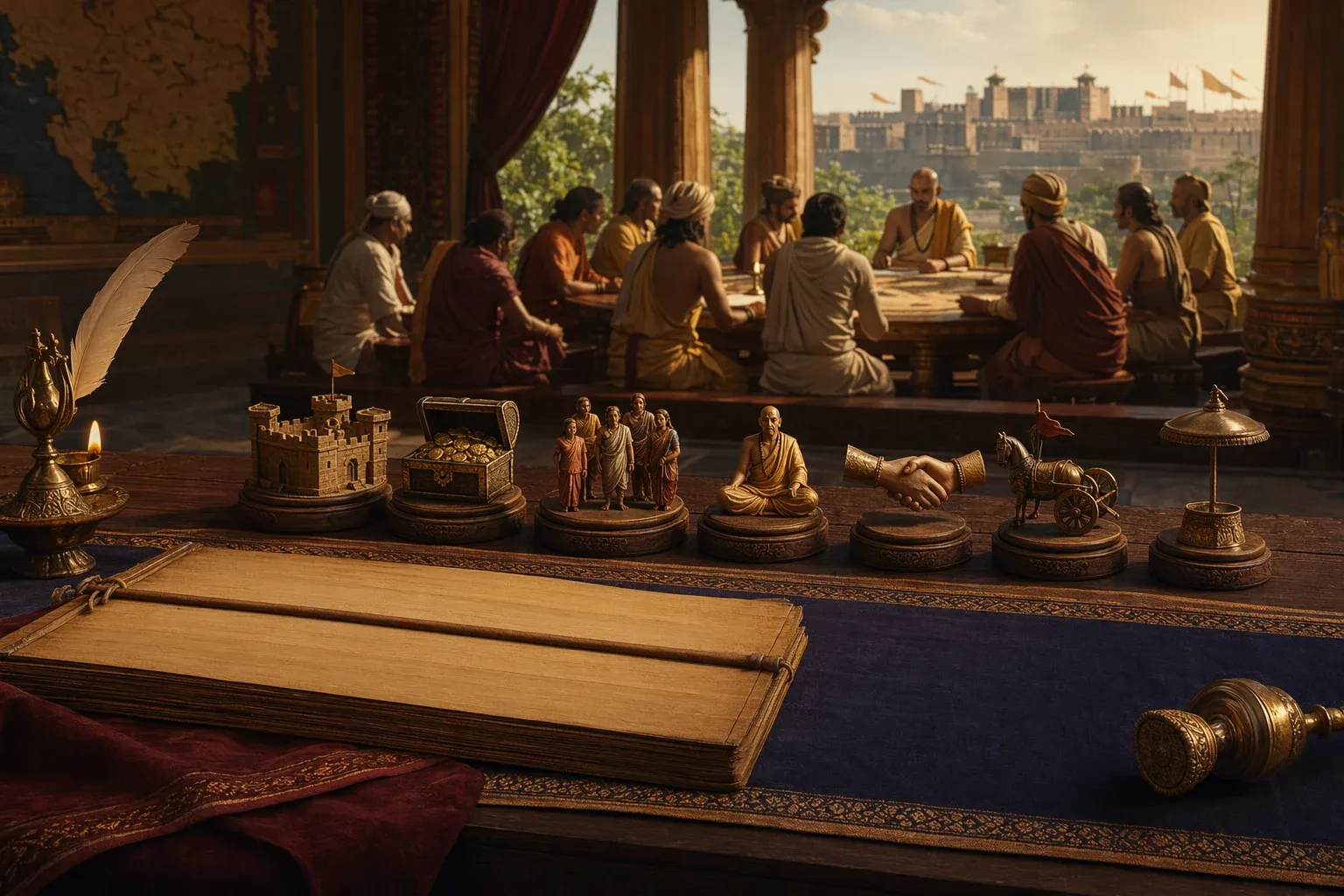
Arthashastra is often introduced as an ancient Indian text on politics, but that description is too small. The work deals with statecraft in a broad sense: how a kingdom is organised, how officials are supervised, how money is collected and spent, how laws are enforced, how enemies and allies are handled, and how a ruler is expected to protect prosperity.
For a beginner, it is helpful to think of Arthashastra as a manual of governance rather than a single-subject book. It is concerned with power, but also with administration, economics, public order, intelligence, taxation, diplomacy, agriculture, trade, punishment, and the stability of the realm.
Governance and the ruler’s responsibilities
At the centre of Arthashastra is the ruler, but the ruler is not shown as a free actor who can do anything. The text repeatedly links authority with responsibility. A king must be trained, disciplined, alert, and surrounded by capable advisers. Laziness, indulgence, poor judgement, and weak supervision are treated as dangers to the whole state.
This is why Arthashastra is still discussed in leadership classes. It asks practical questions: Who should be trusted with office? How should decisions be checked? How can a ruler avoid being misled? What happens when personal comfort becomes more important than public duty?
Administration and officials
A large part of the text concerns administration. It describes officers, departments, records, inspections, salaries, penalties, and systems of accountability. The details can feel surprisingly modern because the problems are familiar: corruption, carelessness, false accounts, misuse of authority, and poor coordination.
The text’s solution is not vague moral advice alone. It wants procedures, audits, observation, and consequences. Whether one agrees with every recommendation or not, the concern is clear: a state cannot run only on good intentions. It needs trained people and reliable checks.
Economy, taxation, and public resources
Arthashastra pays close attention to wealth because the state depends on resources. It discusses revenue, agriculture, mines, forests, trade, weights and measures, storage, and emergency reserves. The text understands that power without economic strength is fragile.
At the same time, the economy is not treated merely as treasure for the ruler. Productive land, secure trade, fair measurement, and protection from exploitation matter because people must be able to work and live. A weak economy harms both the ruler and the public.
Law, order, and punishment
The text also deals with legal disputes, crime, investigation, evidence, fines, and punishments. Modern readers may find some punishments harsh, and it is important to read the work in its historical setting. Still, the broad concern is order. Arthashastra sees disorder as a threat to ordinary life, trade, family security, and political stability.
This does not mean it is only a book of punishment. It is interested in prevention, detection, and the careful use of authority. The ruler must not be asleep while injustice spreads, but punishment must also be connected to rules rather than mere anger.
Diplomacy, war, and alliances
Arthashastra is famous for its discussions of diplomacy and conflict. It examines allies, enemies, neutral powers, treaties, preparation, timing, and different ways of handling external threats. The text is realistic: it assumes neighbouring powers may compete, cooperate, deceive, or change sides.
A beginner should not reduce this to “be cunning.” The larger lesson is that foreign policy requires attention to strength, interest, timing, and consequence. A proud decision made without preparation can damage the kingdom. A cautious treaty at the right moment can protect it.
Welfare and stability
One of the most important points is that stability is not only military. The ruler must protect agriculture, trade, roads, resources, and public confidence. Relief in distress, protection from thieves, fair administration, and attention to prosperity all matter.
In this sense, Arthashastra connects political authority with practical welfare. A ruler who ignores the people weakens the state’s foundation. This is close to Bhaktilipi’s larger explanation of artha as a life goal: material order and prosperity are meaningful when they support life, duty, and stability.
How to read Arthashastra today
Readers should approach Arthashastra with both curiosity and caution. It is not a modern constitution and not a simple moral handbook. Some parts reflect ancient assumptions that should not be copied blindly. Other parts offer enduring insights into administration, incentives, risk, and leadership.
The best beginner summary is this: Arthashastra deals with the practical art of running a state. It studies how power works, how institutions can fail, and how prosperity and security can be protected. That makes it a demanding but fascinating text in Indian political thought.
What it is not
It is also useful to say what Arthashastra is not. It is not only a biography of Chanakya, not only a war manual, and not only a list of clever tricks. Readers sometimes meet the text through dramatic stories about empire and strategy, but the actual subject range is much wider. Its quieter pages on accounts, officials, land, trade, and supervision are essential to its meaning.
That wider view makes the text more balanced for beginners. It can be studied for political realism, but also for administrative thinking and the relationship between prosperity, order, and responsibility.
Why beginners should read selectively
A first reading does not need to cover every technical passage in order. It can begin with themes: the ruler’s discipline, the choice of ministers, protection of resources, legal order, and diplomacy. Reading by theme gives the beginner confidence before entering the denser sections. It also prevents the text from being reduced to one famous idea or one dramatic anecdote.