
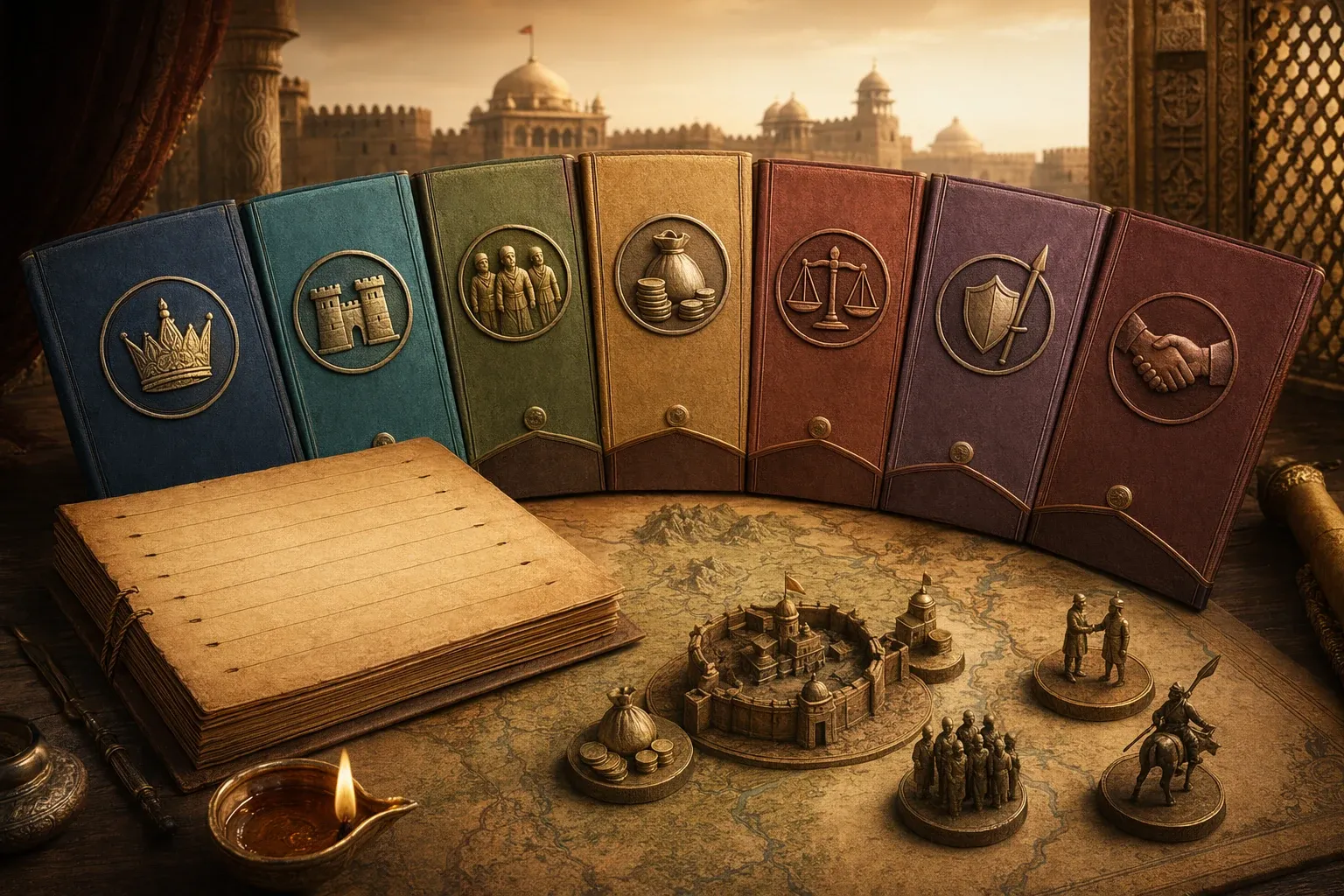
Arthashastra is usually described as a work arranged in fifteen books, with many chapters and topical divisions inside them. Exact numbering can vary slightly by edition and translation, because editors may count sections in different ways. But the broad picture is clear: the text is carefully organised, moving from the training of the ruler to administration, law, foreign policy, conflict, and special situations.
For beginners, the structure matters because Arthashastra can feel overwhelming if read as one long block. It is easier to understand when we see it as a manual with parts. Each part answers a different governance question.
The broad fifteen-book arrangement
The fifteen books move through related but distinct subjects. Early portions discuss discipline, education, advisers, and the ruler’s daily responsibilities. Other portions explain departments, revenue, agriculture, trade, law, courts, internal security, diplomacy, war, and methods for protecting the state. Later sections include more specialised discussions.
This arrangement shows that the text is not only about war or political cleverness. War appears, but so do salaries, accounts, mines, forests, contracts, disputes, forts, messengers, and public order. The structure itself tells us that ancient statecraft was imagined as a wide field of work.
Why the first books focus on the ruler
The opening parts pay attention to the ruler’s training and conduct because leadership is treated as the hinge of administration. If the ruler is careless, even good institutions can weaken. If the ruler is alert, disciplined, and advised by capable people, the state has a better chance of functioning well.
This does not mean Arthashastra worships personality over systems. It actually cares deeply about systems. But it begins with the person who must hold those systems together. A ruler who cannot control desire, anger, sleep, flattery, or suspicion will struggle to govern others.
Administrative books and everyday machinery
Several parts of Arthashastra deal with the machinery of administration. These portions may not sound dramatic, but they are extremely important. They discuss officials, superintendents, records, inspections, revenue, resources, and penalties for misuse. In simple terms, the text asks: who does the work, who checks the work, and what happens when the work is dishonest?
This is where the book can surprise modern readers. It is not only concerned with grand royal decisions. It notices grain, roads, measurements, accounts, and departments. It understands that a kingdom can be harmed by small dishonesties repeated every day.
Law and disputes
The structure also includes legal material. Disputes over property, contracts, family matters, injury, theft, and other social problems are part of the larger question of order. The ruler cannot focus only on diplomacy while people inside the realm face insecurity.
For a beginner, this shows that Arthashastra connects justice with stability. A society where no one trusts rules, measures, contracts, or courts becomes difficult to govern. Even trade depends on confidence that agreements will be recognised.
Foreign policy and the circle of kings
A famous part of Arthashastra concerns relations with other rulers. It discusses allies, enemies, neutral powers, treaties, marches, defence, and the changing balance between neighbouring states. This is where many readers meet terms connected with the “circle of kings” idea.
Structurally, this comes after the text has already discussed internal strength. That order is meaningful. External policy depends on internal resources. A ruler who has weak finances, poor officers, unhappy people, or insecure forts cannot rely on clever diplomacy alone.
War, preparation, and risk
The books on conflict do not treat war as casual adventure. They discuss preparation, timing, terrain, morale, supplies, and alternatives. The text is realistic about danger. It knows that an impulsive campaign can damage the state more than the enemy.
A beginner should notice this pattern: Arthashastra often asks whether an action is suitable to capacity. Strength must be measured before decisions are made. That is a major reason the structure feels analytical rather than merely heroic.
How to read the structure without memorising numbers
You do not need to memorise every book and chapter at first. Instead, read with a map: ruler and training, administration, economy, law, internal security, diplomacy, war, and special measures. Place each passage under one of these headings. The text becomes less intimidating.
If you are comparing it with related Indian thought, Bhaktilipi’s guide to what Arthashastra deals with is a helpful starting point. The structure makes more sense when you first understand the text’s full subject range.
Why the arrangement matters
The fifteen-book structure shows a disciplined mind at work. Arthashastra does not present governance as one inspiring speech. It breaks statecraft into trainable subjects. That is why it remains important for readers interested in Indian political thought, administration, and leadership.
The simplest takeaway is this: Arthashastra’s books and chapters form a practical map of rule. The text begins with self-control and advisers, moves into institutions and law, and then expands toward diplomacy and conflict. Reading it with that map helps beginners see the whole design.
A simple memory aid
A beginner can remember the structure through three circles. The inner circle is the ruler and advisers. The middle circle is internal administration: resources, law, officers, revenue, and order. The outer circle is relations with other powers: allies, enemies, treaties, marching, and defence. This memory aid is not a replacement for the actual books, but it helps first-time readers stay oriented.
Once you see those circles, the work feels less like a maze. Each chapter belongs somewhere in the larger design of self-rule, internal rule, and external policy.