
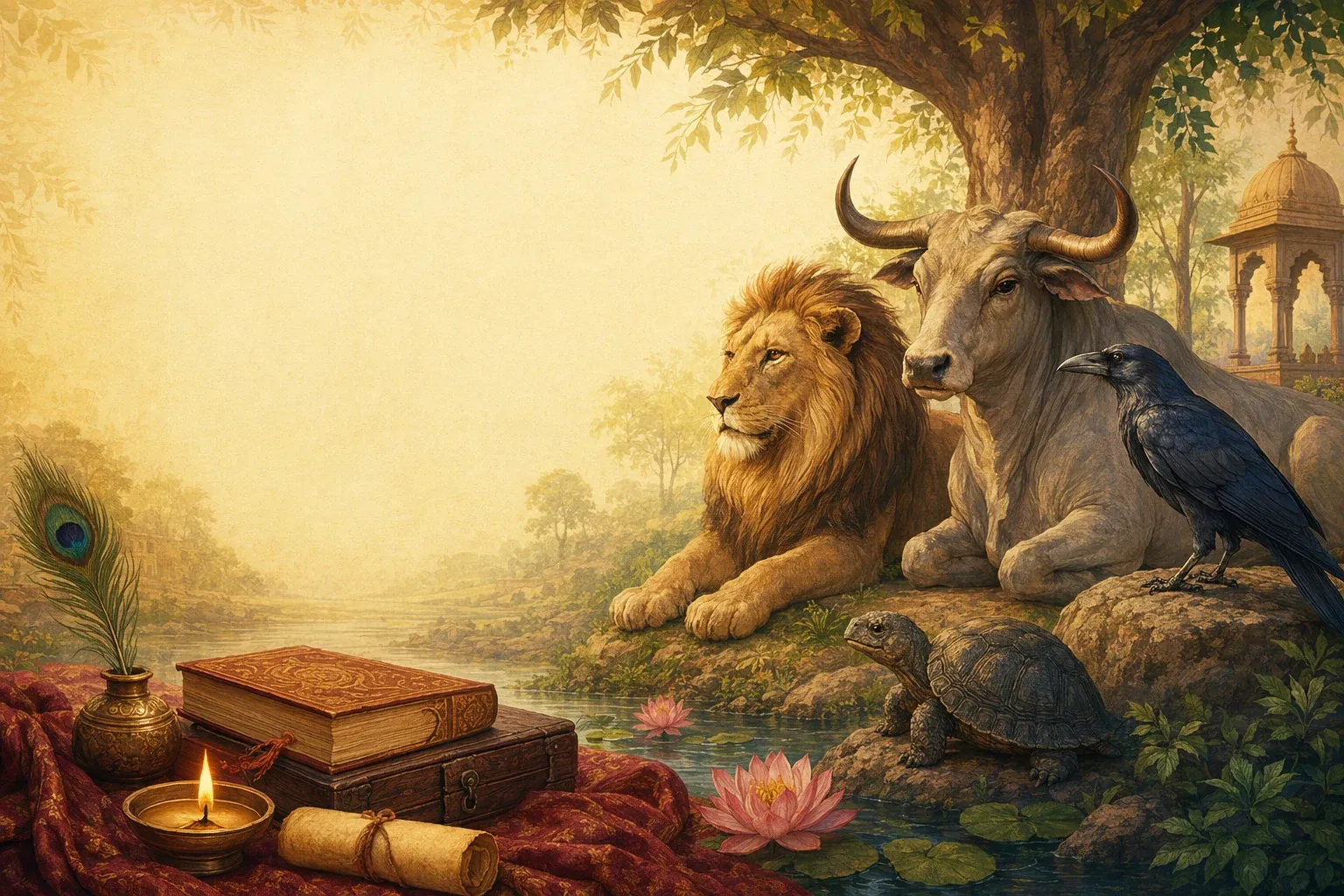
Panchatantra Lessons for Modern Life: Friendship, Wisdom and Choices is a beginner-friendly guide to one part of the Panchatantra tradition: wise stories that use animals, humour, danger, and choice to teach practical life lessons. The aim is not to memorize a moral line, but to understand how the story trains judgment.
Simple answer
Panchatantra still feels modern because friendship, gossip, greed, impatience, bad advice, clever problem-solving, and leadership mistakes have not disappeared. The settings are old, but the habits are current: online rumours, peer pressure, group loyalty, and impulsive choices all have Panchatantra-like patterns.
The best modern reading is not cynical. Panchatantra teaches strategy, but strategy should serve dharma: protect trust, think before acting, speak carefully, and do not let cleverness become manipulation.
Why Panchatantra works through stories
A direct lecture can make readers defensive, but a story gives them distance. When a lion, jackal, monkey, crow, or crocodile makes a mistake, we can notice the pattern calmly. That is why Panchatantra is useful for kids, students, parents, teachers, and adults: it teaches without sounding like a scolding.
The stories also respect intelligence. They do not pretend that life is always simple. Friends may become jealous, powerful people may become arrogant, sweet words may hide danger, and a small character may survive by observing carefully.
Modern lessons
Panchatantra still feels modern because friendship, gossip, greed, impatience, bad advice, clever problem-solving, and leadership mistakes have not disappeared. The settings are old, but the habits are current: online rumours, peer pressure, group loyalty, and impulsive choices all have Panchatantra-like patterns.
The best modern reading is not cynical. Panchatantra teaches strategy, but strategy should serve dharma: protect trust, think before acting, speak carefully, and do not let cleverness become manipulation.
How students can read it
Read one story slowly instead of rushing through ten. First understand the plot: who wanted what, what mistake happened, and what changed at the end. Then look for the habit behind the plot. Was the problem greed, fear, pride, bad friendship, careless speech, impatience, or failure to listen?
For classroom or family discussion, ask children to retell the story in their own words, then ask what they would do differently. This keeps the lesson alive and avoids turning Panchatantra into only a memory exercise.
Tradition and responsible context
Panchatantra has travelled through Sanskrit, regional languages, translations, retellings, schoolbooks, comics, and family storytelling. Because of that, details can differ across editions. One version may change names or shorten scenes; another may add explanation for children. That is normal for a living story tradition.
Beginners should avoid treating one short internet version as the only original form. A better approach is to compare reliable editions, notice the common lesson, and respect the long journey of the text.
For helpful background, you can also read our related Bhaktilipi guides: What Is Dharma? and What Is Karma?.
Common misunderstandings
- Panchatantra is not only for small children; many stories discuss politics, risk, friendship, and decision-making.
- The “moral” is not always one flat sentence; the wiser lesson often depends on context.
- Cleverness is not automatically good; in the best reading, intelligence should be joined with responsibility.
- Different retellings may vary, so readers should focus on the core pattern and choose legal, reliable editions.
A deeper reading method
For Panchatantra Lessons for Modern Life: Friendship, Wisdom and Choices, the best reading method is plot, pattern, principle. Plot means the visible story: who appears, what they want, what goes wrong, and how the situation ends. Pattern means the human habit hidden inside the animal world: pride, greed, loyalty, fear, cleverness, bad advice, or impatience. Principle means the lesson you can carry into real life without copying the story mechanically.
This method helps students avoid two extremes. One extreme is to treat Panchatantra as only entertainment, where the animals are cute but the wisdom is forgotten. The other extreme is to reduce every story to a flat moral sentence. The richer reading asks how the characters think, why they misjudge, and what kind of decision would have prevented the problem.
Parents and teachers can use the same method gently. After reading, ask: Which character noticed the truth first? Which character ignored a warning? Which character used words wisely or badly? What would you do if a friend pressured you the same way? These questions make the old story feel alive in school, friendships, family, and online life.
Ethical intelligence, not manipulation
Panchatantra often praises cleverness, but cleverness alone is not the final value. A person can be clever and still selfish. The better lesson is ethical intelligence: seeing danger clearly, choosing friends carefully, speaking at the right time, and using wit to protect life, trust, and fairness. This is why Panchatantra can sit comfortably beside dharma-based reflection.
Some stories include trickery because they describe a dangerous world. Beginners should not copy every tactic literally. Instead, ask why the trick appears: is it self-defence against cruelty, a warning against greed, or a mirror showing how foolishness gets exploited? That question turns the story into wisdom rather than just strategy.
How to use this guide
Use this article as a starting point, not as the final word. Read the main idea, note the terms that feel new, and then compare the topic with a reliable book, teacher, or longer source. Cultural knowledge becomes stronger when curiosity is joined with patience, humility, and careful reading.
For younger readers, the practical question is simple: what does this teach me about thinking better, acting with more responsibility, and respecting the tradition without turning it into a slogan? That question keeps the learning useful beyond exams or search results.
Final takeaway
Panchatantra Lessons for Modern Life: Friendship, Wisdom and Choices helps readers see Panchatantra as practical wisdom, not just cute animal tales. Read the story, enjoy the characters, but then pause and ask what kind of choice the tale is training you to make in real life.