
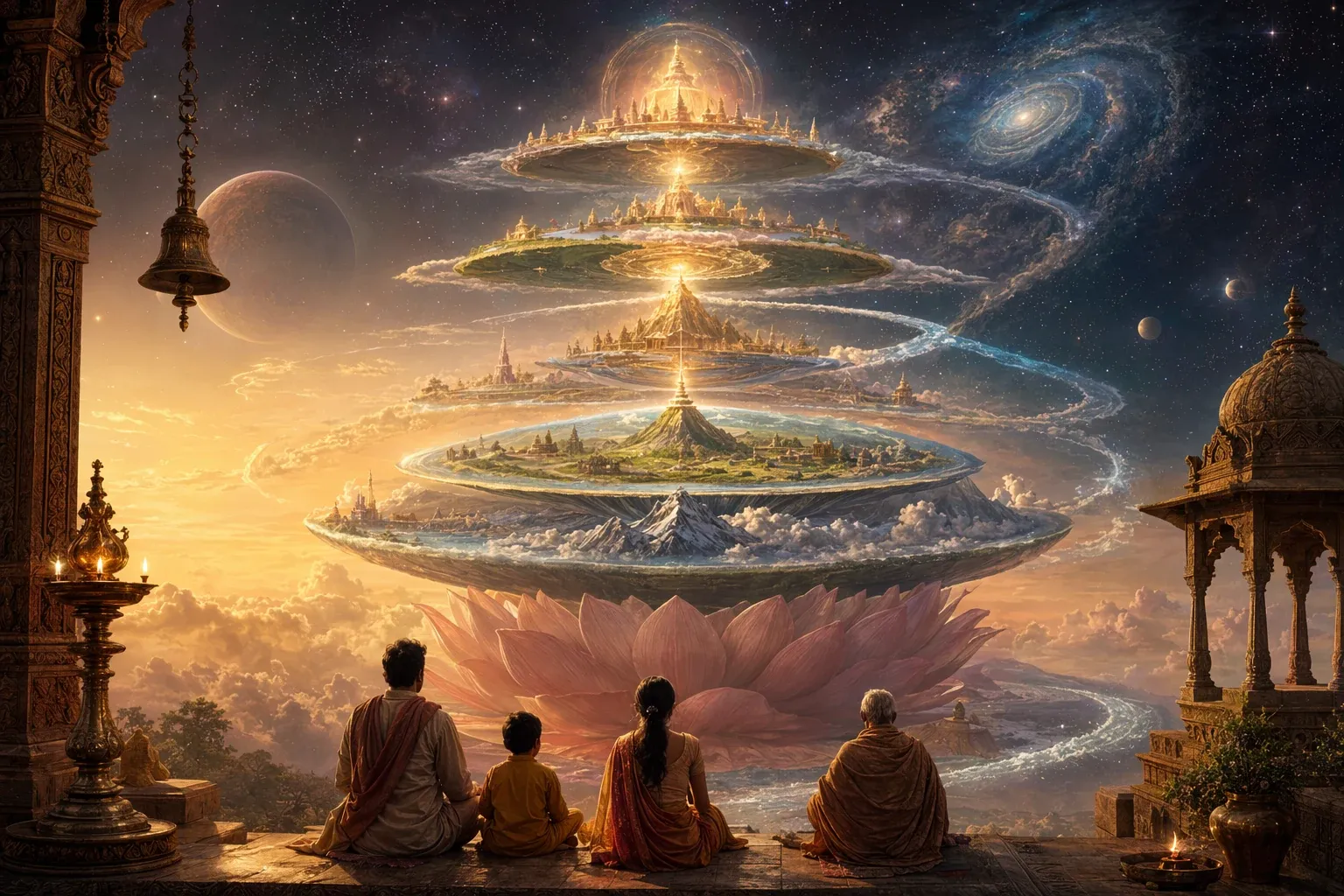
When people hear the word multiverse today, they often think of science fiction, superhero films, or modern physics. Then they notice that Hindu texts speak about many lokas, huge cycles of time, repeated creation and dissolution, and countless living beings across levels of existence. The comparison feels tempting. It also needs care.
Hindu cosmology is not one single diagram from one book. It is a wide family of ideas found across Vedic, epic, Puranic, philosophical, and devotional traditions. Some passages are symbolic. Some are ritual. Some are theological. Some describe sacred geography and cosmic order. So the better question is not, “Did Hindu texts already state the scientific multiverse?” A more honest question is: “How did Hindu traditions imagine reality as much larger than the visible human world?”
Many worlds in a Hindu imagination
In everyday Indian religious language, a loka is a world, realm, or plane of experience. The word does not always mean a planet like Earth. It can mean a domain where certain beings, karmic conditions, or spiritual states are described. This is why “many worlds” in Hindu thought often means layered existence, not only separate physical universes floating in space.
A common Puranic and later Hindu map speaks of fourteen lokas: seven higher and seven lower. The higher sequence is often given as Bhuloka, Bhuvarloka, Svarloka, Maharloka, Janaloka, Tapaloka, and Satyaloka or Brahmaloka. The lower sequence includes Atala, Vitala, Sutala, Talatala, Mahatala, Rasatala, and Patala. Different texts and traditions may arrange or interpret these with variation, so they should not be treated like a modern astronomy chart.
Earth is not the whole stage
Bhuloka is the human world, the realm most directly connected to ordinary life, duty, memory, and action. Svarloka is often associated with devas and heavenly enjoyment. Brahmaloka or Satyaloka is placed at the highest level in many accounts. Patala is not simply “hell” in the modern horror sense; in some Puranic descriptions it can be a splendid subterranean or lower realm associated with nagas, asuras, and other beings.
This layered picture gives a powerful cultural message: human life matters, but it is not the centre of all existence. A person is part of a larger moral and cosmic order. Karma, dharma, knowledge, ignorance, devotion, and attachment are not private moods only; they shape movement through existence. That is very different from a random fantasy map. It is a moral universe.
Cosmic time changes the feeling of life
Another reason Hindu cosmology feels close to “many worlds” thinking is its huge scale of time. Puranic accounts speak of yugas, mahayugas, manvantaras, kalpas, and pralaya. A kalpa, commonly described as a day of Brahma, is given as 4.32 billion years in the standard Puranic scheme, followed by a night of Brahma. A mahayuga contains four yugas: Satya, Treta, Dvapara, and Kali.
For a modern reader, these numbers are striking. But the point is not only mathematics. The scale makes human pride feel smaller. Kingdoms rise and fall. Civilisations change. Even cosmic forms pass through creation, preservation, and dissolution. The visible moment is real, but it is not final. This is why Hindu cosmology often creates a feeling of humility rather than domination.
Where the multiverse comparison helps
The word multiverse can be useful as a doorway for beginners because it breaks one narrow habit: thinking that reality must be limited to what ordinary human senses see. Hindu cosmology repeatedly asks the mind to imagine multiple realms, vast time, beings beyond normal sight, and cycles larger than one lifetime. In that broad sense, the comparison can help a reader enter the subject.
It also helps young readers understand why Indian traditions were comfortable with scale. The universe is not just a small stage for human ego. It is an immense field of consciousness, matter, time, action, and consequence. The idea that existence contains more than one human-centred layer is deeply natural in Hindu storytelling and philosophy.
Where the comparison breaks
Modern scientific multiverse ideas usually come from physics, mathematics, cosmology, and theories about space-time, inflation, quantum measurement, or possible universes. These are technical models debated through observation, equations, and scientific method. Hindu lokas come from sacred texts, ritual imagination, philosophy, and theological reflection. They answer different kinds of questions.
So it is not helpful to say, “Hinduism proved the multiverse before science.” That sounds exciting, but it creates confusion. A respectful reading does not need that overclaim. Hindu cosmology has its own depth. It can be meaningful without being forced into modern laboratory language. Science asks how the physical cosmos works. Sacred cosmology asks how existence, duty, beings, time, and liberation are understood within a tradition.
Tradition, interpretation, and source context
Tradition gives the lokas spiritual and cultural meaning. A devotee may think of them through stories of devas, rishis, ancestors, nagas, or divine abodes. Interpretation asks what these levels teach: humility, moral consequence, cosmic belonging, and the limits of ordinary perception. Source context asks where the descriptions come from and how they vary across texts.
This separation matters. The Vedas, Upanishads, Mahabharata, Puranas, and later commentarial traditions do not always speak in one identical voice. Puranic cosmology often uses grand images, numbers, genealogies, and sacred geography. Philosophical schools may focus more on prakriti, purusha, consciousness, bondage, and liberation. A careful reader enjoys the richness without pretending that all texts are the same textbook.
Questions people ask
Does Hindu cosmology talk about many worlds?
Yes, many Hindu traditions speak about multiple lokas or realms of existence. These are usually religious and philosophical worlds of experience, beings, and karmic conditions, not simply planets in a modern astronomy sense.
What are lokas in Hindu cosmology?
Lokas are worlds, realms, or planes. A common model speaks of fourteen lokas, including Bhuloka, Svarloka, Satyaloka, and Patala. Their meaning depends on text, tradition, and interpretation.
Is Hindu cosmology like a multiverse?
It is similar only in a loose, beginner-friendly way: both stretch the imagination beyond one visible world. But Hindu lokas are sacred and philosophical categories, while modern multiverse theories are scientific models. Mixing them too strongly creates confusion.
A grounded takeaway
Hindu cosmology invites us to see life as part of a vast order. The lokas remind us that the human world is important but not absolute. Cosmic time reminds us that even grand structures move through cycles. The multiverse comparison can open curiosity, but it should remain a comparison, not a forced claim. The real beauty is deeper: Hindu thought trains the mind to be humble before existence and responsible within it.