
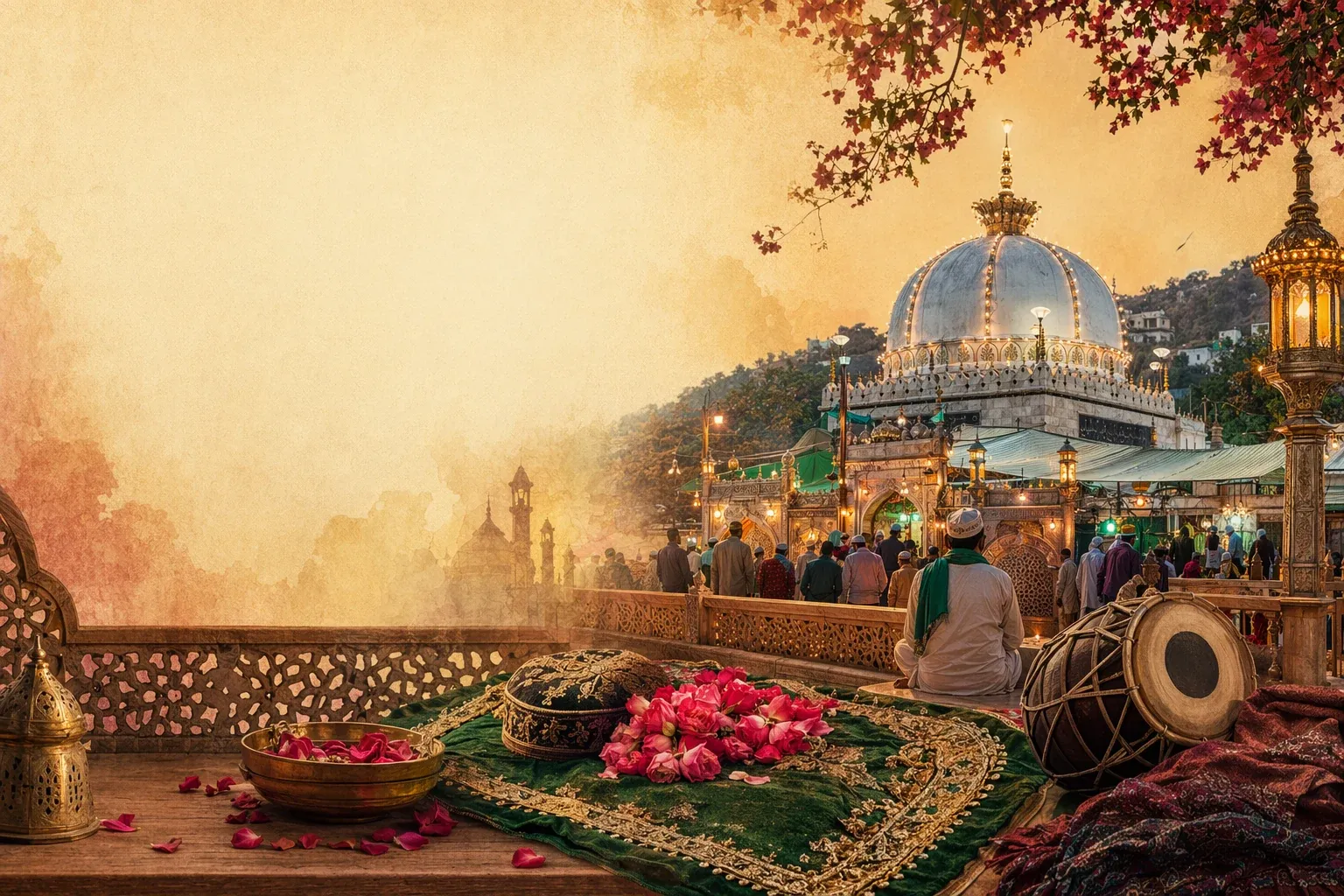
Sufi saints and dargahs in India are part of a living devotional landscape. They belong to Islamic spiritual history, but their public memory often reaches wider: pilgrims, poets, musicians, travellers, local families, and curious students all meet these spaces in different ways. A dargah is not just an old building. For devotees, it is a place where love, grief, gratitude, and hope are carried into prayer.
To understand Indian Sufi shrines well, we need both respect and care. Respect means recognising that these places are sacred to many people. Care means not turning them into tourist clichés, miracle markets, or vague symbols of “mysticism.” Each saint lived in a real historical world. Each shrine has its own customs. Each community has its own understanding of what devotion should look like.
What a dargah is
The word dargah usually refers to a shrine built around the grave of a revered Sufi saint. In South Asia, many dargahs became centres of prayer, charity, music, festivals, and memory. People may come to offer flowers, tie threads where local custom allows, distribute food, listen to qawwali, or simply sit in silence. The exact practice changes from place to place.
From a theological point of view, Muslims do not all agree about shrine practices. Some communities see visiting saints’ graves as a meaningful act of remembrance and prayer to God. Others are uncomfortable with certain customs. A good reader should not flatten this diversity. Indian Sufi culture is important, but it is not the only way Indian Muslims live Islam.
Ajmer Sharif and Mu‘in al-Din Chishti
Ajmer Sharif in Rajasthan is one of the most famous Sufi shrines in India. It is connected with Mu‘in al-Din Chishti, remembered as Khwaja Gharib Nawaz, a title often understood as the benefactor of the poor. His historical life belongs to the world of medieval Islamic scholarship and Sufi teaching, while his devotional memory in India is vast and emotional.
People visit Ajmer with many kinds of prayers: illness, exams, marriage worries, gratitude, sorrow, or the wish to feel close to a beloved saint. The annual urs, marking the saint’s death anniversary as a union with God, draws large crowds. For many families, Ajmer is not a one-time trip. It is part of inherited memory, a place elders speak about with affection.
Historically, Ajmer also shows how a shrine can shape a city. Streets, markets, food stalls, guest houses, qawwali spaces, and ritual rhythms grow around the dargah. The sacred and the everyday stand side by side.
Nizamuddin Auliya and the Delhi atmosphere
Delhi’s Hazrat Nizamuddin area carries the memory of Nizamuddin Auliya, one of the most loved Chishti saints of the Indian subcontinent. He lived in the 13th and 14th centuries and is remembered for compassion, spiritual insight, and a deep distance from arrogance. Devotional memory links him with feeding the hungry, welcoming seekers, and softening hearts.
The Nizamuddin dargah is also tied to qawwali. The area’s evening gatherings, narrow lanes, rose petals, lamps, and music have made it one of the most recognisable Sufi spaces in north India. But again, the music is not merely performance. In devotional context, listening can become a way of turning the heart toward God.
Nizamuddin’s story is often connected with Amir Khusrau, the poet, musician, and disciple whose memory is central to Indo-Persian and Hindavi cultural history. Their association helps explain why Indian Sufi culture is so closely linked with poetry and music.
Baba Farid and the Punjab connection
Baba Farid, also known as Fariduddin Ganjshakar, is one of the most revered Sufi figures of South Asia. His memory is especially strong in Punjab. He belongs to the Chishti lineage and is remembered as a mystic, poet, preacher, and guide. His importance also reaches Sikh tradition, where verses associated with him are included in the Guru Granth Sahib.
This does not mean religious differences disappear. It means that a saint’s words can travel across community boundaries when people recognise humility, longing, and moral seriousness in them. Baba Farid’s memory is a powerful example of how Indian spiritual history often moves through language and poetry, not only institutions.
Salim Chishti and Fatehpur Sikri
Sheikh Salim Chishti is associated with the Mughal period and with Fatehpur Sikri near Agra. His white marble tomb is one of the memorable spaces within the historic complex. Devotional stories connect him with Emperor Akbar and the birth of a son, but a careful reader should treat such stories as part of courtly and devotional memory rather than simple proof of supernatural claims.
What matters culturally is how the shrine joins politics, architecture, and devotion. Fatehpur Sikri is not only a royal site; it is also a place where saintly memory shaped imperial imagination. This is a common pattern in South Asian history: rulers, towns, and ordinary people often sought blessing and legitimacy near respected holy figures.
What people do at dargahs
A visitor may see many practices at Indian dargahs: covering the head, removing footwear, offering flowers or a chadar, making dua, giving food, listening to qawwali, joining an urs, or sitting near the courtyard in quiet remembrance. These actions can look simple, but they carry layers of meaning. A chadar may express honour. Food may express service. Music may express longing. Silence may express surrender.
It is wise to visit with humility. Dress modestly, follow local rules, ask before photographing people, avoid blocking worshippers, and do not treat a shrine like a prop. If you are not from the tradition, you can still be respectful. Watch how elders behave. Let the space teach you slowly.
Are dargahs only for Muslims?
Many dargahs in India receive visitors from different backgrounds. Hindus, Sikhs, Christians, and people with no fixed religious label may visit famous shrines such as Ajmer or Nizamuddin. This mixed visitation is one reason Sufi spaces are often discussed in the language of shared culture.
But we should phrase this carefully. A dargah remains an Islamic sacred space connected to a Muslim saint. Visitors from other communities may be welcomed, but welcome does not erase the shrine’s religious identity. The better word is not ownership by everyone, but hospitality toward many.
How to learn about Sufi saints without getting lost
Start with a few names and places: Mu‘in al-Din Chishti at Ajmer, Nizamuddin Auliya in Delhi, Baba Farid in the Punjab region, and Salim Chishti at Fatehpur Sikri. Then notice what each example teaches. Ajmer teaches public devotion and care for the poor. Nizamuddin teaches compassion, music, and urban memory. Baba Farid teaches poetry across communities. Salim Chishti teaches the meeting of saintly memory, architecture, and empire.
After that, you can explore local saints in your own region. Almost every part of India has its own Sufi map: Bengal, Kashmir, Gujarat, Maharashtra, the Deccan, Uttar Pradesh, Bihar, and the south all preserve different memories. The famous shrines are only the beginning.
The best way to approach Indian Sufi saints is neither blind belief nor cold dismissal. Read history, listen to tradition, notice architecture, and respect living devotion. A dargah is a doorway into how Indians have prayed, sung, mourned, hoped, and remembered for centuries. Enter gently.
For a wider comparison with India’s devotional traditions, read Bhaktilipi’s guide to Bhakti Movement and Sufism.