
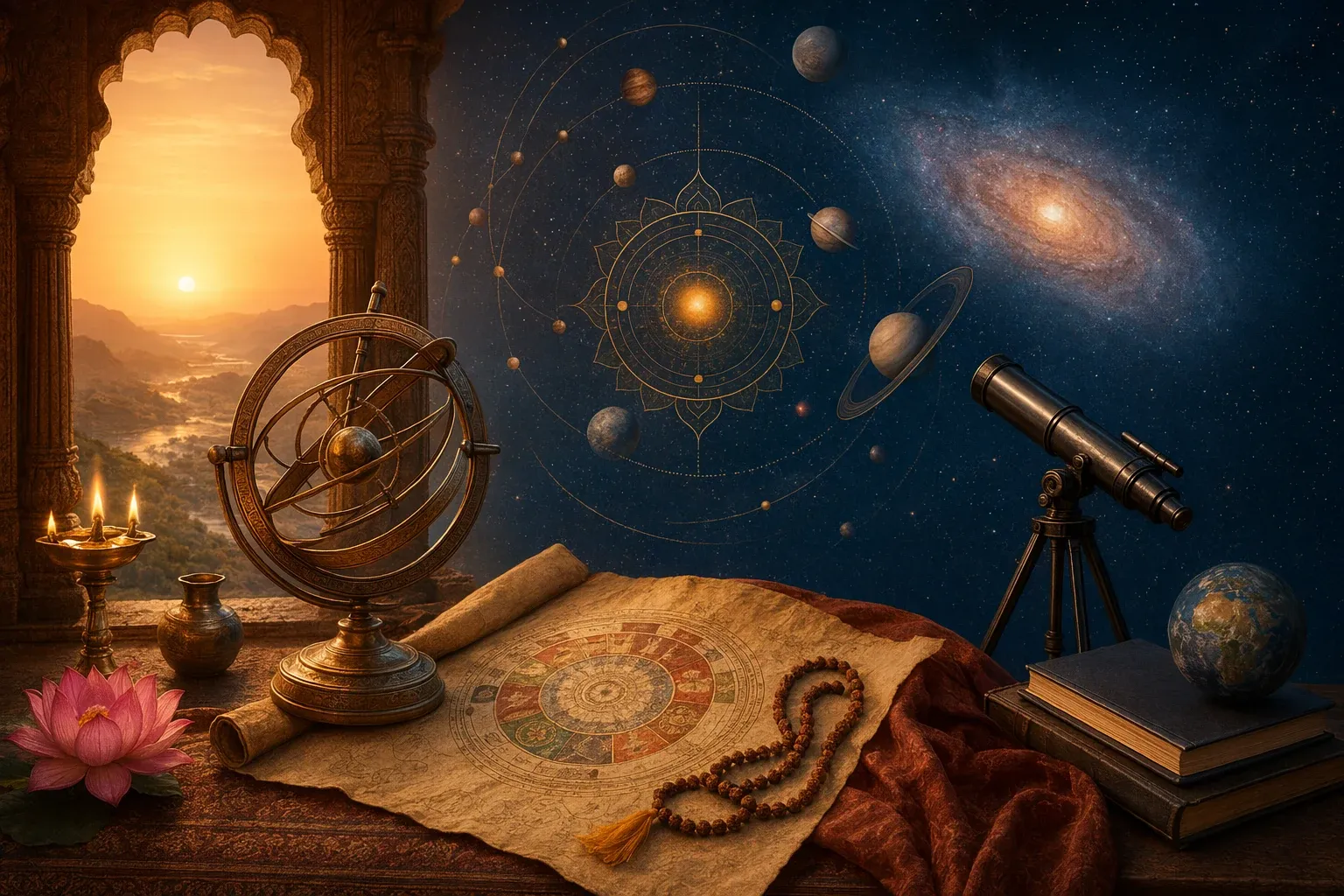
Hindu cosmology and modern science are often compared online. Some posts say ancient Hindu texts already knew everything about the Big Bang, multiverse theory or the age of the universe. Others dismiss Hindu cosmology as only mythology. Both reactions are too quick. A respectful comparison needs two qualities at the same time: pride in the depth of Hindu thought, and honesty about what modern science actually does.
Modern cosmology is a branch of physics and astronomy. It studies the origin, structure, evolution and possible future of the universe through observation, mathematics, telescopes, satellites and testable models. Hindu cosmology is wider in another direction. It connects the universe with dharma, karma, divine order, sacred time, many worlds, ritual imagination and the human search for liberation. The two can speak to each other, but they are not the same language.
Where the comparison feels natural
The first similarity is scale. Many Hindu texts imagine time in astonishingly large cycles: yugas, manvantaras, kalpas and repeated creation and dissolution. Even if we do not treat these as modern scientific numbers, the emotional effect is familiar to anyone who studies astronomy. Human life begins to feel tiny before cosmic time.
Modern science also gives us deep time. Current scientific cosmology describes a universe around 13.8 billion years old, expanding from an extremely hot, dense early state, with galaxies, stars and planets forming across immense stretches of time. The details are different, but both traditions push the mind beyond everyday measurement. They make us ask: what is a human life inside such vastness?
The second similarity is that both reject a small, closed world. Hindu Puranic imagination speaks of many lokas and repeated worlds. Some philosophical traditions also speak of countless beings and cycles. Modern astronomy reveals billions of galaxies and a universe far larger than what naked-eye observers could see. Again, this does not mean the Puranas “predicted” telescope data. It means both create humility by breaking the ego’s small map.
The biggest difference: method
The most important difference is method. Modern science builds models from evidence that can be checked, corrected and replaced. A claim about cosmic background radiation, expansion or the formation of elements is not accepted because it sounds beautiful. It must fit observations and survive criticism.
Hindu cosmology works through scripture, tradition, philosophical reasoning, ritual symbolism and devotional meaning. A Puranic description of lokas or Meru is not trying to do the same job as a space telescope. A temple plan may express cosmic order. A mantra may connect sound and sacred reality. A story of creation may teach dependence on the divine, the rhythm of time or the limits of pride.
Confusing these methods creates bad arguments. If someone says, “Hindu cosmology is true only if it matches the latest physics,” they shrink the tradition. If someone says, “Modern science is unnecessary because scripture already contains all equations,” they shrink science and make Hindu thought look insecure. A confident tradition does not need fake proofs.
Creation, beginning and cycles
Modern popular talk often links Hindu cosmology with the Big Bang. The connection is understandable because both involve questions of origin and cosmic development. But it should be handled carefully. The Big Bang model is a scientific account of the early observable universe, expansion and later formation of matter and structure. It is not simply a religious story of creation.
Hindu traditions, meanwhile, often imagine creation as cyclical. Universes arise, endure and dissolve. Brahma’s day and night, Vishnu’s preservation, Shiva’s dissolution and other images express cosmic rhythm in devotional and theological forms. Some schools give more philosophical accounts, asking how the changing world relates to Brahman, prakriti, purusha or Ishvara. These ideas are not identical to twentieth-century physics.
A better comparison is this: modern cosmology asks how the physical universe has developed according to measurable laws; Hindu cosmology asks how cosmic existence participates in meaning, order and spiritual truth. The questions overlap at the edges, but they are not interchangeable.
Multiverse talk needs extra care
Another popular comparison is the multiverse. Hindu texts certainly contain many-world ideas: multiple lokas, repeated creations and vast cosmic geography. Modern multiverse theories, where discussed, arise from physics and mathematical models, and remain debated. It is tempting to say, “Hinduism discovered the multiverse first.” But that sentence is too blunt.
It is safer and more respectful to say that Hindu traditions developed rich ideas of multiple realms and repeated cosmic cycles long before modern scientific multiverse speculation. That is interesting enough. We do not need to pretend that a Sanskrit cosmological image and a physics model are the same object.
What Hindu cosmology adds to wonder
Science can tell us much about stars, galaxies and early cosmic history. But scientific knowledge alone does not automatically answer how we should live. Hindu cosmology adds a moral and spiritual horizon. It says the human being is not an isolated consumer floating in empty space. We live inside rta, dharma, karma, samsara and the possibility of moksha. Action has consequence. Life has responsibility.
This is why cosmic scale in Hindu thought often becomes ethical. If time is vast and creation cycles endlessly, ego becomes foolish. If the universe is sustained by order, falsehood and greed are not small private matters. If all beings are tied into a wider web of existence, compassion becomes practical wisdom.
Healthy comparison, unhealthy comparison
A healthy comparison says: “Both Hindu cosmology and modern science invite wonder. Hindu texts have profound ideas of time, order, many worlds and repeated creation. Modern science gives evidence-based models of the physical universe. Let us study both carefully.”
An unhealthy comparison says: “Every modern discovery was already exactly written in Hindu texts,” or “Anything not written like a science paper is worthless.” The first approach turns tradition into internet boasting. The second approach ignores the symbolic, philosophical and devotional intelligence of culture.
A balanced takeaway
For Bhaktilipi readers, the best position is simple: be curious without overclaiming. Read Hindu cosmology for its vast imagination, spiritual seriousness and civilisational depth. Read modern science for its disciplined method, evidence and openness to revision. When similarities appear, enjoy them. When differences appear, respect them.
Hindu cosmology does not need to compete with science like a rival textbook. Its power lies in showing that the universe can be thought of as ordered, meaningful and spiritually connected. Modern science shows how much disciplined observation can reveal. Together, they can make us more humble — if we do not force one to become the other.