
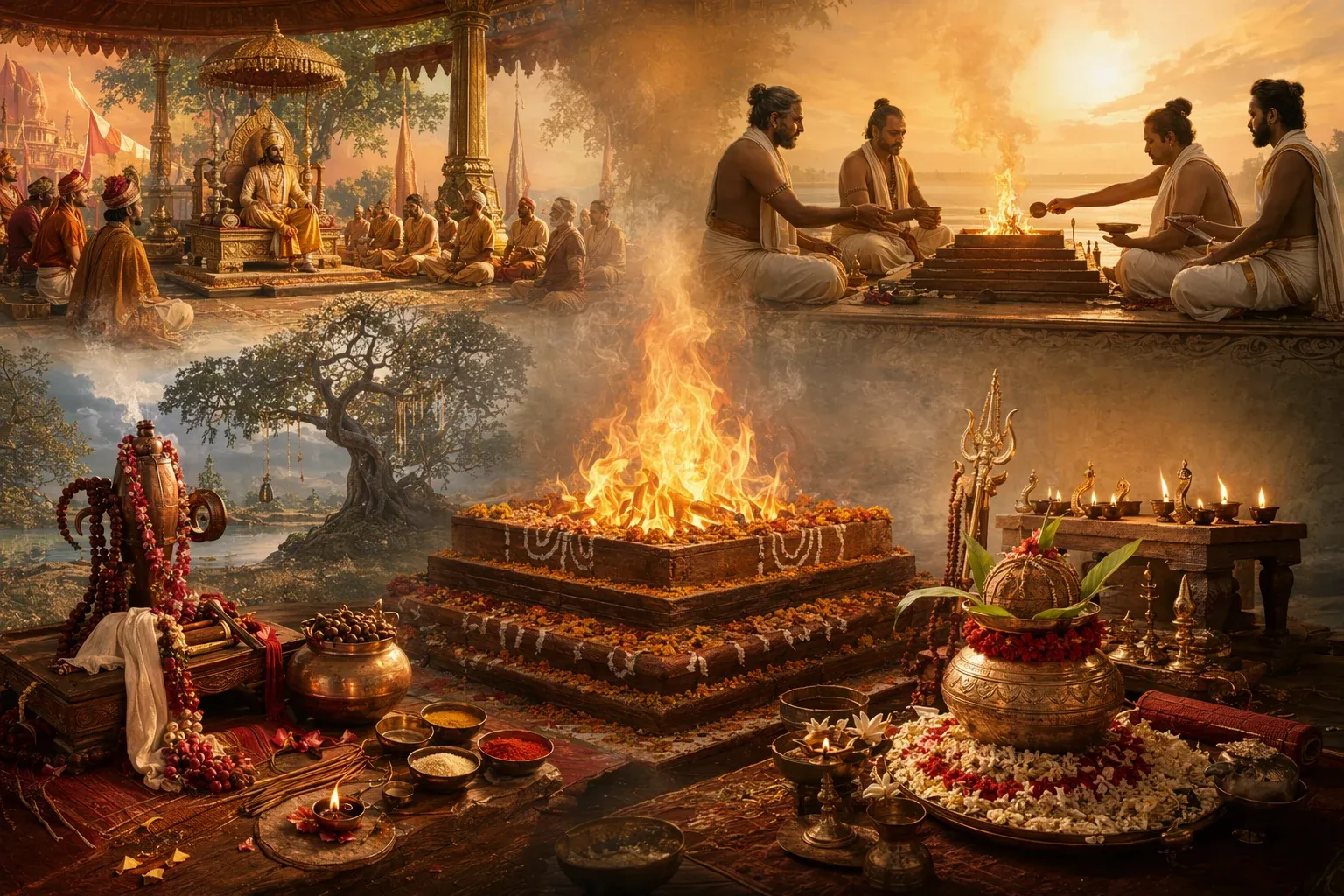
Hindu stories mention many yajnas, but some names are heard again and again: Rajasuya, Putrakameshti, Daksha Yajna, and Navchandi. They are not the same kind of ritual, and they do not teach the same lesson. Some are connected with kingship, some with prayer, some with devotion, and some with warning.
This guide gives a beginner-friendly overview without turning sacred terms into a shallow list. If the word yajna itself is new to you, first read our Yajna meaning guide. In simple language, yajna means sacred offering and disciplined action, not only fire and smoke.
Why certain yajnas became famous
A yajna becomes famous in story when it carries more than ritual procedure. It may reveal a king’s ambition, a family’s prayer, a devotee’s surrender, a community’s hope, or the danger of pride. That is why the best question is not only “What was done?” but also “What did the story want us to notice?”
For beginners, it helps to group famous yajnas by theme. Rajasuya is mainly remembered through royal authority. Putrakameshti is remembered through the desire for children and continuation of family. Daksha Yajna is remembered through ego, insult, grief, and Shiva-Sati tradition. Navchandi is remembered through Devi worship and devotional practice.
Rajasuya: royal consecration and public authority
Rajasuya is a royal yajna associated with consecration and recognition of a king’s status. In the Mahabharata, Yudhishthira’s Rajasuya is a major event because it gathers rulers, elders, warriors, sages, and family tensions into one public setting. The ritual is not just about personal success; it shows how power is seen, accepted, challenged, and tested.
The famous Mahabharata context also reminds us that public honour can awaken jealousy and conflict. A ritual meant to display order can expose disorder in people’s hearts. That is why Rajasuya is useful for readers today: it shows that recognition and leadership need humility, not only celebration. For more background, see our Mahabharata beginner guide.
Putrakameshti: prayer, family, and longing
Putrakameshti is commonly remembered as a yajna performed with the desire for a child. The best-known story is King Dasharatha in the Ramayana tradition, where the ritual is connected with the birth of Rama and his brothers. For many readers, the story speaks to longing, family continuity, divine grace, and trust.
At the same time, modern readers should avoid reducing Putrakameshti to a guaranteed result formula. Traditional stories often express hope through sacred language. They should be read with reverence, but also with maturity. The heart of the story is not mechanical wish-fulfilment; it is prayer placed inside dharma, responsibility, and family destiny. Our Ramayana beginner guide gives a wider context for Dasharatha, Rama, and the epic setting.
Daksha Yajna: ritual without humility
Daksha Yajna is one of the most powerful warning stories. Daksha performs a great sacrifice but insults Shiva and dishonours Sati. The story is remembered in different forms, but its emotional centre is clear: ritual pride can become spiritually empty when respect, love, and humility are missing.
This is why Daksha Yajna is not famous merely because it was large. It is famous because it shows a breakdown of sacred relationship. A person can arrange offerings, invite guests, and follow outer form, yet still fail at the inner spirit. For young readers, this is one of the most important lessons in Hindu storytelling: sacred action needs the right heart.
Navchandi: Devi devotion and protection
Navchandi is associated with worship of the Divine Mother, especially through Chandi or Durga traditions. Unlike Rajasuya, it is not mainly a royal power ritual. It is remembered more through devotion, protection, blessings, and the recitation or worship connected with Devi. Practices vary by region, family, temple, and lineage, so details should be learned from qualified guides.
For beginners, the key is to see Navchandi as part of the living devotional world of Shakti worship. It expresses reverence for the fierce and compassionate power of the Mother, especially in times when devotees seek strength, clarity, protection, or gratitude.
How these yajnas differ
Rajasuya asks us to think about leadership and public legitimacy. Putrakameshti asks us to think about longing, family, and prayer. Daksha Yajna asks us to think about pride, disrespect, and the emptiness of ritual without humility. Navchandi asks us to think about devotion to Devi and the protective force of the Mother.
They are all called yajna in broad conversation, but they should not be flattened into one meaning. Hindu tradition uses ritual stories to speak about many parts of life: kingship, family, ego, devotion, duty, and transformation. That variety is exactly what makes the stories memorable.
What beginners should remember
Do not treat famous yajnas as magic labels. Treat them as doorways into story, meaning, and values. Ask who performs the yajna, why it is performed, what goes right, what goes wrong, and what the story teaches about dharma.
If you want to understand practical ritual objects, our Yajna samagri guide is a helpful next step. But for these famous yajnas, the main lesson is bigger than materials. Sacred action becomes meaningful when it is joined with humility, responsibility, devotion, and a clear sense of purpose.
How to read these stories without confusion
A helpful way to read famous yajnas is to ask three questions. First, what desire or duty begins the ritual? Second, what kind of person performs it: a king, a family, a devotee, or a community? Third, what does the story reveal after the outer ritual is complete? These questions stop us from treating every yajna as the same kind of event. Rajasuya points toward public authority, Putrakameshti toward family longing, Daksha Yajna toward pride and disrespect, and Navchandi toward devotion to the Mother.
This also protects young readers from two common mistakes. One mistake is to read every ritual name as a recipe. Another is to dismiss every ritual story as irrelevant because the setting is ancient. Hindu storytelling often works between those extremes. It preserves memory, teaches values, and gives people a language for gratitude, fear, hope, power, grief, and surrender.