
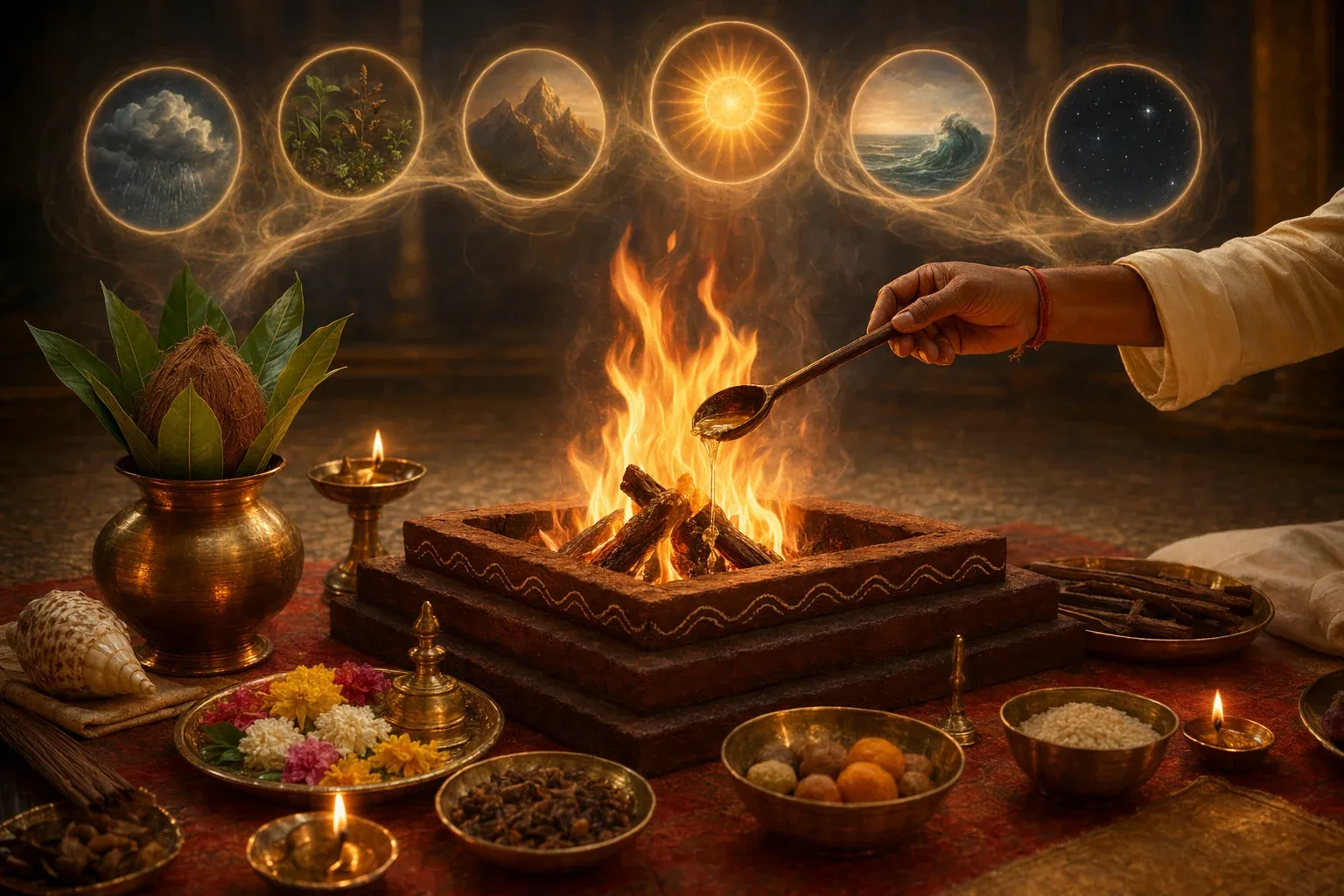
Yajna is often described as a sacred fire ritual, so many beginners naturally ask one direct question: who is the main deity in a yajna? The simplest answer is that Agni, the sacred fire, stands at the centre of the ritual. But that does not always mean Agni is the only deity being honoured. In many yajnas, Agni is the visible presence through which offerings are made, while the mantras may invoke different devatas such as Indra, Varuna, Soma, Vishnu, Rudra, Surya, Saraswati, or other divine powers depending on the purpose and tradition of the ritual.
This distinction matters because yajna is not just about lighting a fire. It is about offering, intention, mantra, discipline, and relationship. Agni makes the ritual visible and active. The offering is placed into the fire, the mantra gives it meaning, and the devata being invoked gives the ritual its particular direction. A beginner can think of Agni as the sacred carrier, witness, purifier, and bridge between the human act of offering and the divine world addressed by the ritual.
Why Agni is central in yajna
Agni is one of the most important deities in Vedic tradition. The Rigveda opens with a hymn to Agni, calling him the priest of the sacrifice, the divine minister, and the one who brings blessings. That opening is not accidental. Fire transforms whatever it touches: wood becomes flame, ghee becomes light and fragrance, and a small offering becomes part of a larger sacred action. This power of transformation made Agni a natural centre for yajna.
In practical terms, Agni is also the most visible part of the ritual. People can see the flame, hear the crackle, smell the offerings, and gather around the fire. The fire gives focus to the ceremony. Without that focus, the ritual may become only words. With Agni, the action becomes embodied. The devotee is not merely thinking about offering; the offering is actually made.
Agni is also described as a messenger. This is why many explanations say that Agni carries offerings to the gods. The idea is symbolic and devotional: what humans offer with care is not treated as ordinary material. Through the sacred fire and mantra, it is lifted into a spiritual exchange. Agni therefore connects earth and heaven, home and cosmos, person and deity.
Does every yajna worship only Agni?
No. Agni is central, but different yajnas may have different devatas. A ritual connected with health, prosperity, learning, rainfall, family duties, planetary concerns, temple worship, or a particular deity tradition may invoke a different divine focus. The fire remains the ritual medium, while the devata gives the offering its devotional direction.
For example, a Vishnu-related homa may use the sacred fire while invoking Vishnu or Narayana. A Saraswati-related ritual may focus on learning and speech. A Ganesha homa may begin with prayers for removing obstacles. A Vedic ritual may invoke Indra, Varuna, Soma, Savitr, or other deities according to the mantras used. In each case, Agni is not pushed aside. Agni is the one through whom the offering becomes ritually active.
A useful comparison is a lamp used in many kinds of worship. The lamp may be offered before Shiva, Devi, Vishnu, Ganesha, or another form, but the flame itself still carries meaning: purity, attention, and sacred presence. Similarly, yajna can honour different devatas while keeping Agni at the centre of the action.
What does devata mean here?
Devata is often translated as deity, but in Vedic and Hindu usage it can also point to a divine power, principle, or sacred presence invoked through mantra. A devata is not merely a name in a list. Each devata carries a field of meaning. Agni is connected with fire, transformation, offering, priestly mediation, and sacred energy. Surya is connected with light, sight, rhythm, and life-giving power. Saraswati is connected with speech, learning, flow, and wisdom.
Understanding devata helps beginners avoid a common mistake. Yajna is not a random act where any mantra and any offering mean the same thing. The ritual is structured. The mantra, devata, offering, priestly method, and intention must belong together. This is why traditional rituals are normally learned from trained priests, family elders, or teachers rather than invented casually.
At the same time, a beginner does not need to memorise every technical detail to understand the basic idea. The devata is the sacred focus being addressed. Agni is the fire through which the offering is made. The yajamana, or person on whose behalf the ritual is performed, participates through intention, respect, and offering.
Agni as priest, witness, and purifier
Agni is sometimes called the priest of the yajna because he performs a mediating role. In many traditions, a human priest chants and guides the ceremony, but Agni is the divine priest who receives and carries the offering. This double image is powerful: the human priest serves the ritual on earth, while Agni connects it to the divine order.
Agni is also a witness. Fire is difficult to ignore. It demands attention and discipline. People sitting near a sacred fire become aware of posture, timing, materials, and speech. The flame silently reminds participants that the ritual should be done with care, not laziness or show.
Purification is another important meaning. Fire can burn impurities, but in yajna the idea is not only physical burning. It also suggests inner refinement. Offering into Agni can represent offering ego, confusion, greed, fear, or attachment into a larger sacred purpose. This is why yajna language often connects outer ritual with inner discipline.
How beginners should understand offerings
Offerings in yajna may include ghee, grains, herbs, sesame, wood, or other materials depending on the ritual. These are not meant to be treated as magic ingredients. Their meaning comes from tradition, mantra, purity of intention, and correct use. The offering is a sign that the devotee gives something with reverence rather than merely asking for results.
The Bhagavad Gita also expands the idea of yajna beyond fire ritual. It speaks of disciplined action, knowledge, self-control, and service as forms of yajna when they are performed with the right spirit. This does not erase the ritual meaning; it shows that the deeper principle of offering can guide daily life too.
For a simple foundation, read Bhaktilipi’s guide to what yajna means and the broader article on dharma in everyday life. Together they show why ritual and ethical action are not separate worlds in Hindu thought.
Simple takeaway
If someone asks who the main deity in yajna is, answer with care: Agni is central because the sacred fire receives, purifies, witnesses, and carries offerings. But the devata invoked in a particular yajna may vary according to the mantra and purpose. Agni is the bridge; the devata is the sacred focus; the offering is the devotee’s act of reverence.
This balanced answer protects the topic from two mistakes. One mistake is saying every yajna is only fire worship. The other is ignoring Agni and treating the fire as a background object. In the traditional imagination, Agni is alive with meaning. He makes the offering visible, disciplined, and connected to the divine.