
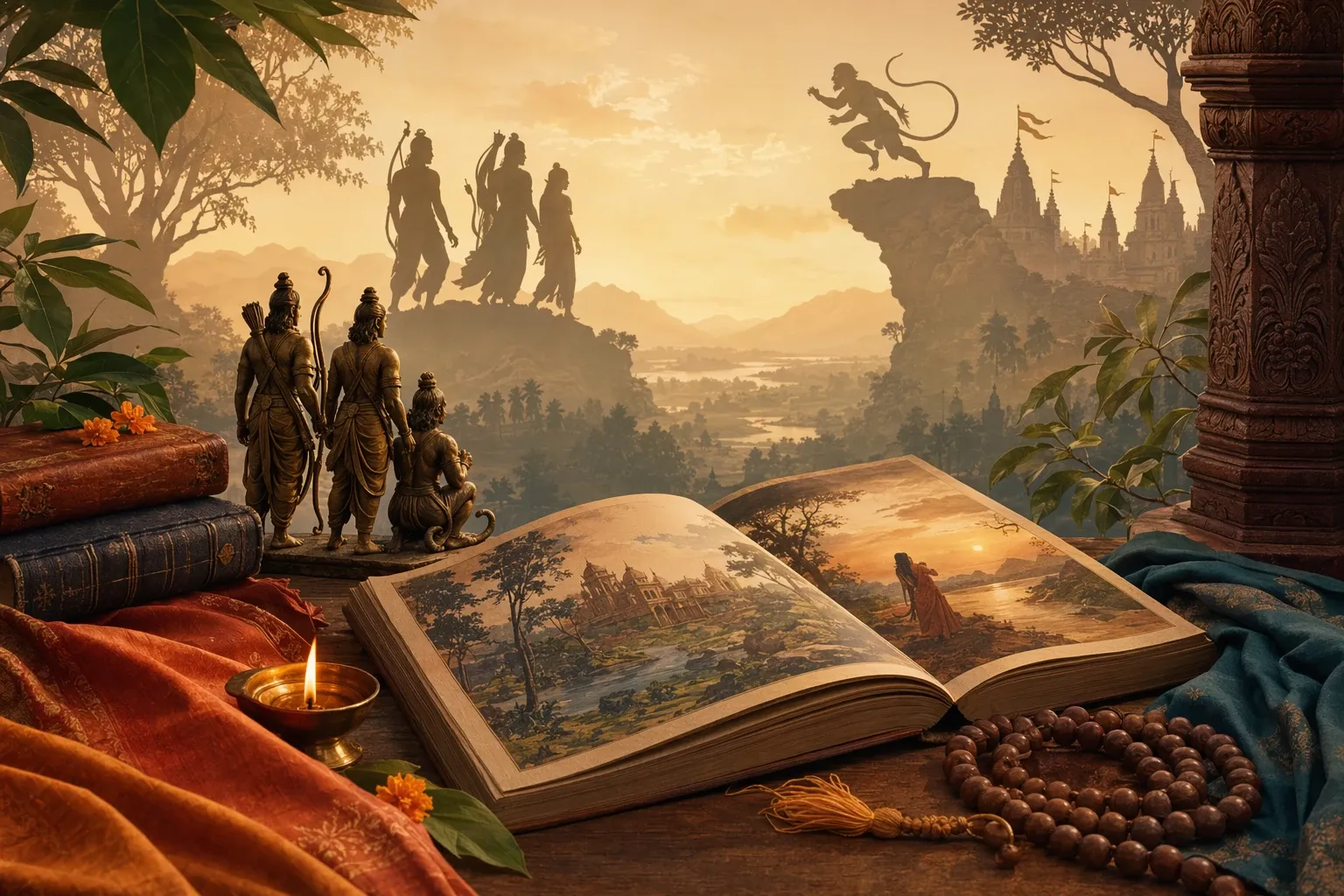
The Ramayana is one of India’s most loved stories, but calling it only a “story” feels too small. For many people, it is sacred memory, family teaching, festival emotion, temple culture, poetry, theatre, music, and a guide to dharma. It has shaped how generations think about courage, loyalty, love, duty, and the cost of difficult choices.
For a beginner, the Ramayana can be understood as the journey of Rama, Sita, Lakshmana, Hanuman, and many others through a world where personal feelings and moral responsibility often meet. It is not just about winning a war. It is about how a person tries to remain truthful when life becomes painfully complicated.
What does Ramayana mean?
The word Ramayana is commonly understood as “the journey of Rama.” This is not only a physical journey from Ayodhya to the forest and Lanka. It is also a journey through dharma: how to act when power, family, grief, temptation, friendship, and duty pull in different directions.
In tradition, the Ramayana is an Itihasa, a sacred epic connected with remembered history and moral meaning. The most famous Sanskrit version is attributed to Maharishi Valmiki, who is honoured as Adi Kavi, the first poet. Over time, the Ramayana has also been retold in many Indian languages, including Awadhi, Tamil, Telugu, Bengali, Malayalam, Kannada, Odia, Assamese, and others.
The main story in simple words
Rama, prince of Ayodhya, is loved by the people and chosen for the throne. But because of a promise made by his father Dasharatha, Rama accepts exile for fourteen years. Sita chooses to go with him, and Lakshmana follows out of love and loyalty. This first movement already shows a central theme: dharma may demand sacrifice, even when the heart is hurt.
In the forest, Sita is abducted by Ravana, the powerful king of Lanka. Rama and Lakshmana search for her and meet Hanuman and Sugriva. Hanuman’s devotion becomes one of the brightest lights of the epic. With the help of the vanara army, Rama reaches Lanka, defeats Ravana, and returns to Ayodhya, where he is crowned king.
Tradition, interpretation, and historical context
In devotional tradition, Rama is worshipped as an avatar of Vishnu and an ideal of righteous conduct. Sita is honoured for strength, purity, endurance, and dignity. Hanuman is loved as the perfect devotee, full of strength and humility. The Ramayana is read, sung, enacted, and remembered during festivals such as Ram Navami and through performances like Ramlila.
In interpretation, readers should be careful with easy one-line judgments. Characters in the Ramayana often face painful duties, and different traditions have reflected on those moments in different ways. Some episodes invite devotion, some invite ethical debate, and some ask us to sit with discomfort instead of rushing to a simple answer.
Historically, the Ramayana has lived through many versions and retellings. Valmiki’s Sanskrit Ramayana is central, but regional Ramayanas helped communities bring the story into their own language, poetry, and local imagination. This is why the Ramayana feels both ancient and close to home.
Why young readers still connect with it
The Ramayana speaks to problems that are still real: family expectations, peer pressure, promises, anger, ego, loyalty, friendship, and the search for purpose. Ravana is not only an outside enemy; he also represents the danger of brilliance without humility. Hanuman shows that strength becomes beautiful when it serves devotion and good work.
Rama’s life shows that being good is not the same as having an easy life. Sita’s journey shows that quiet strength can be deeper than loud power. Lakshmana shows loyal service, Bharata shows self-control, and Hanuman shows courage with surrender.
How to begin reading the Ramayana
Start with a simple retelling, then move toward a fuller translation when you are ready. If you read a regional version, respect it as part of a living tradition, not as a “lesser copy.” Ask what each version highlights: devotion, poetry, ethics, politics, family, or bhakti.
Do not treat the Ramayana as a random collection of moral quotes. Its power comes from the whole journey. Read patiently. Notice how choices create consequences. Notice how dharma is sometimes clear and sometimes difficult.
The takeaway
The Ramayana remains alive because it gives people a language for goodness under pressure. It does not pretend that life is simple. It asks a harder question: when life is not simple, what kind of person will you become?
A gentle way to remember the Ramayana
If you are reading the Ramayana for the first time, remember three relationships: Rama and dharma, Sita and dignity, Hanuman and devotion. These are not the only meanings of the epic, but they give beginners a strong starting point. Rama shows the weight of responsibility. Sita shows strength that is not dependent on noise. Hanuman shows what happens when courage serves love.
Also remember that the Ramayana is not meant to be consumed only as plot. Its power grows when you ask what each moment teaches about speech, promises, anger, loyalty, and self-control. The story becomes personal when it makes you examine your own choices.
What to keep in mind
One beginner mistake is trying to master everything in one sitting. Indian knowledge traditions are layered, and the first reading is only the first friendship. Learn the basic meaning, notice the main values, and then return with better questions. That slow return is how understanding becomes mature.
It also helps to separate respect from blind acceptance. Respect means we do not mock a living tradition or flatten it into memes. Careful thinking means we ask about context, language, community, and interpretation. When both are present, learning becomes honest and warm.