
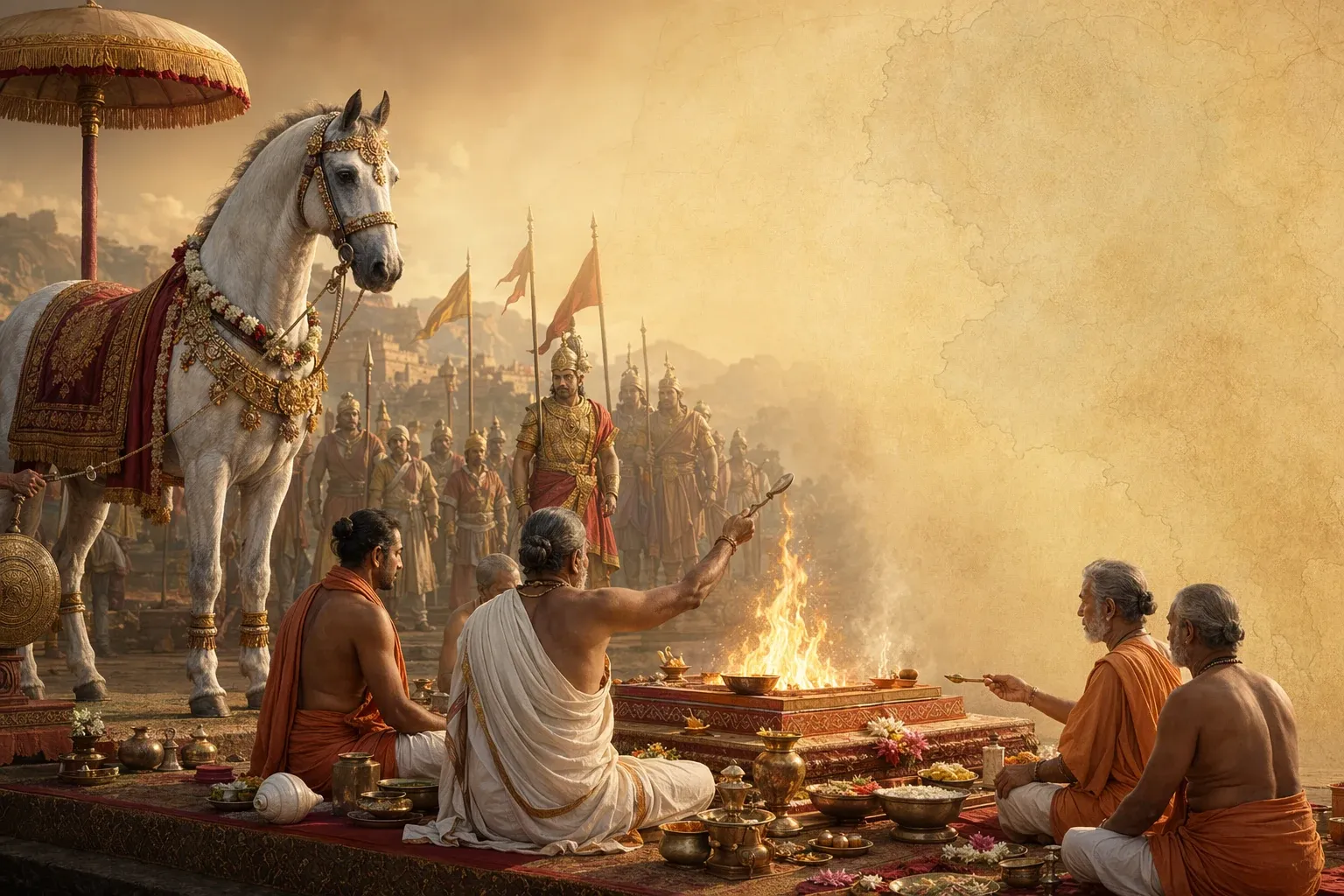
Ashwamedha Yagna is one of the most discussed royal rituals in Hindu texts because it combines power, symbolism, dharma, and difficult historical questions. For a beginner, the safest starting point is simple: Ashwamedha was not an ordinary household practice. It belonged to the world of ancient kingship and appears in epic and textual memory as a way to express sovereignty.
That does not mean modern readers should copy it, romanticize it, or ignore its uncomfortable parts. It means we should understand what the ritual represented in its own setting, why stories mention it, and what ethical distance is needed today. If you are new to yajna as a broader idea, start with our Yajna meaning guide before reading Ashwamedha as a special royal case.
Simple meaning of Ashwamedha
The word is usually explained from ashwa, meaning horse, and medha, connected with sacrifice or offering. In simple terms, Ashwamedha Yagna was a royal horse ritual associated with a king’s authority. A consecrated horse was allowed to roam, and the king’s power was symbolically tested by whether other rulers challenged or accepted that movement.
This is why Ashwamedha is not just a ritual topic. It is also a political topic. In the ancient imagination, the horse became a sign of royal reach, military confidence, and public recognition. The ritual setting, priests, offerings, mantras, gifts, and assemblies all reflected a world where kingship and sacred order were closely connected.
Why kings performed it in ancient stories
In many traditions, a king was expected to protect people, uphold order, support learning, honour sacred duties, and use power responsibly. A major royal yajna could show that the king had wealth, support, discipline, and legitimacy. It was also a public event: people saw gifts, alliances, ritual specialists, and political relationships gathered around the ruler.
This matters because Ashwamedha should not be reduced to a “mysterious ritual” headline. Its meaning sits at the meeting point of authority and responsibility. A king who performed it was not only claiming power; he was also being placed inside a moral language where power was supposed to serve order, generosity, and protection. Whether rulers actually lived up to that ideal is a different question, and the epics often invite that kind of reflection.
Ashwamedha in the Ramayana and Mahabharata
Many readers know Ashwamedha through the Ramayana and Mahabharata world. The Ramayana tradition connects it with King Dasharatha before the birth of Rama, and later with Rama’s reign in some tellings. The Mahabharata tradition remembers Yudhishthira’s Ashwamedha after the war, where victory is mixed with grief, responsibility, and the need to restore moral order.
These stories are not simple celebrations of power. In the Ramayana beginner guide, royal duty is constantly tested by family, promise, suffering, and public responsibility. In the Mahabharata beginner guide, kingship is even more complex because triumph after war does not erase loss. Ashwamedha appears in that wider emotional and ethical landscape.
Was Ashwamedha only symbolic?
Beginners often ask whether Ashwamedha was symbolic or literal. A careful answer avoids extremes. The texts do describe concrete ritual actions, including elements that modern readers may find disturbing. At the same time, the ritual also carried symbolic meanings: sovereignty, abundance, cosmic order, sacrifice, and the public burden of kingship.
Because of that, it is best to study Ashwamedha as a historical and textual subject, not as a practical guide. The tradition can be discussed respectfully while still recognizing that modern ethics, law, social life, and devotional practice are very different. Respect does not require pretending that every ancient detail is meant for today.
Why it is not a modern practice
Ashwamedha is not a modern personal ritual for ordinary devotees. It belonged to royal institutions, large ritual communities, and a political world that no longer exists in the same form. Today, Hindu practice is more commonly expressed through puja, japa, vrata, temple worship, study, seva, family rites, and smaller yajna or havan traditions performed with proper guidance.
This distinction is important for cultural safety. A young reader may see dramatic online claims and think Ashwamedha is something to recreate. It is not. The better approach is to learn what it meant, understand why texts preserved its memory, and take from it the larger questions: What makes power legitimate? What responsibilities come with leadership? Can outward ritual have meaning without inner dharma?
Common misunderstandings
One misunderstanding is that Ashwamedha was a simple “horse race” or military parade. It was more complex than that. Another misunderstanding is that the ritual should be treated only as superstition. That also misses how ancient societies used ritual language to express law, authority, economics, theology, and public identity.
A third misunderstanding is that every story mention should be read as a direct instruction. Hindu texts contain history-like memory, poetry, law, devotion, debate, warning, and symbolism. Good reading asks what kind of text we are looking at and what question it is answering.
What beginners should remember
Ashwamedha Yagna is best understood as an ancient royal ritual connected with sovereignty, not as a modern practice. It appears in epic memory because kingship was not only political; it was also moral and sacred. The difficult parts should be handled honestly, without sensationalism and without blind imitation.
For today’s reader, the lasting value is not in copying a royal rite. It is in understanding how Indian traditions thought about power, duty, sacrifice, public responsibility, and the danger of ritual without humility. That is a more mature way to read Ashwamedha: with respect, context, and clear ethical distance.