
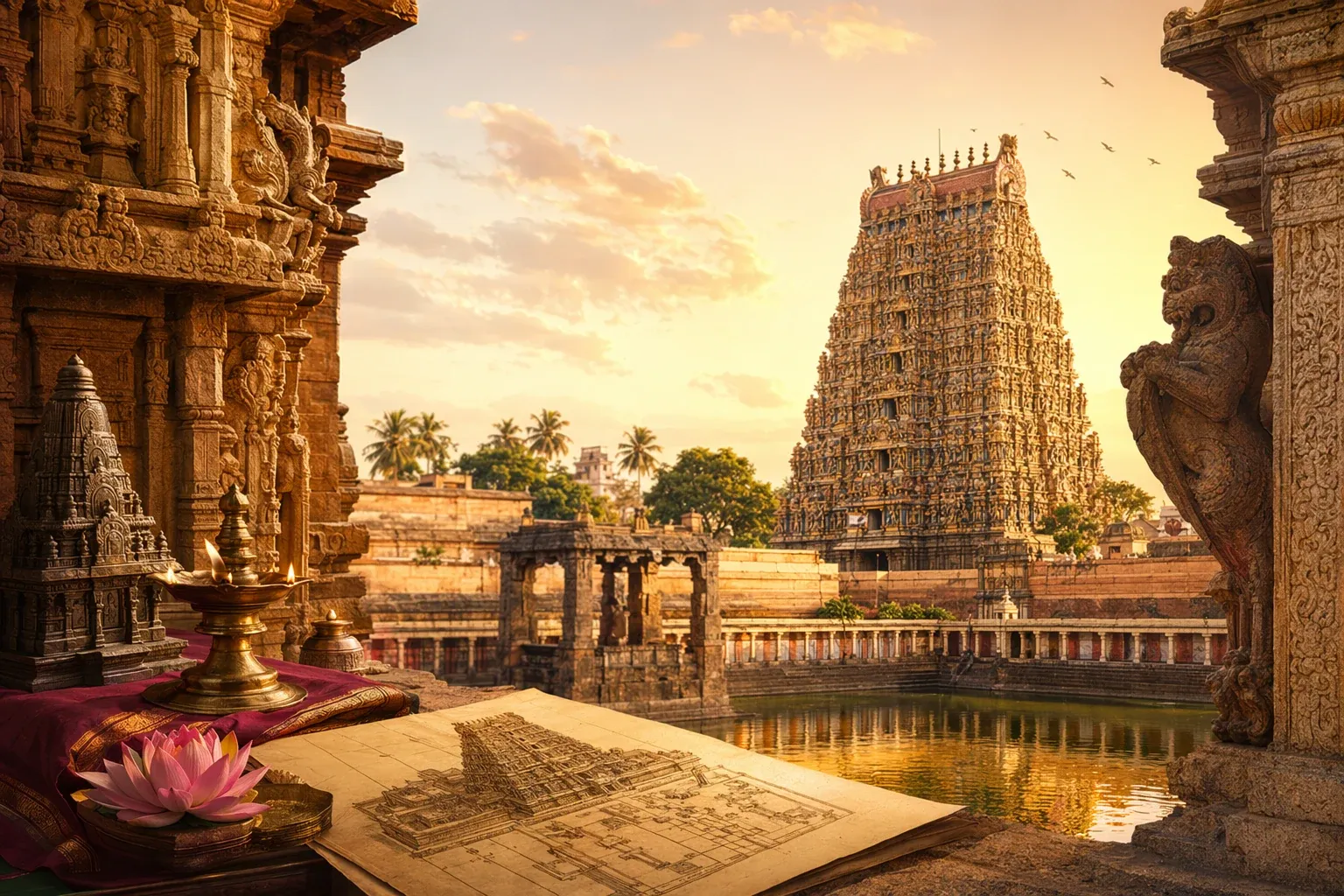
Walk into a large South Indian temple and the first thing you notice may not be the sanctum at all. It may be a towering gateway, crowded with gods, guardians, dancers, animals, colours and stories. Inside, courtyards open one after another. A tank may sit to one side. Pillared halls give shade. The main shrine rises in a stepped pyramid above the deity. This is the world most people mean when they speak of Dravidian temple architecture.
Dravidian temple architecture is the southern family of Indian temple design, especially visible in Tamil Nadu, Karnataka, Andhra Pradesh, Telangana and parts of Kerala. It developed over many centuries, so it is better to see it as a living tradition with regional flavours rather than one fixed formula. The Pallavas, Cholas, Pandyas, Hoysalas, Kakatiyas, Vijayanagara rulers and Nayakas all shaped it in different ways.
The southern temple as a sacred enclosure
A classic Dravidian temple usually feels like an enclosed sacred world. The shrine is not standing alone in the open. It is protected by walls, entered through gateways, and surrounded by spaces for worship, festivals, processions and community life. In big temple towns such as Srirangam, Madurai and Chidambaram, the temple complex can feel almost like a city arranged around the deity.
The heart of the temple is still the garbhagriha, the inner sanctum where the main murti is housed. But in many South Indian temples, the journey toward that heart is stretched out through courtyards and mandapas. This creates a strong feeling of movement: from the busy street, through the gopuram, across open courts, past pillars and shrines, toward a quieter centre.
This is why Dravidian architecture is not only about height or decoration. It is about controlled approach. The devotee does not simply “see a building”; the devotee enters a sacred geography. Festivals, circumambulation, music, lamps, temple chariots and daily puja all use the architectural layout.
Vimana and gopuram are not the same thing
Two words cause the most confusion: vimana and gopuram. The vimana is the tower directly above the sanctum. In Dravidian temples it is usually tiered and pyramidal, rising in storeys that become smaller as they go up. The gopuram is the gateway tower at the entrance to the temple enclosure.
In early and medieval examples, the vimana could be the main visual focus. The Brihadeshwara Temple at Thanjavur, built under the Chola king Rajaraja I in the early 11th century, is the famous example: its massive stone vimana dominates the complex. Later, especially in large temple cities of the Pandya, Vijayanagara and Nayaka periods, gopurams often became taller and more dramatic than the central shrine tower. Madurai’s Meenakshi temple is a familiar example of the gateway becoming the public face of the temple.
So a simple way to remember it is this: the vimana marks the sacred centre; the gopuram marks the grand entrance. Both are important, but they do different jobs.
Important parts of a Dravidian temple
Most Dravidian temples include a garbhagriha, an antarala or connecting space in some layouts, mandapas or pillared halls, a circumambulatory path, a prakara or enclosure wall, gopurams, and often subsidiary shrines. Many also have a temple tank, known in different regions as pushkarini, kalyani or by local names. The tank is not just decorative; water is connected with ritual purity, festivals and the temple’s relationship with the surrounding settlement.
The mandapa is especially important in South Indian temples. Some mandapas are small halls before the sanctum; others are grand pillared spaces used for dance, music, recitation, wedding rituals of deities, festival images and public gatherings. In Vijayanagara and Nayaka temples, pillared halls can become astonishing sculptural spaces, with yali pillars, horse riders and narrative carvings.
Dvarapalas, the guardian figures near the sanctum or entrances, are another recognisable feature. They remind visitors that the innermost area is not an ordinary room. It is a charged sacred space, approached with respect.
Dynasties that shaped the style
The Pallavas gave South Indian temple architecture some of its early stone landmarks. Mahabalipuram, with its rock-cut caves, monolithic rathas and the Shore Temple, shows experimentation in form and material. These monuments help us see a transition from rock-cut ideas to structural stone temples.
The Cholas took the Dravidian temple to a new scale. Thanjavur’s Brihadeshwara, Gangaikonda Cholapuram and Darasuram’s Airavatesvara temple show powerful stone construction, carefully planned spaces and refined sculpture. Chola temples also connect architecture with bronze image worship, inscriptions, royal patronage and temple administration.
The Pandyas, Vijayanagara rulers and Nayakas expanded the public and urban side of temples. Tall gopurams, larger enclosures, festival streets and elaborate halls became more prominent. The temple was not only a shrine; it was also an economic, artistic and social institution.
Regional variety inside the southern tradition
It is tempting to say “Dravidian equals Tamil Nadu,” but that is too narrow. Karnataka has early Chalukya experiments at Badami, Aihole and Pattadakal, and later Hoysala temples at Belur, Halebid and Somnathpura with star-shaped plans and dense carving. Telangana’s Ramappa temple shows the Kakatiya world with elegant bracket figures and distinctive materials. Kerala temples often adapt to heavy rainfall with sloping roofs and timber traditions while still sharing southern sacred planning ideas.
This variety matters because Indian temple styles do not behave like school uniforms. Geography, stone type, climate, patronage, ritual practice and local artists all affect the final building. A granite Chola temple, a soapstone Hoysala temple and a later gopuram-filled temple city can all belong to the broad southern conversation, yet feel very different.
What makes the design feel sacred?
Traditional temple design often connects the shrine with cosmic order. The sanctum is the concentrated centre. The tower rises above it like a symbolic mountain. The plan may use geometry, direction and proportional rules. Sculpture covers the outer walls with deities, guardians, dancers, mythical beings and everyday details, reminding the visitor that the sacred and the worldly are not totally separate.
At the same time, we should separate faith meaning from historical description. Devotees may experience the temple as a living house of the deity. Art historians may describe plan, patronage, dynastic style and material. Both approaches can be valuable, as long as we do not reduce one into the other.
How to recognise Dravidian architecture quickly
Look for an enclosed complex, gateway towers, a pyramidal vimana over the sanctum, mandapas, temple tanks and multiple shrines. If the gateway tower dominates the skyline, ask whether it belongs to a later expansion. If the sanctum tower dominates, the temple may represent an earlier or royal phase, such as the Chola period.
Also notice how the temple relates to the town. In many South Indian places, streets, markets and festivals are organised around the temple. The architecture continues beyond stone walls into processional routes, music traditions, food offerings and seasonal celebrations.
Questions people often ask
What is the main feature of Dravidian temple architecture?
The most recognisable features are the pyramidal vimana over the sanctum, the use of enclosure walls, grand gopurams in many later temples, pillared mandapas and a strong temple-complex layout.
Which temples are good examples?
Mahabalipuram’s Shore Temple, Brihadeshwara at Thanjavur, Gangaikonda Cholapuram, Airavatesvara at Darasuram, Meenakshi at Madurai, Srirangam and many Hoysala and Kakatiya temples help show the range of southern temple architecture.
Dravidian temple architecture is best understood as a long conversation between sacred imagination and skilled construction. Its towers, gateways and halls are beautiful, but their deeper power lies in how they guide people from the ordinary street into a carefully shaped world of darshan, memory and devotion.