
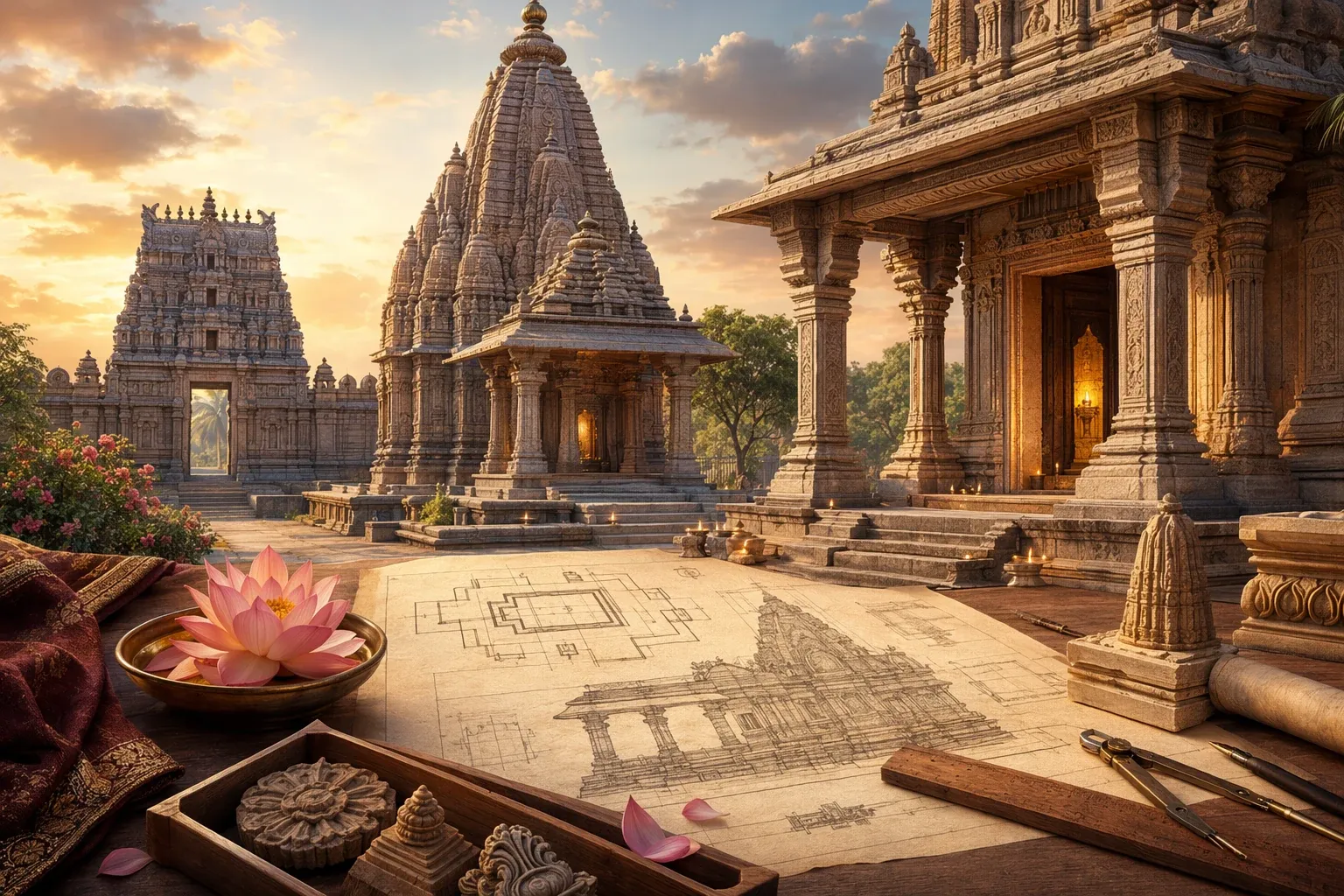
A Hindu temple can feel overwhelming at first. There may be a dark inner room, a tall tower, carved walls, pillared halls, bells, lamps, gateways, a flagstaff, a sacred tree, a tank and many smaller shrines. Once you learn the main parts, the whole place begins to make sense. You stop seeing only “beautiful old stone” and start seeing a carefully arranged sacred journey.
Temple architecture varies widely across India. A temple in Khajuraho, a Chola temple in Thanjavur, a wooden-roofed Kerala temple and a Hoysala temple in Belur will not look the same. Still, many Hindu temples share a basic vocabulary. These parts may change in name, size or shape, but their purpose is often connected.
Garbhagriha: the sacred centre
The garbhagriha is the innermost sanctum. The Sanskrit word is often translated as “womb chamber.” It is the most sacred room of the temple because it houses the main murti or symbol of the deity. In many temples, this space is small, plain and dim compared with the richly carved outside.
That contrast is meaningful. The outer temple may be full of movement, stories and decoration, while the sanctum is concentrated and quiet. The devotee’s attention moves toward darshan, the sacred seeing of the deity. In a Shiva temple, the sanctum may hold a linga; in a Vishnu temple, an image of Vishnu or one of his forms; in a Devi temple, a form of the Goddess.
From an art-history point of view, the garbhagriha is also the anchor around which the rest of the temple is planned. The tower usually rises above it, and the main axis of the temple leads toward it.
Mandapa: the hall for gathering and worship
A mandapa is a hall, often pillared, placed before the sanctum or within the temple complex. Some mandapas are simple porches; others are large spaces for devotees, rituals, music, dance, recitation, festivals or wedding ceremonies of the deities.
In many temples, you pass through one or more mandapas before reaching the sanctum. The ardha-mandapa may be a smaller entrance hall, while a maha-mandapa is a larger hall. In South Indian temples, mandapas can become grand architectural statements, with carved pillars showing yali figures, dancers, warriors, animals and episodes from sacred stories.
The mandapa reminds us that a temple is not only a private meditation space. It is also a community space where people gather, learn, sing, listen and celebrate.
Antarala: the connecting space
The antarala is the vestibule or small connecting chamber between the sanctum and the mandapa. Not every temple makes this part obvious, but in many plans it acts like a transition zone. Architecturally, it links the public hall and the inner sacred chamber.
You can think of it as a pause before the centre. The devotee has moved from the outside world into the hall, and from the hall toward the deity. The antarala helps mark that shift from gathering space to sanctum space.
Shikhara and vimana: the tower above the sanctum
The tower above the sanctum is one of the most visible parts of a temple. In North Indian or Nagara temples, it is commonly called the shikhara. It often rises in a curving form above the garbhagriha. In South Indian or Dravidian temples, the tower over the sanctum is usually called the vimana and often has a tiered pyramidal form.
These words are sometimes used loosely, so context matters. The important point is that the tower marks the sacred centre from the outside. It announces: the deity is here. In many traditions, the rising tower also suggests a mountain, especially the cosmic mountain idea connected with sacred space.
Examples make this clearer. The Kandariya Mahadeva temple at Khajuraho has a dramatic Nagara shikhara with clustered smaller spires. Brihadeshwara at Thanjavur has a powerful Dravidian vimana rising in stone above the Shiva sanctum.
Gopuram: the gateway tower
A gopuram is a monumental gateway tower, especially associated with South Indian temple complexes. It stands at the entrance to an enclosure, not directly over the sanctum. In many later South Indian temples, the gopuram may be taller and more visually dominant than the central vimana.
This is why visitors sometimes confuse gopuram and vimana. The easiest difference is location: the gopuram is the gateway; the vimana is above the sanctum. Madurai’s Meenakshi temple and Srirangam are famous for grand gateway towers, while Thanjavur’s Brihadeshwara is famous for its central vimana.
The gopuram has a public role. It can be seen from streets and markets, guiding devotees toward the temple. It also carries sculpture, colour and mythic imagery, turning the entrance itself into a sacred threshold.
Pradakshina path: the path around the shrine
Pradakshina means circumambulation, usually moving clockwise around the deity or sacred centre. Many temples provide a path around the sanctum, either inside the temple structure or outside around the shrine. This path is called the pradakshina patha or circumambulatory passage.
The movement is not random walking. It is a devotional act that keeps the sacred centre to one’s right. In some temples, the outer walls become part of this experience, because carvings, deities and narrative panels are encountered while walking around.
Jagati, adhisthana and the raised base
Many temples stand on a raised platform. In some traditions this platform is called a jagati, while the moulded base of the temple may be described as the adhisthana. A raised base protects the structure, gives it dignity and creates a clear separation from ordinary ground.
In Hoysala temples such as Belur and Somnathpura, the platform also helps devotees walk around the temple and view the detailed outer carvings. In Nagara temples, a high platform can make the shrine feel more elevated and visible.
Amalaka, kalasha, dhvaja and vahana
Some smaller parts are easy to miss but important. In many North Indian temples, the amalaka is a ribbed stone element near the top of the shikhara, and the kalasha is the finial placed above. These elements complete the upward movement of the tower.
The dhvaja-stambha, or flagstaff, is often placed on the temple axis, especially in South Indian temples. It marks honour and ritual presence. The vahana, or vehicle of the deity, may also be placed facing the sanctum: Nandi before Shiva, Garuda before Vishnu, the lion before many Devi shrines, and so on.
These parts help devotees recognise the deity and the ritual orientation of the temple even before entering the sanctum.
Sculpture, walls and stories
Temple walls are not empty boundaries. They may hold images of deities, guardians, river goddesses, dikpalas, dancers, musicians, animals, plants and scenes from the Ramayana, Mahabharata or Puranas. The exact programme depends on region, period, sect and patronage.
For example, Khajuraho temples are famous for sculptural richness on their outer walls. Odisha temples such as Konark show powerful wall divisions and narrative carving. Chola temples use inscriptions and sculpture to connect worship, kingship and community. Hoysala temples turn the whole exterior into a layered carved surface.
Temple tank, sacred tree and outer spaces
Many temples include features beyond the main shrine: a tank, sacred tree, kitchen, processional route, smaller shrines, monastery spaces or festival storage areas. These are not “extra decoration.” They show that the temple is part of lived religious culture.
A temple tank may be used in ritual contexts and festivals. A sacred tree may connect local tradition with broader Hindu worship. Outer streets may become part of processions when festival images are taken out for the community.
Questions people often ask
What is the most important part of a Hindu temple?
The garbhagriha is the central sacred chamber because it houses the main deity. Architecturally and ritually, the rest of the temple is arranged around this centre.
What is the difference between shikhara and gopuram?
The shikhara is the tower above the sanctum in many North Indian temples. A gopuram is a gateway tower, especially common in South Indian temple complexes. One marks the shrine; the other marks the entrance.
Why do temples have so many sculptures?
Sculptures can teach stories, honour deities, mark directions, protect sacred space and express beauty. They also show the artistic world of the community that built and used the temple.
Learning the parts of a Hindu temple does not reduce its mystery. It deepens it. Once you know the sanctum, mandapa, tower, gateway and path, you can read the temple as a journey: from the outside world, through art and movement, toward a sacred centre.