
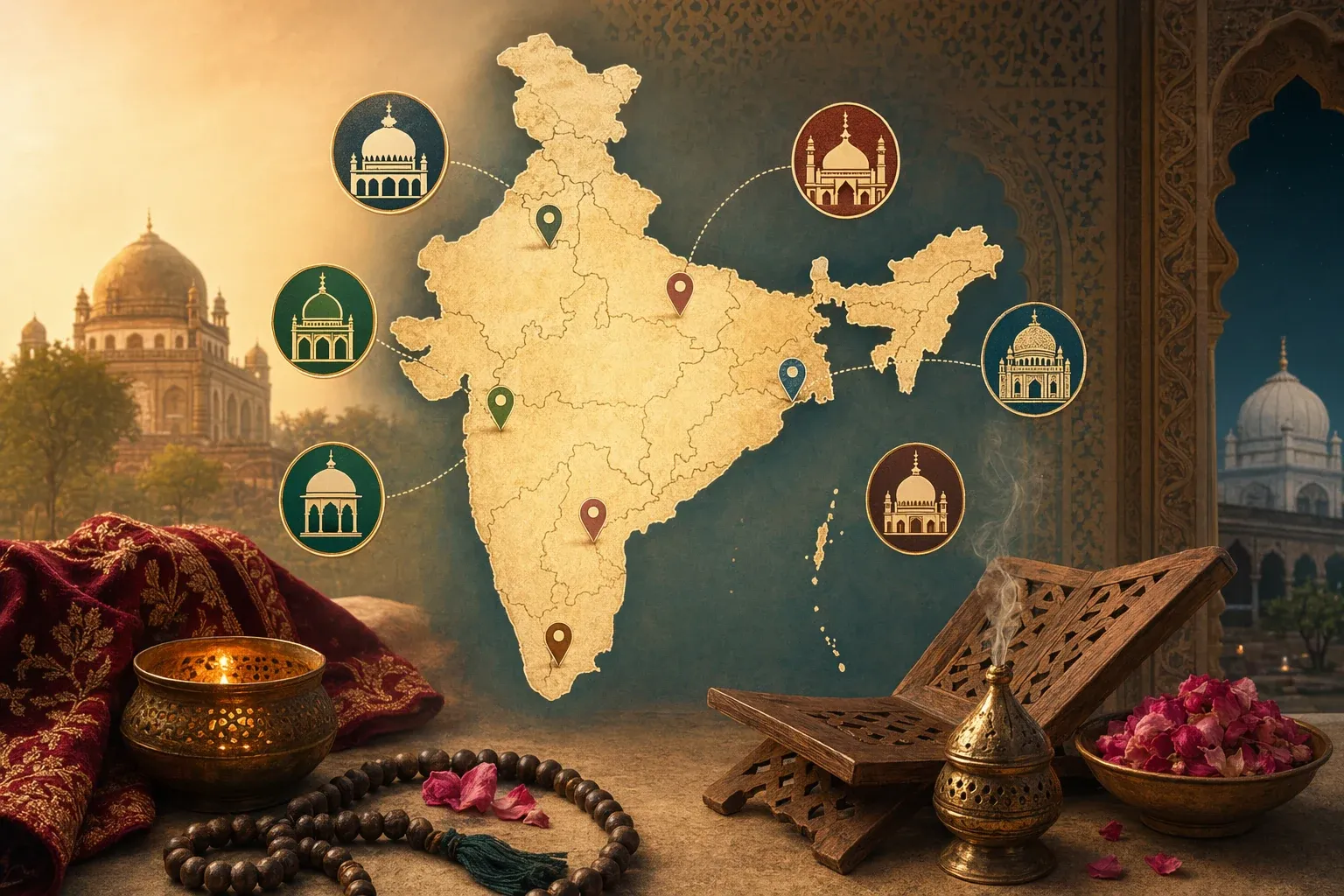
Sufi orders in India are spiritual lineages within Islamic life. They are often called silsilas, a word that suggests a chain of teachers and disciples. For a beginner, this idea is very helpful: Sufism is not only a mood of poetry or music. It is also a lived path passed through teachers, practices, books, gatherings, and communities.
India’s Sufi history is especially associated with four major lineages: Chishti, Suhrawardi, Qadiri, and Naqshbandi. These are not the only Sufi orders in the world, and different books may classify them in different ways. But these four names appear again and again in Indian history, shrine culture, devotional music, and discussions of Indo-Islamic spirituality.
What a Sufi order means
A Sufi order is not like a political party with one central office. It is closer to a spiritual family. A teacher guides disciples in remembrance of God, discipline, ethics, and inner refinement. Over time, students become teachers and carry the lineage to new places. That chain of transmission is the silsila.
Many orders share common concerns: dhikr, prayer, humility, service, learning, and the purification of the ego. Yet each order can develop its own temperament. Some are known for public hospitality, some for scholarly discipline, some for silent remembrance, and some for strong links with music and poetry. These descriptions are useful, but they should not be treated as rigid boxes. Real communities are always more varied than neat labels.
Chishti: the Indian household name
The Chishti order is probably the most familiar Sufi lineage in India. It is named after Chisht, a town in present-day Afghanistan, and is strongly associated in South Asia with Mu‘in al-Din Chishti of Ajmer. His shrine, Ajmer Sharif, became one of the best-known Sufi sites in the subcontinent.
The Chishti image in India is warm, open, and people-centred. Chishti saints are remembered for hospitality, distance from worldly power, care for the poor, and the use of devotional listening in some settings. Nizamuddin Auliya of Delhi is one of the great examples. His memory is connected with compassion, langar-like feeding traditions, qawwali gatherings, and a spiritual atmosphere that attracted people beyond narrow social lines.
Historically, we should be careful. Not every story about every saint can be read as a verified event. But the broad memory is clear: the Chishti order shaped Indian devotional culture through shrines, poetry, music, and the idea that love of God should make a person more generous toward creation.
Suhrawardi: scholarship and urban influence
The Suhrawardi order is another important Sufi lineage. It is linked with Abu al-Najib Suhrawardi and later figures who gave the order wider intellectual and institutional shape. In India, the Suhrawardis were especially visible in parts of the Delhi Sultanate world and in regions such as Multan and Sindh in the wider Indo-Islamic sphere.
Compared with the popular image of the Chishtis, the Suhrawardis are often described as more comfortable with organised institutions and learned public life. This does not mean they were less spiritual. It means their historical role sometimes appears closer to scholarship, law, administration, and urban networks. Such differences remind us that Sufism was never one single social style.
A beginner can remember the Suhrawardi order as a lineage that helped show how inner spirituality and formal learning could work together. Its Indian presence also shows that Sufi traditions were not only rural or shrine-based; they interacted with cities, scholars, and rulers too.
Qadiri: a wide and respected lineage
The Qadiri order traces its name to Abdul Qadir Jilani, the revered scholar and saint associated with Baghdad. Across the Muslim world, the Qadiri lineage became one of the most widespread Sufi orders. In India too, Qadiri influence appeared in many regions and among many communities.
The Qadiri path is often associated with devotion, remembrance, moral discipline, and reverence for its founding saint. Because it spread widely, its local forms can differ. In one place it may appear through a shrine and family lineage; in another, through teachings, gatherings, or devotional recitation. This flexibility helped it become part of many Muslim societies.
For Indian readers, the Qadiri order is a reminder that Sufism in India was connected to global Islamic networks. Saints, books, travellers, teachers, and ideas moved between Baghdad, Central Asia, Persia, Arabia, and South Asia. Indian Sufism has local colour, but it is not cut off from the wider Muslim world.
Naqshbandi: sober remembrance and discipline
The Naqshbandi order is named after Baha al-Din Naqshband, the 14th-century Central Asian master. In many descriptions, Naqshbandi practice is associated with sobriety, silent remembrance, close attention to Islamic law, and disciplined inner work. In India, the order became especially important in later medieval and early modern Indo-Islamic history.
One reason the Naqshbandis are interesting is their different public flavour. If the Chishti image often brings qawwali and open shrine culture to mind, the Naqshbandi image is quieter and stricter. Again, this is a broad contrast, not a rule for every person or place. But it helps beginners understand that Sufi orders can differ strongly in method while remaining part of Islamic spirituality.
The Naqshbandi presence also corrects a common misunderstanding: Sufism is not always anti-law, anti-scholarship, or purely emotional. Many Sufi teachers saw inner purification and outer religious discipline as partners, not enemies.
Which order is the oldest or most famous?
Questions like “Which is the oldest Sufi order?” or “Which is the most famous?” need careful answers. Sufi practices and teachers existed before orders became formal lineages. Different orders trace their spiritual chains in different ways, and “oldest” can mean founder, institutional form, or arrival in a region. So it is better to avoid a single dramatic claim.
In the Indian context, the Chishti order is often the most famous in public memory because of Ajmer Sharif, Nizamuddin, qawwali, and popular devotional culture. Globally, Qadiri, Naqshbandi, Chishti, Suhrawardi, Mevlevi, Tijani, Shadhili, and many other orders have been important in different regions. Fame depends on place and community.
How to read Sufi lineages without confusion
A useful way to read Sufi orders is to ask four questions. First, who is the founding or central figure? Second, where did the lineage become strong? Third, what practices or public style is it known for? Fourth, how did it interact with local society?
For Chishti, think Ajmer, Delhi, hospitality, and devotional listening. For Suhrawardi, think scholarship, institutions, and urban connections. For Qadiri, think Abdul Qadir Jilani and a wide transregional presence. For Naqshbandi, think Central Asian roots, silent remembrance, and disciplined sobriety.
These simple memory hooks are not replacements for deeper study, but they make the map easier. Once the map is clear, Indian Sufi history becomes less like a list of difficult names and more like a living network: teachers guiding students, students carrying teachings to new regions, and communities shaping spiritual memory through language, music, service, and devotion.
For a wider comparison with India’s devotional traditions, read Bhaktilipi’s guide to Bhakti Movement and Sufism.