
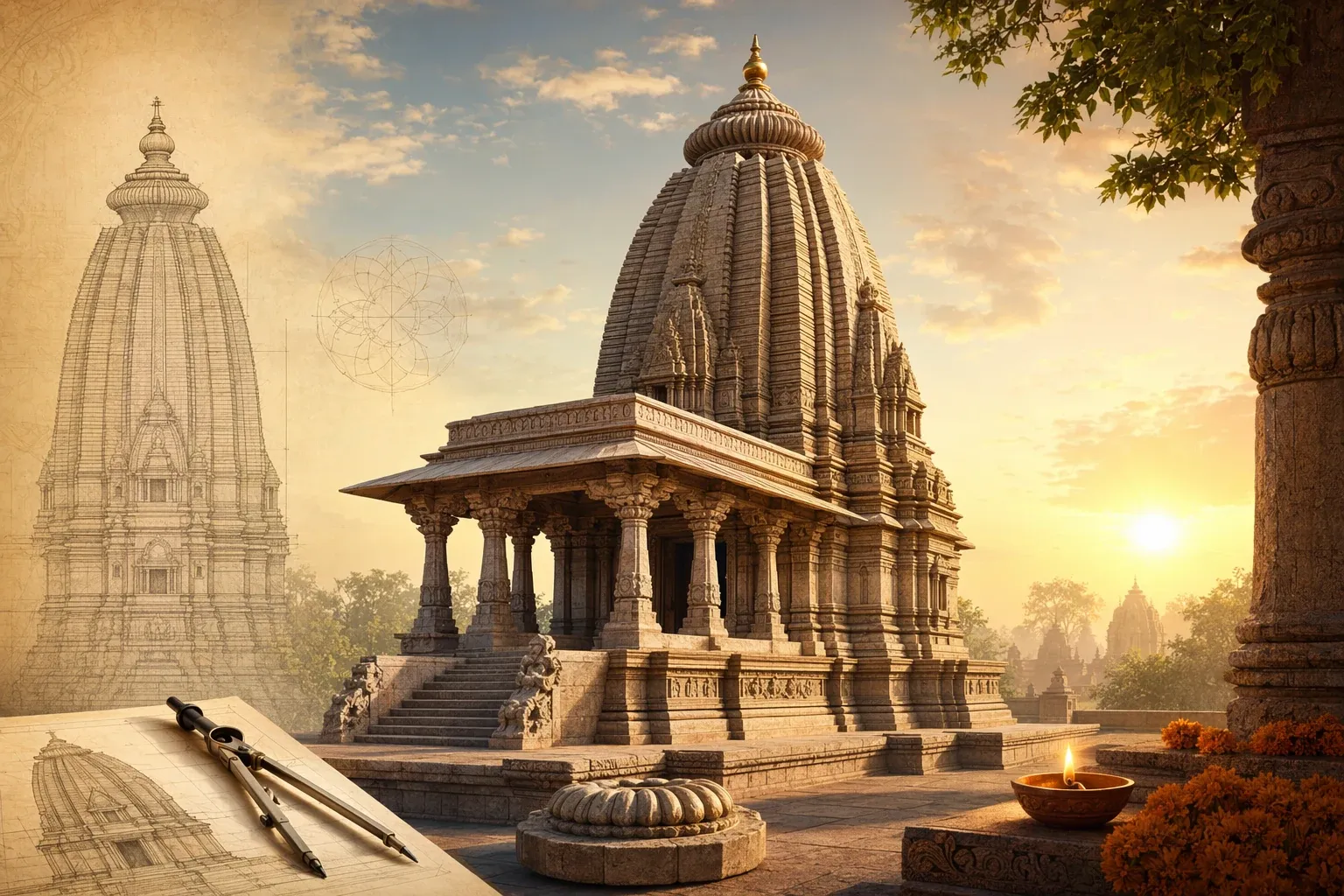
Nagara temple architecture is one of the major ways to understand Hindu temple design in northern India. If you have seen photographs of Khajuraho, Modhera, Odisha temples or many older temples in Rajasthan, Madhya Pradesh and Uttar Pradesh, you have already met parts of the Nagara world. Its most memorable feature is often the rising tower above the sanctum, called the shikhara.
But Nagara is not only a tower shape. It is a family of temple forms that grew across different regions and centuries. A temple in central India, a temple in Odisha and a temple in Gujarat may all be discussed under Nagara, yet each has its own local language. The best way to learn Nagara is to begin with its core parts and then notice regional variation.
The sanctum below the highest tower
In a Nagara temple, the main deity is placed in the garbhagriha, the sanctum. The highest shikhara usually rises directly above this sacred chamber. This relationship is important. The devotee approaches the deity at ground level, while the architecture lifts the sanctum upward in visual form. It creates a connection between inner stillness and vertical energy.
In front of the garbhagriha there may be an antarala, or vestibule, and one or more mandapas, pillared halls for gathering, ritual or movement. Early temples could be small and direct. Later temples became more complex, adding halls, porches, subsidiary shrines and richly carved exterior walls.
The shikhara and its crowning signs
The shikhara is the most recognisable Nagara feature. In the common latina or rekha-prasada form, it rises from a square base and curves inward as it reaches the top. The effect is mountain-like. Many Nagara temples also have an amalaka, a ribbed circular stone element near the top, and a kalasha, a pot-like finial above it.
Not every Nagara roof is the same. A phamsana roof is broader and lower, made of slabs rising toward a point. A valabhi form has a barrel-vaulted appearance and is often associated with rectangular plans. Some temples combine different roof forms for the sanctum and mandapa. So instead of memorising one silhouette, it is better to ask which part of the temple you are looking at.
Platforms, plans and movement
Many Nagara temples are built on a raised platform, often reached by steps. This platform separates sacred space from the surrounding ground and gives the temple a strong visual base. In some temples, devotees can walk around the sanctum on a circumambulatory path, while in others the movement is more limited.
A common plan is based on a square sanctum, but outer walls may project and recess rhythmically. These projections create surfaces for sculpture and also make the temple feel alive in light and shadow. As temples became more elaborate, the wall was no longer a flat boundary; it became a sculptural field.
Central India and the Khajuraho imagination
Central India gives some of the clearest Nagara examples. The Deogarh temple in Uttar Pradesh, often connected with the late Gupta period, is important for understanding early structural temple development. It shows how a sanctum, platform, subsidiary shrines and rising tower ideas were taking shape.
Khajuraho, built largely under the Chandela rulers, shows a later and more elaborate Nagara vision. The Lakshmana Temple, dedicated to Vishnu, stands on a high platform and uses a strong vertical composition. The Kandariya Mahadeva Temple is famous for the way many smaller spires gather around the central shikhara, almost like a mountain range. Its sculptures are not random decoration; they are part of a full sacred and artistic surface.
Odisha and the Kalinga expression
Odisha temples are often placed within the wider Nagara discussion, but they have such a distinct identity that they deserve special attention. In Odisha, the sanctum tower is commonly called a deul, while the assembly hall may be called a jagamohana. Temples at Bhubaneswar, Puri and Konark show a regional style with strong vertical forms, carved exteriors and carefully ordered temple parts.
The Sun Temple at Konark is one of the most famous examples. It is imagined as the cosmic chariot of Surya, the Sun god, with enormous carved wheels and horses. Historically, it belongs to the thirteenth century and reflects the ambition of the Eastern Ganga period. As architecture, it shows how Nagara-related forms could become deeply regional, symbolic and sculptural at once.
Western India and refined surface work
In western India, especially Gujarat and Rajasthan, Nagara temples developed with their own elegance. The Sun Temple at Modhera in Gujarat is a major example, connected with the Solanki period. Its relationship between shrine, assembly hall and stepped tank shows that temple architecture is not only about the tower. Water, ritual approach, sunlight, carving and geometry all matter.
Jain temples in western India, such as those at Mount Abu and Ranakpur, also show extraordinary carving traditions, though they belong to a different religious context. They remind us that Nagara-related architectural ideas were not limited to one community or one type of sacred practice.
Sculpture on Nagara temples
Nagara temple walls often carry deities, guardians, celestial beings, dancers, musicians, animals, floral patterns and narrative scenes. Doorframes may include river goddesses such as Ganga and Yamuna. Exterior walls may include images connected with the temple’s main deity, other gods, auspicious couples, mythical beings and everyday cultural imagination.
Some famous sites, especially Khajuraho, are popularly reduced to erotic sculpture. That is too narrow. Those images are part of a much larger sculptural world that includes devotion, music, movement, divine stories and cosmic themes. A respectful reading looks at placement, proportion, iconography and the overall temple programme.
Nagara is not one fixed formula
The biggest mistake is to imagine Nagara as a single design copied across north India. It is better seen as a broad family. Central Indian temples, Odisha temples, western Indian temples, Himalayan temples and Bengal traditions developed in different ways. Climate, available material, local craft, dynastic patronage and older sacred habits all shaped the final form.
Even the contrast with Dravida should be used carefully. It is true that Nagara temples often emphasise a shikhara over the sanctum, while Dravida temples often include enclosure walls, gopurams and stepped vimanas. But Indian architecture loves variation. The categories are learning tools, not prison walls.
How to recognise Nagara temple architecture
Begin with the sanctum and tower. If the main shrine sits below a curving shikhara, especially with an amalaka and kalasha, you may be looking at a Nagara temple. Check whether the temple stands on a raised platform. Look for mandapas, wall projections, sculptural bands and regional features. Then place it geographically: central India, Odisha, Gujarat, Rajasthan, the Himalayan belt or another region.
After that, connect the temple to history. Is it Gupta, Chandela, Solanki, Eastern Ganga, Paramara or another tradition? Is the material sandstone, granite, chlorite, marble, brick or wood? These questions make the temple more real. Nagara architecture is not only a style name; it is a long conversation between sacred presence, regional craft and historical memory.
What is Nagara temple architecture?
Nagara temple architecture is a broad north Indian family of Hindu temple design. It is often recognised by the garbhagriha below a rising shikhara, with forms such as latina or rekha-prasada, phamsana and valabhi, plus regional examples from central India, Odisha, Gujarat, Rajasthan and other areas.
Which temples show Nagara style?
Important Nagara-related examples include the Deogarh temple in Uttar Pradesh, Lakshmana and Kandariya Mahadeva temples at Khajuraho, the Sun Temple at Modhera, Odisha’s temples at Bhubaneswar and Konark, and many regional temples across north, central and western India.