
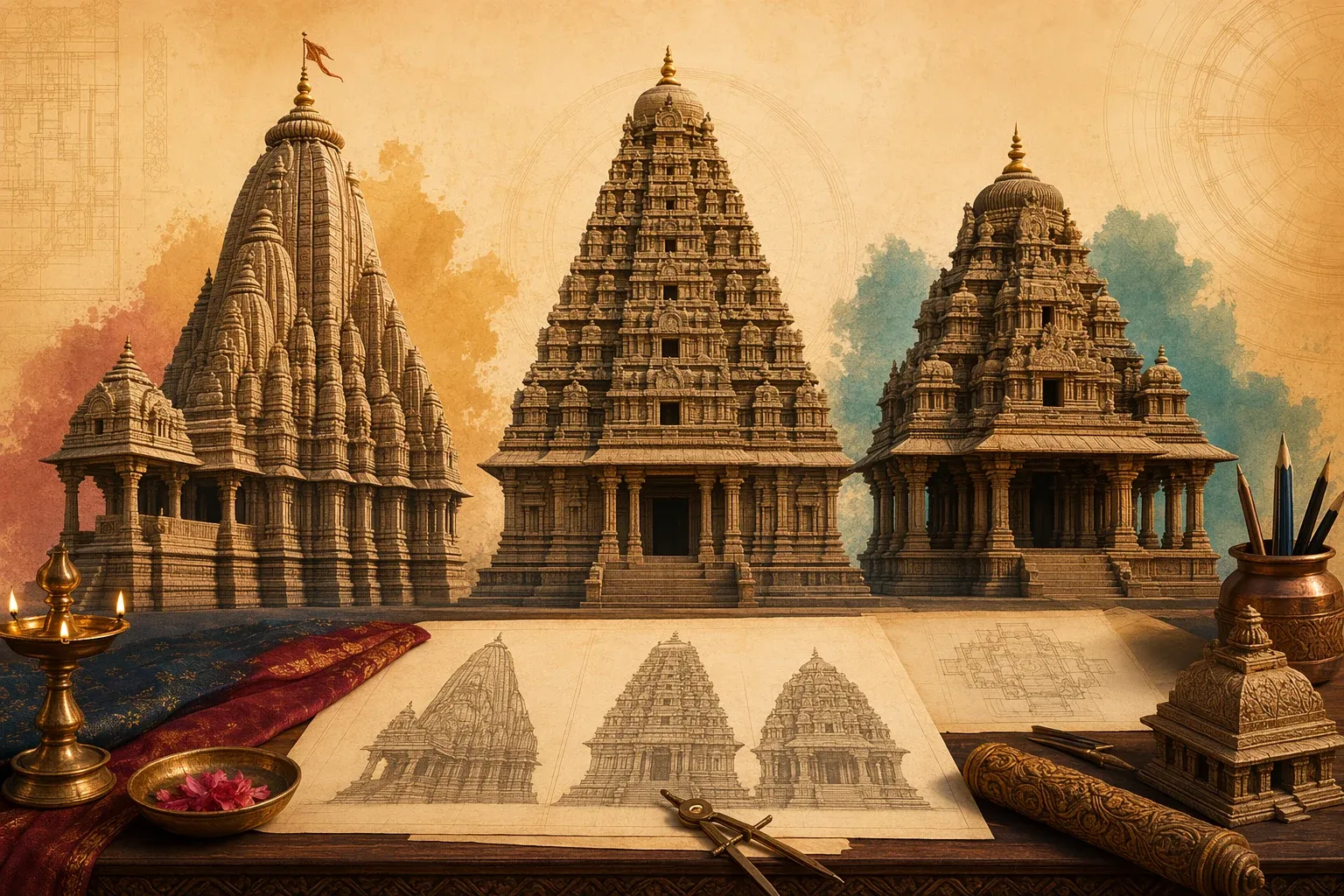
Nagara, Dravida and Vesara are three names every student meets while learning Indian temple architecture. They sound like exam terms, but they are actually a helpful first map. Nagara is usually linked with north Indian temple traditions, Dravida with south Indian temple traditions, and Vesara with creative temple forms of the Deccan, especially Karnataka and nearby regions.
The important word is “usually”. India’s temples were not built by a single committee following one textbook. They were built across centuries by local guilds, royal patrons, religious communities and regional craft traditions. So these three styles are best understood as broad families. They help us recognise patterns, but they should not stop us from noticing local detail.
Nagara: the northern temple family
Nagara temples are most commonly associated with northern India. A beginner’s first clue is the tower above the sanctum. In many Nagara temples, the shikhara rises in a curving form above the garbhagriha, the chamber of the main deity. The sanctum usually sits directly below the tallest tower, which gives the temple a strong vertical pull.
Many Nagara temples stand on a raised stone platform with steps. They often do not depend on huge enclosing walls or very tall entrance gateways in the way many later south Indian temples do. This is not a universal rule, because Odisha and other regions developed their own strong forms, but it is a useful comparison for beginners.
Nagara itself has subtypes. The latina or rekha-prasada form has a curving tower that rises from a square base. Phamsana forms are broader and lower, with roof slabs rising gently. Valabhi forms are rectangular with a vaulted appearance. In actual temple complexes, these forms may appear in different parts: for example, a sanctum tower may differ from a mandapa roof.
Nagara examples that make the style visible
Khajuraho in Madhya Pradesh is one of the best-known Nagara-related sites. The Lakshmana Temple, built in the Chandela period, stands on a high platform and uses a clustered vertical composition. The Kandariya Mahadeva Temple is often admired for the way smaller towers gather around the main shikhara, creating a mountain-like effect.
Odisha’s temple tradition is also connected to the Nagara family, but it has a powerful regional identity called Kalinga architecture. At Konark, the Sun Temple is famous for its chariot-like imagination, carved wheels and rich exterior sculpture. In Bhubaneswar and Puri, terms such as deul and jagamohana are part of the local vocabulary. This reminds us that “Nagara” is not one plain style; it contains regional languages of stone.
Dravida: the southern temple family
Dravida architecture is usually associated with south India. The most recognisable features include an enclosure wall, an entrance gateway called a gopuram, and a sanctum tower called a vimana. The vimana generally rises in a stepped, pyramidal manner rather than the curving shikhara common in many Nagara temples.
In many south Indian temples, especially later temple towns, the gopuram can become taller and more visually dominant than the older central shrine. A visitor may first notice the gateway tower from the street, then pass through enclosure after enclosure before reaching the sanctum. Temple tanks, pillared corridors, subsidiary shrines and festival routes are also important parts of the experience.
The Dravida tradition developed through many phases. The Pallavas created major works at places such as Mamallapuram. The Cholas expanded stone temple building with extraordinary confidence, especially at Thanjavur. Later Pandya, Vijayanagara and Nayaka traditions added vast corridors, gateways and temple-town scale. A south Indian temple can therefore be both a sacred centre and an urban landmark.
Dravida examples from Pallava to Chola worlds
The Shore Temple at Mamallapuram, connected with the Pallava period, is a useful early example for seeing structural stone temple design near the sea. It includes shrines connected with Shiva and Vishnu and shows how Pallava builders moved between rock-cut and structural forms.
Brihadeshwara Temple at Thanjavur, built under Rajaraja Chola in the early eleventh century, shows the Chola sense of scale. Its granite construction, tall vimana, inscriptions and sculptural programme make it more than an architectural monument. It also records royal devotion, administration, gifts and the cultural world of the Chola state.
Vesara: the Deccan’s creative middle zone
Vesara is usually discussed as a Deccan temple style, especially in Karnataka. It is often explained as a blend of Nagara and Dravida, and that is a decent starting point. But the word “blend” can make it sound passive, as if builders simply mixed two ready-made recipes. In reality, Deccan builders experimented boldly.
Chalukya temples at Aihole, Badami and Pattadakal show many experiments in plan, tower and hall design. Rashtrakuta builders created the Kailasanatha temple at Ellora, a massive rock-cut achievement with a Dravida-like composition carved from living rock. Hoysala temples at Belur, Halebid and Somnathpura are known for star-shaped plans, detailed sculptural surfaces and lathe-turned-looking pillars.
In Vesara-related temples, you may see northern and southern ideas, but you also see a strong local artistic personality. The Deccan was not just a bridge between north and south; it was a centre of innovation in its own right.
Simple recognition clues
If you are trying to identify a temple style, begin with the tower. A curving shikhara over the sanctum often points toward Nagara. A stepped pyramidal vimana, enclosure walls and gopuram often point toward Dravida. Star-shaped plans, experimental pillars and Deccan examples such as Chalukya or Hoysala sites may point toward Vesara.
Then check the region and period. A temple in Tamil Nadu from the Chola period will not be read the same way as a Chandela temple in Madhya Pradesh or a Hoysala temple in Karnataka. Material also matters: sandstone, granite and soapstone behave differently under the sculptor’s hand.
Where the three-style map can mislead
The three-style model is helpful, but it can become misleading if used too rigidly. Odisha temples are often discussed within Nagara, yet their Kalinga features are distinct. South Indian temples changed greatly over time; a Pallava monument and a later Madurai temple town do not create the same visual experience. Deccan temples may borrow, transform and invent at the same time.
Also, temples are religious spaces, not just style diagrams. A devotee may experience the same temple through darshan, festival, family memory and local legend. An art historian may focus on plan, material, patronage and date. Both views matter, as long as we do not confuse tradition, interpretation and historical evidence.
A better way to remember Nagara, Dravida and Vesara
Think of Nagara as the northern family where the shikhara above the sanctum often dominates. Think of Dravida as the southern family where enclosure, gopuram, vimana and temple-town scale become important. Think of Vesara as the Deccan family where builders creatively adapted and transformed ideas from multiple directions.
Once this map is clear, the real fun begins. You can look at Khajuraho, Konark, Mamallapuram, Thanjavur, Pattadakal, Belur and Halebid not as random famous names, but as different answers to one beautiful question: how can sacred presence be shaped through stone, space, sculpture and movement?
What are the three styles of temple architecture?
The three commonly taught styles of Indian temple architecture are Nagara, Dravida and Vesara. Nagara is linked mainly with northern India, Dravida with southern India, and Vesara with the Deccan, though each category contains many regional and historical variations.
How many types of temple architecture are found in India?
For beginners, Indian temple architecture is often grouped into three broad types: Nagara, Dravida and Vesara. But India also has many regional traditions, including Odisha/Kalinga, Hoysala, Bengal terracotta, Himalayan wooden forms and others, so the three names are only a starting framework.