
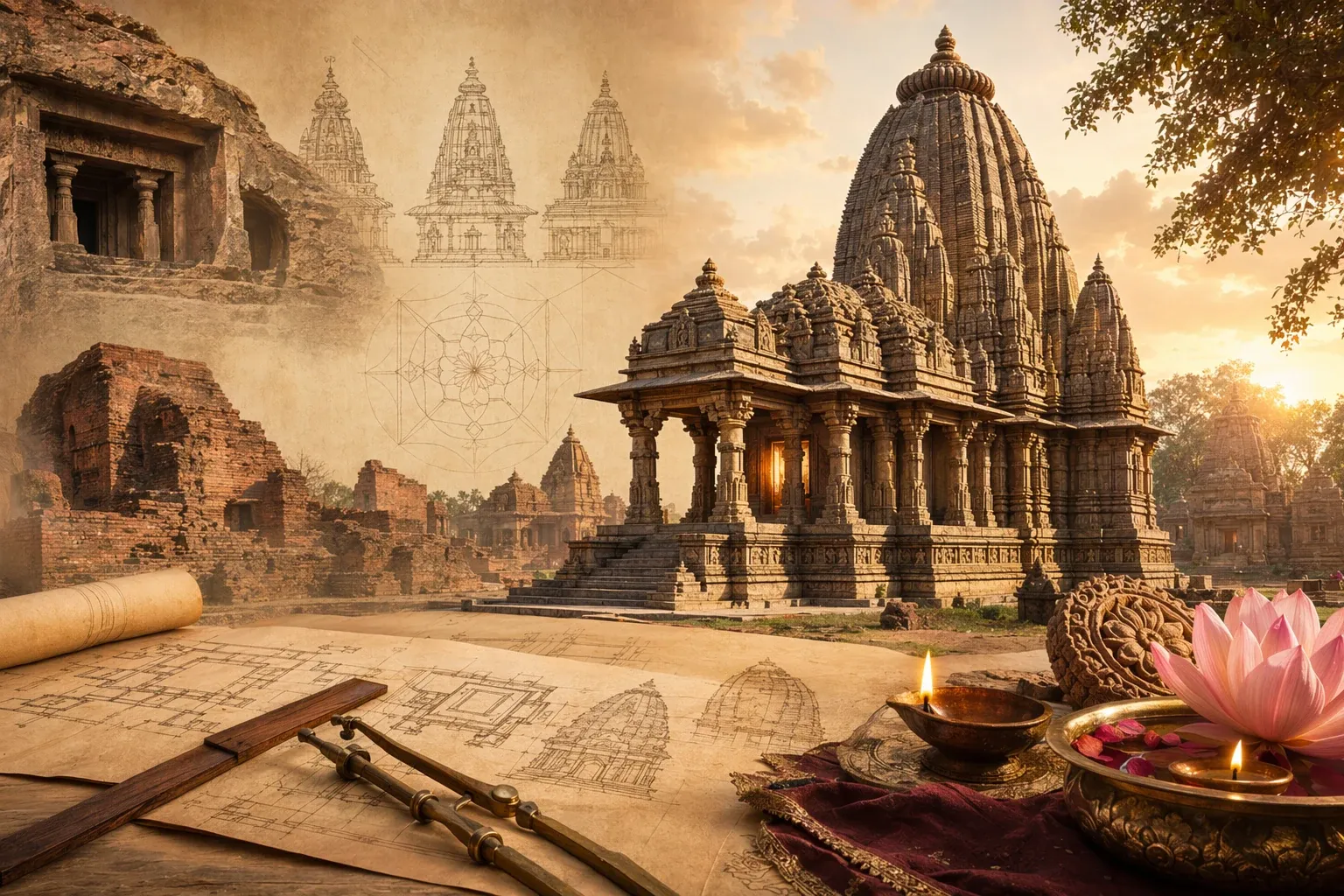
Indian temple architecture did not begin as one perfect finished form. It grew slowly through experiments in sacred space, image worship, rock-cut caves, brick structures, stone temples, regional styles and royal patronage. This is why the question “who introduced temple architecture?” is too simple. Many communities, patrons and craft lineages shaped it over centuries.
A better way to understand the story is to see continuity and innovation together. The basic devotional need was clear: create a sacred place where a deity could be worshipped, visited and honoured. But the architectural answer kept changing. Builders learned from earlier wooden and brick forms, from Buddhist and Jain sacred spaces, from local materials and from the ambitions of kings, merchants and temple communities.
Before the great stone temple
Early Indian sacred architecture included altars, temporary ritual spaces, sacred trees, stupas, railings, monasteries and shrines. Much of the earliest material may have been wood, clay or brick, so it has not survived as well as stone. That makes the historian’s work difficult. We should not assume that worship was absent just because buildings disappeared.
By the early centuries BCE and CE, India already had impressive traditions of carving and planning sacred spaces. Buddhist and Jain sites such as Sanchi, Karle, Bhaja, Ajanta and Udayagiri-Khandagiri show how rock, image, procession and community gathering could be combined. Hindu temple architecture later shared the larger Indian world of craftsmen, patrons and sacred geography, even while developing its own ritual forms around the murti and sanctum.
Rock-cut architecture: carving space from the mountain
Rock-cut architecture means that builders carved shrines, halls or monasteries directly into living rock. This was not “construction” in the normal sense of stacking stones. It was excavation. The mountain or cliff became the material. India’s rock-cut tradition is famous because it created long-lasting spaces with pillars, façades, cells, images and halls.
There is no single inventor of rock-cut architecture in India. It developed through several regions and religious traditions. Early examples are often linked with Buddhist and Jain patronage, and later Hindu rock-cut monuments became highly sophisticated. The Pallava monuments at Mahabalipuram, the caves of Badami and the great Kailasa temple at Ellora show how carving could imitate and transform structural architecture.
From carved caves to built shrines
The major shift came when builders increasingly made free-standing structural temples from brick, stone or mixed materials. Instead of cutting into a cliff, they built a sanctum, hall, tower and platform in open space. This allowed temples to become visible landmarks in villages, towns and royal centres.
Early structural temples were often small by later standards. A shrine might have a square sanctum, a simple doorway and a modest superstructure. Yet these experiments were crucial. Once the garbhagriha, doorway, platform and tower began to stabilise as architectural elements, later builders could expand them into complex temple forms.
The Gupta period and early structural clarity
The Gupta period, roughly fourth to sixth century CE in north India, is often treated as a milestone in early Hindu temple architecture. This does not mean the Guptas invented temples. It means several surviving temples from this broad period show a clearer movement toward durable, free-standing, image-based shrines with carefully carved doorways and sacred imagery.
The Dashavatara Temple at Deogarh, usually dated around the early sixth century, is a famous example. Dedicated to Vishnu, it has a square plan and important sculptural panels. The temple is partly ruined, but it remains important because it shows how a compact stone shrine could carry rich Vaishnava meaning through architecture and sculpture. Gupta and post-Gupta examples help us see temple design becoming more stable and recognisable.
Nagara, Dravida and regional imagination
Over time, temple architecture developed strong regional languages. In broad classroom terms, Nagara is associated with many northern temples and their curving shikharas. Dravida is associated with many southern temples and their pyramidal vimanas and later monumental gateways. Vesara is often used for mixed or Deccan forms, though real buildings are more complex than neat labels.
These categories are useful, but they should not become cages. Odisha’s Kalinga temples, Chalukya monuments in Karnataka, Pallava and Chola temples in Tamil regions, Chandela temples at Khajuraho, Solanki temples in Gujarat and Kerala’s timber-influenced temple forms all show local creativity. Climate, stone type, ritual practice and political culture shaped design.
Royal patronage and the temple as public centre
By the early medieval period, many temples became more than shrines. They were centres of ritual, landholding, inscription, craft, music, dance, festivals, education and local economy. Kings and chiefs used temple building to express devotion, legitimacy and generosity. Donors offered lamps, land, jewellery, food, gardens and services.
This public role changed architecture. Temples needed larger halls, more subsidiary shrines, tanks, processional routes and boundary walls. In South India, later temple complexes developed huge gopurams that made the sacred site visible from far away. In many regions, the temple became a place where sacred time, royal memory and community life met.
Great temples and mature styles
By the tenth to thirteenth centuries, many parts of India produced large and highly refined temples. The Brihadeshwara Temple at Thanjavur shows Chola scale, granite ambition and royal Shaiva devotion. The Sun Temple at Konark presents Odisha’s architectural imagination in monumental form. The Khajuraho temples show Chandela-era Nagara composition with clustered shikharas and dense sculpture.
These great temples were not sudden miracles of engineering. They were the result of long traditions of measurement, craft training, patronage and experimentation. A mature temple combines architecture, sculpture, inscription, ritual and landscape. It is both a work of devotion and a record of historical society.
Continuity without a single origin story
The safest answer to “how did temple architecture change over time?” is this: it moved from varied early sacred spaces and perishable forms toward rock-cut and structural shrines, then developed into regional stone traditions with increasingly complex plans, towers, sculpture and temple complexes. The change was gradual, not the work of one person.
This matters because Indian culture is often misunderstood through “first inventor” stories. Temple architecture is better seen as a civilisational conversation. Each generation inherited forms, solved local problems and added beauty. That is why a small Gupta shrine, a Pallava rock-cut monument, a Chola granite temple and a Kalinga temple in Odisha can all feel connected, even when they look different.
Questions people ask
How did the architecture of a temple change over time?
It moved from early sacred spaces and smaller shrines toward rock-cut caves, free-standing structural temples, regional tower forms, larger halls, richer sculpture and complex temple campuses.
Who introduced rock-cut temple architecture?
No single person introduced it. Rock-cut architecture in India developed across regions and religions, with early Buddhist and Jain examples and later Hindu monuments by dynasties such as the Pallavas, Chalukyas and Rashtrakutas.
What is temple architecture in ancient India?
It refers to the planning and building of sacred spaces for worship, especially shrines with a sanctum, image, hall, tower, sculpture and ritual movement. Its forms changed widely across time and region.