
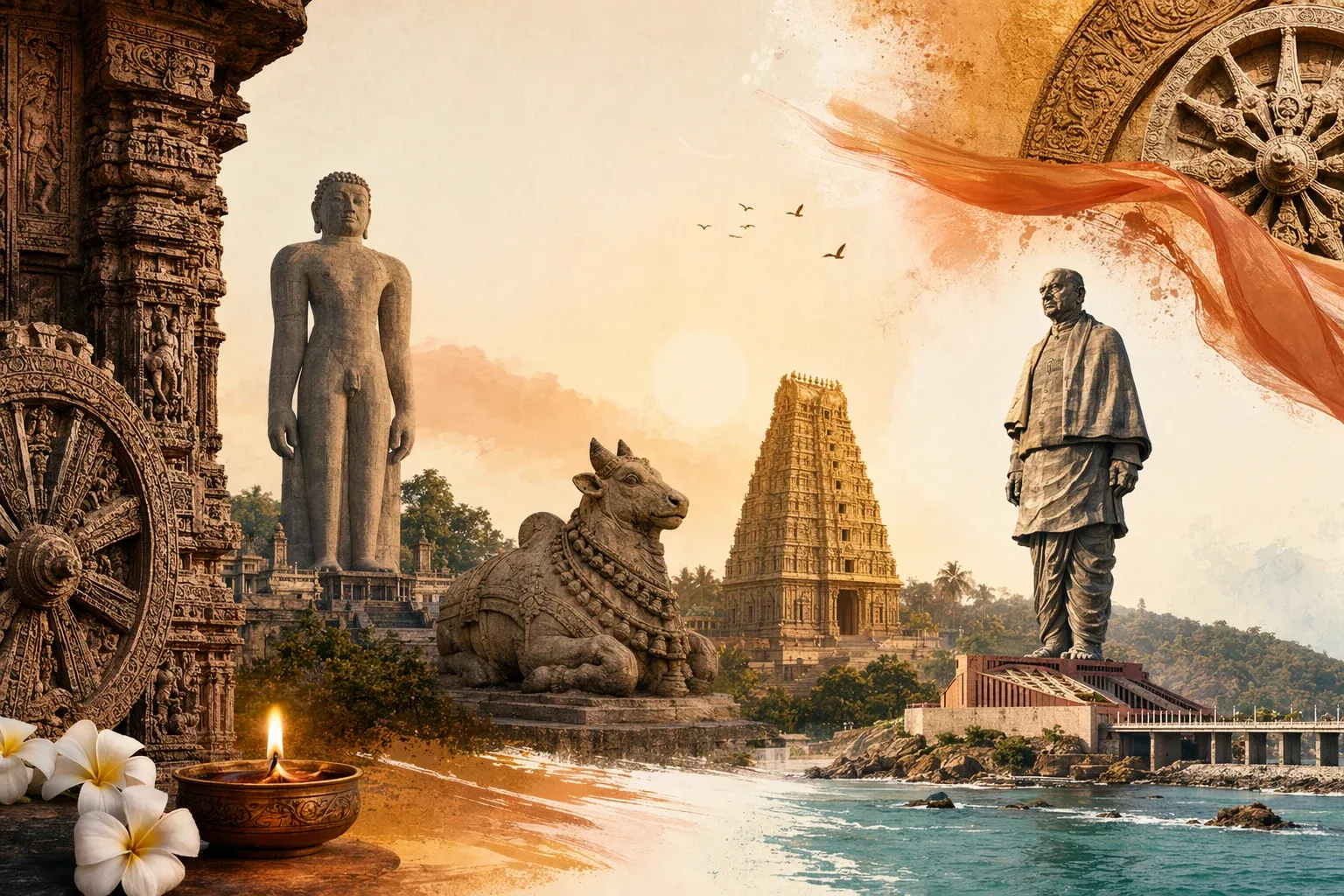
Biggest statues and sculptures are easy to rank by height, but size is not the only thing that matters. A tall monument, a sacred image, a temple relief and a historic sculpture can matter in different ways.
This guide explains what “biggest” can mean, why public scale attracts attention and how to keep cultural meaning, safety, access and historical context in the conversation.
The simple meaning
This topic becomes easier when we remember that sculpture is shaped form. A sculptor, craftsperson, workshop, patron, community, or temple tradition takes material and gives it form. That form may show a deity, a teacher, a ruler, a dancer, an animal, a symbol, a story, or a public ideal.
In India, sculpture is rarely only decoration. It can stand at a temple entrance, sit in a sanctum, cover a cave wall, mark a public space, teach a story on a stupa railing, honour a spiritual figure, or preserve the style of a region. This is why we need both the eye of an art lover and the manners of a respectful visitor.
Tradition, interpretation, and historical context
Tradition tells us how communities honour and remember sculpture. A murti in a temple, a Jain Tirthankara image, a Buddha figure, a village guardian, or a processional bronze may carry living reverence. For devotees, the image is not merely an object to consume with the eyes.
Interpretation asks what the form is communicating. A raised hand may suggest reassurance. A lotus may suggest purity or sacred beauty. A vehicle may identify a deity. A dramatic dance may express cosmic rhythm. But meanings must be explained with context; one symbol does not always mean the same thing everywhere.
Historical context asks when, where, how, and why the work was made. Scholars look at materials, inscriptions, patronage, style, trade routes, workshop practice, and comparison with other works. This layer helps us avoid vague claims and appreciate the real diversity of Indian art.
Key points for beginners
- A statue is usually a figure of a person, deity, or symbol; sculpture is a wider art category.
- A murti belongs to sacred presence and worship in Hindu, Jain, Buddhist, and other Indian contexts.
- Modern public monuments may be huge, but size alone does not decide cultural importance.
- Large works should be discussed through purpose, location, patronage, public meaning, and respect.
Examples to remember
- Statue of Unity
- Adiyogi Shiva statue
- large Hanuman and Buddha statues across India
- Gommateshwara Bahubali at Shravanabelagola
- temple and cave reliefs where scale works differently
Sculpture, statue, murti and monument: quick difference
The first step is to define the topic without flattening it. Biggest Statues and Sculptures in India: What Counts and Why It Matters is not only about beautiful objects. It is about how people shaped matter into meaning: devotion, memory, teaching, power, protection, beauty, and identity.
A helpful way to read this topic is this: Clarify the difference between sculpture, statue, murti and public monument, then explain major large Indian examples without turning it into trivia-only ranking. That angle matters because many online answers either become too shallow or too confident. A better article gives the useful answer first, then adds nuance where the subject deserves it.
What people usually mean by biggest sculpture/statue in India
Material changes the message. Stone can feel permanent and architectural. Bronze can hold movement and ritual presence. Terracotta can feel intimate and local. Wood and metal can carry folk, temple, domestic, or regional traditions. A beginner should always notice what the object is made from.
This is also where craft respect enters. Before a sculpture becomes famous, someone has planned, cut, cast, polished, modelled, carved, carried, installed, protected, repaired, or worshipped it. The human hand and community setting should not disappear behind a single label.
Major examples and why they were built
Sacred context is important. In Hindu, Buddhist, Jain, Sikh, folk, and regional settings, images may belong to worship, teaching, procession, meditation, protection, or community memory. In a museum, the same object may be studied as art history, but that does not erase its sacred or cultural life.
A good viewing habit is to describe before judging. What do you see? What is the material? Is the figure standing, sitting, dancing, teaching, blessing, or fighting? What objects are present? Where was it originally placed? These questions slow the mind in a useful way.
Sacred vs civic/public monument context
Historical context asks careful questions: who patronised the work, which region made it, what style does it show, what religious or social world shaped it, and what evidence do we actually have? Good history avoids both blind pride and casual dismissal.
We should also avoid turning every sculpture into trivia. Dates, heights, and names are helpful, but they are not the whole story. Meaning, use, emotion, and cultural memory are just as important for a beginner-friendly understanding.
Why size is only one way to understand importance
The practical lesson is to look slowly. Notice the posture, hands, face, objects held, surrounding figures, base, material, scale, and location. These details often explain more than a quick label can.
The safest conclusion is usually balanced: Indian sculpture can be sacred and artistic, ancient and living, regional and shared, beautiful and instructive. Holding these together makes the subject richer.
Common mistakes to avoid
- Do not call every sacred image a decorative statue without context.
- Do not treat all Indian sculpture as one style; region, period, material, and tradition matter.
- Do not force one fixed meaning onto every symbol without evidence.
- Do not rank sacred or historical works only by size or price.
- Do not use unsafe download shortcuts when textbooks, museums, legal books, and trusted resources are available.
Questions people ask
Which is the biggest sculpture in India?
If the question means height, modern examples such as the Statue of Unity often come up. But sculpture, statue, murti, and monument are not exactly the same, so context matters.
Who is the number one statue in India?
If the question means height, modern examples such as the Statue of Unity often come up. But sculpture, statue, murti, and monument are not exactly the same, so context matters.
What is an example of sculpture in India?
Well-known examples include the Lion Capital of Ashoka, Didarganj Yakshi, Gandhara and Mathura Buddha images, Nataraja bronzes, Mahabalipuram reliefs, and major Jain and temple sculptures.
Why it matters today
Indian sculpture matters because it trains the eye and the mind together. It asks us to see form, but also to ask what the form protects: a story, a deity, a political memory, a regional style, a philosophical idea, or a community’s skill.
It also teaches respect. A sculpture in a museum may invite study. A sculpture in a temple may invite darshan. A public monument may invite civic reflection. A classroom image may invite revision. The same habit works everywhere: look carefully, speak respectfully, and do not pretend to know more than the evidence allows.
Big sculptures are impressive, but the real question is deeper: what memory, value, devotion, or civic message is being made visible at that scale?
Related guides
For more context, read dharma and public responsibility and temple architecture in Odisha. These guides connect sculpture with nearby ideas without pulling this article away from its main topic.