Bharatanatyam is a classical dance form from Tamil Nadu, known for grounded posture, precise rhythm, expressive storytelling, and devotional depth. This beginner guide explains its origin, style, stages, and respectful learning path.
Short answer
Bharatanatyam is one of India’s best-known classical dance forms. It is strongly associated with Tamil Nadu and is known for precise footwork, sculptural poses, expressive eyes, hand gestures, and a deep connection with music and storytelling.
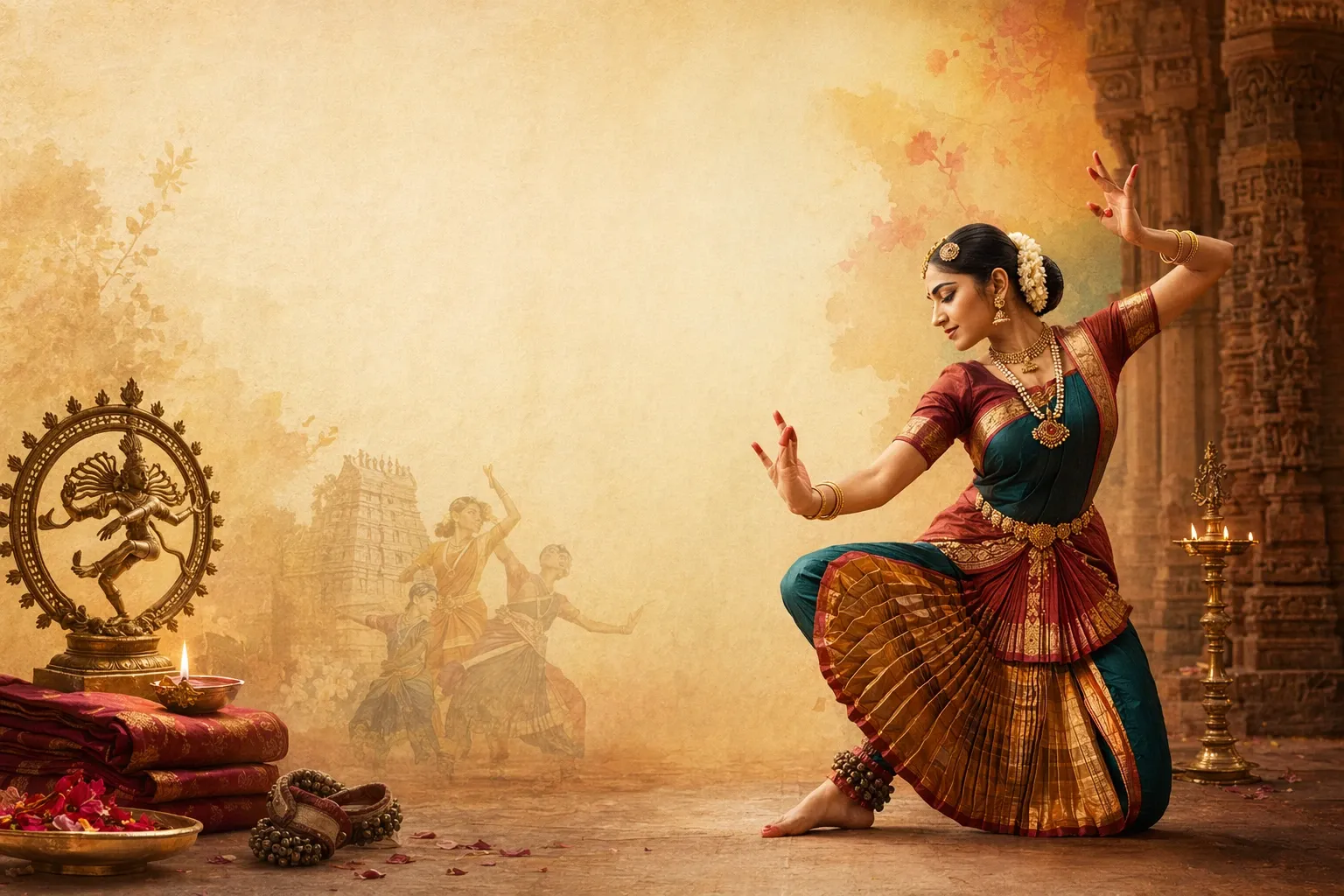
A beginner can recognise Bharatanatyam by its strong half-sitting posture, clean lines, rhythmic stamping, and expressive abhinaya.
Origin and history
Bharatanatyam has roots in Tamil cultural and devotional performance traditions, including temple-linked dance histories. In the modern period, the form was revived, reorganised, and brought to public stages through the work of many artists, teachers, and institutions.
Because its history includes social change, colonial disruption, reform, and revival, we should avoid oversimplifying it as only “ancient temple dance” or only “modern stage dance.” It is both rooted and re-shaped.
What makes the style recognisable
A key posture is aramandi, a half-sitting stance that gives the form its grounded geometry. Dancers train in adavus, basic movement units that combine steps, hands, rhythm, and posture.
Bharatanatyam can be powerful and graceful at once: the feet mark rhythm, the torso stays controlled, the face carries emotion, and the hands help tell the story.
Stages, levels, and margam
People often search for the “7 stages” or “7 levels” of Bharatanatyam. Different schools may use different teaching levels. Another important word is margam, the traditional performance pathway or repertoire sequence taught in many lineages.
A beginner does not need to memorise every item immediately. Understand that training usually moves from basics to combinations, expression, repertoire, and eventually full performance readiness.
How to start respectfully
Choose a teacher or school that values basics, safety, rhythm, meaning, and respect for tradition. Do not rush into performance costumes before learning posture and adavus properly.
Also learn the context of songs and stories. Bharatanatyam is not just exercise; it is cultural art. Learning pronunciation, meaning, and respect is part of the practice.
Key takeaway
Bharatanatyam teaches discipline through beauty: posture, rhythm, devotion, expression, and years of patient practice.
Additional beginner context
The next sections add plain-language context so the article is more useful as a complete beginner guide.
A beginner-friendly way to read this
This guide is mainly about Bharatanatyam for Beginners: Origin, Meaning, Stages, and Style. The useful way to read it is not as a final verdict, but as a beginner-friendly map: learn the key idea, notice the context, and then connect it with the wider Indian cultural world. Important terms in this article include Bharatanatyam, Origin, Stages, Style. The central angle is: Explain Bharatanatyam’s Tamil Nadu roots, posture, expressions, repertoire/stages, and beginner learning path without turning it into a local class directory.
Indian classical dance is not only entertainment. It brings together rhythm, gesture, facial expression, costume, music, devotion, regional memory, and storytelling. A beginner should look beyond the stage photo and ask: what story is being shown, what mood is being created, and how does the body become a language?
What to remember
Each form has its own history and personality. Bharatanatyam, Kathak, Odissi, Kuchipudi, and the other recognised forms should not be flattened into one generic ‘Indian dance’ image. Their postures, costumes, musical settings, temple or court associations, and training methods all matter.
For modern readers, the safest approach is to keep curiosity and humility together. A tradition can be meaningful without being reduced to a slogan, and a complex topic can be made simple without pretending that every region, family, school, or teacher follows the exact same wording.
For students, the respectful approach is to learn vocabulary slowly: mudra, abhinaya, tala, costume, guru, repertoire, and practice. Once those words become familiar, performances stop looking like decoration and start becoming readable cultural expression.
Where to go next
For the rhythm and music context behind Bharatanatyam, read our Indian classical music beginner guide and this simple explainer on taal, swara, and laya. For a wider dance-and-culture view, see how folk music and dance define culture.
More context for careful readers
Common misunderstandings to avoid
A common mistake is to treat Bharatanatyam for Beginners: Origin, Meaning, Stages, and Style as only one sentence or one social-media definition. In reality, Indian classical dance topics usually carry many layers: language, practice, regional memory, family tradition, teacher explanation, and modern interpretation. A beginner guide should simplify the entry point, but it should not erase that depth.
Another mistake is to assume that one version explains every community. Indian traditions often travel through many regions and languages, so examples may differ. That does not make the topic confused; it means the tradition is alive and has been remembered in more than one way.
The safest reading habit is to keep the main idea clear and hold details gently. Start with what the word means, then notice where it appears, who practices or discusses it, and what value it is trying to teach. This makes Bharatanatyam for Beginners: Origin, Meaning, Stages, and Style easier to remember without forcing a narrow answer.
Why this matters today
This topic still matters because young readers are meeting Indian culture through school, family stories, social media, travel, music, health conversations, and festival posts. Without context, the same idea can look either too mysterious or too casual. A clear explanation helps readers respect the subject without feeling lost.
For Bhaktilipi readers, the practical value is not just information. The goal is better cultural literacy: knowing enough to ask good questions, avoid lazy stereotypes, and recognise why earlier generations preserved these ideas through stories, songs, rituals, debates, art, and daily habits.
Good learning also means knowing the limits of a short article. This guide gives a reliable starting point, but deeper study can come from teachers, trusted books, temple or community elders, museums, performances, and careful reading of primary traditions where possible.
Simple takeaway
If you remember only one thing, remember this: Bharatanatyam for Beginners: Origin, Meaning, Stages, and Style becomes meaningful when the definition, the cultural setting, and the human purpose are read together. That balanced view protects the topic from both blind rejection and blind romanticisation.
Use this article as a first map. Revisit the key words, compare them with real examples, and keep learning patiently. Dharma-oriented learning is not about collecting facts quickly; it is about understanding what those facts ask us to value and practice.