
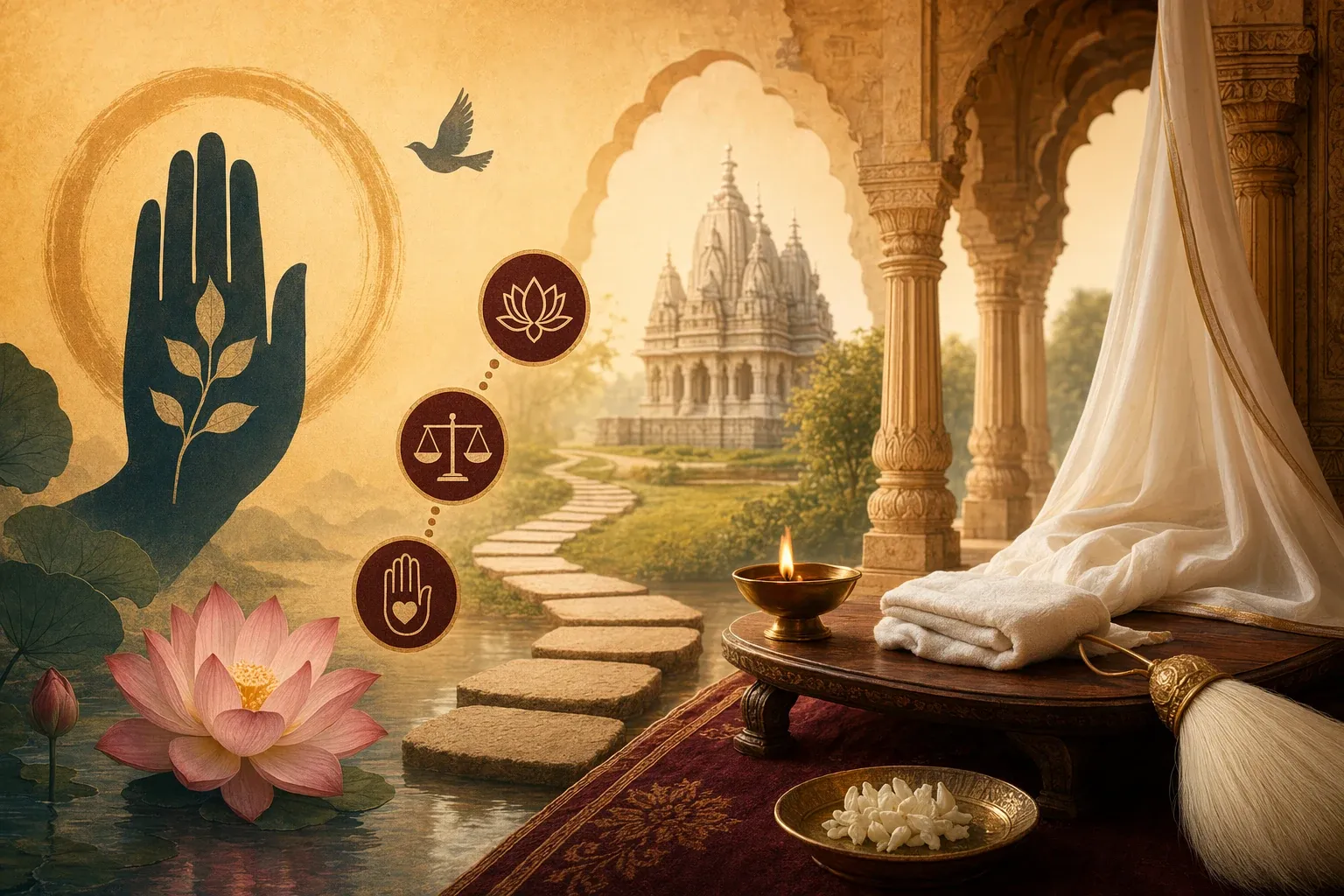
Jainism teaches a disciplined way of seeing life: every being matters, every action leaves an effect, and the soul can become free when violence, attachment, ignorance, and passion are overcome. Its core teachings may sound philosophical, but they are meant to shape ordinary choices: how we eat, speak, earn, travel, consume, and react when life tests us.
For beginners, three ideas are especially important: ahimsa, karma, and moksha. Ahimsa is non-violence and care. Karma is the bondage created by action and passion. Moksha is liberation, the complete freedom of the soul. Around these ideas Jainism builds a path of restraint, self-knowledge, humility, and compassion.
Ahimsa: more than “do not hurt”
Ahimsa is the most famous Jain value, but it is deeper than avoiding physical violence. It includes speech, thought, intention, lifestyle, food, business, and the small harms we may ignore for convenience. Jainism asks a person to become more awake to the life around them: animals, insects, plants, humans, and even tiny forms of life that ordinary habits may crush without attention.
This does not mean ordinary householders can avoid every possible harm. Jainism recognizes levels of practice. Monks and nuns follow extremely strict discipline, while laypeople practise smaller vows. The shared direction is reduction of harm. Even if perfect non-violence is difficult, carelessness should not become an excuse.
Karma in Jain thought
Karma in Jainism is not only a phrase meaning “what goes around comes around”. Jain philosophy describes karma as a kind of subtle bondage connected with the soul. Actions, passions, anger, pride, deceit, greed, attachment, and ignorance attract karma. The soul’s natural purity becomes covered, and the cycle of birth and death continues.
This makes responsibility very personal. No creator God simply cancels karma by favour. Teachers can guide, scriptures can explain, and community can support, but the soul must purify itself through right faith, right knowledge, and right conduct. For wider background on the Indian idea, see our karma meaning guide.
Moksha: the goal of liberation
Moksha means liberation from karmic bondage and the cycle of rebirth. In Jainism, the liberated soul is free, pure, and perfected. This is not just a happy heaven where desires continue. It is complete release from attachment, ignorance, and the burden of karma.
The ideal may feel far away from student life, jobs, social media, and family pressure. But Jainism uses the distant goal to reshape daily life. Each act of restraint, forgiveness, truthfulness, simplicity, and compassion becomes a small movement toward freedom.
Aparigraha and self-control
Aparigraha means non-possessiveness or limiting attachment. It asks us to examine how much we own, crave, collect, compare, and protect out of ego. A person can be outwardly rich and inwardly trapped by greed, or outwardly simple and inwardly proud. Jain discipline looks at both outer behaviour and inner attachment.
For young readers, aparigraha is especially relevant. Consumer culture constantly says: buy more, show more, want more, upgrade more. Jain teaching asks the opposite question: how much is enough, and what is this desire doing to my mind?
Anekantavada: many-sided truth
Anekantavada teaches that reality is many-sided and human viewpoints are limited. It does not mean every opinion is equally correct. It means truth is deep, so speech should be careful, humble, and aware of context. This idea can reduce arrogance in debate and make room for listening.
In online life, where people rush to mock, label, and cancel, anekantavada feels surprisingly practical. It reminds us that strong conviction should be paired with humility. A person can disagree without hatred and speak clearly without pretending to know everything.
What Jainism teaches us today
Jainism teaches that ethics is not separate from daily life. Food, words, money, anger, travel, relationships, and entertainment all matter because they shape the soul. Non-violence is not weakness; it is disciplined awareness. Karma is not fatalism; it is responsibility. Moksha is not escapism; it is the highest form of freedom.
If you want broader Indian context, our dharma guide helps explain why conduct and purpose matter across traditions, while Jainism gives these ideas its own precise form.
How the teachings work together
Ahimsa without karma can become only a social rule. Karma without moksha can become fear of consequences. Moksha without everyday discipline can become a distant idea with no practical power. Jainism joins them together: because actions bind the soul, non-violence and self-control become the practical path toward freedom.
This is why Jain ethics can feel demanding but also very clear. The question is not only “Is this allowed?” The deeper question is “Does this action increase attachment, carelessness, and harm, or does it move me toward awareness and freedom?”
Learning Jain philosophy today
Modern readers can learn Jain philosophy through books, temple classes, community talks, online lectures, and conversations with knowledgeable practitioners. When learning online, choose sources that explain without mocking, exoticizing, or flattening the tradition. Jainism is not only an ancient subject; it is a living path followed by real communities.
A useful study habit is to connect each idea with one daily practice. Ahimsa can become kinder speech. Aparigraha can become buying less. Anekantavada can become listening before arguing. Karma can become responsibility. Moksha can become the reminder that the soul’s freedom matters more than temporary ego.
What beginners should remember
Ahimsa, karma, and moksha are not separate slogans. They form one path: reduce harm, understand the consequences of action, purify the soul, and move toward liberation. Jainism’s core teachings challenge us to live with more care, less greed, humbler speech, and a deeper sense of responsibility for every living being.