
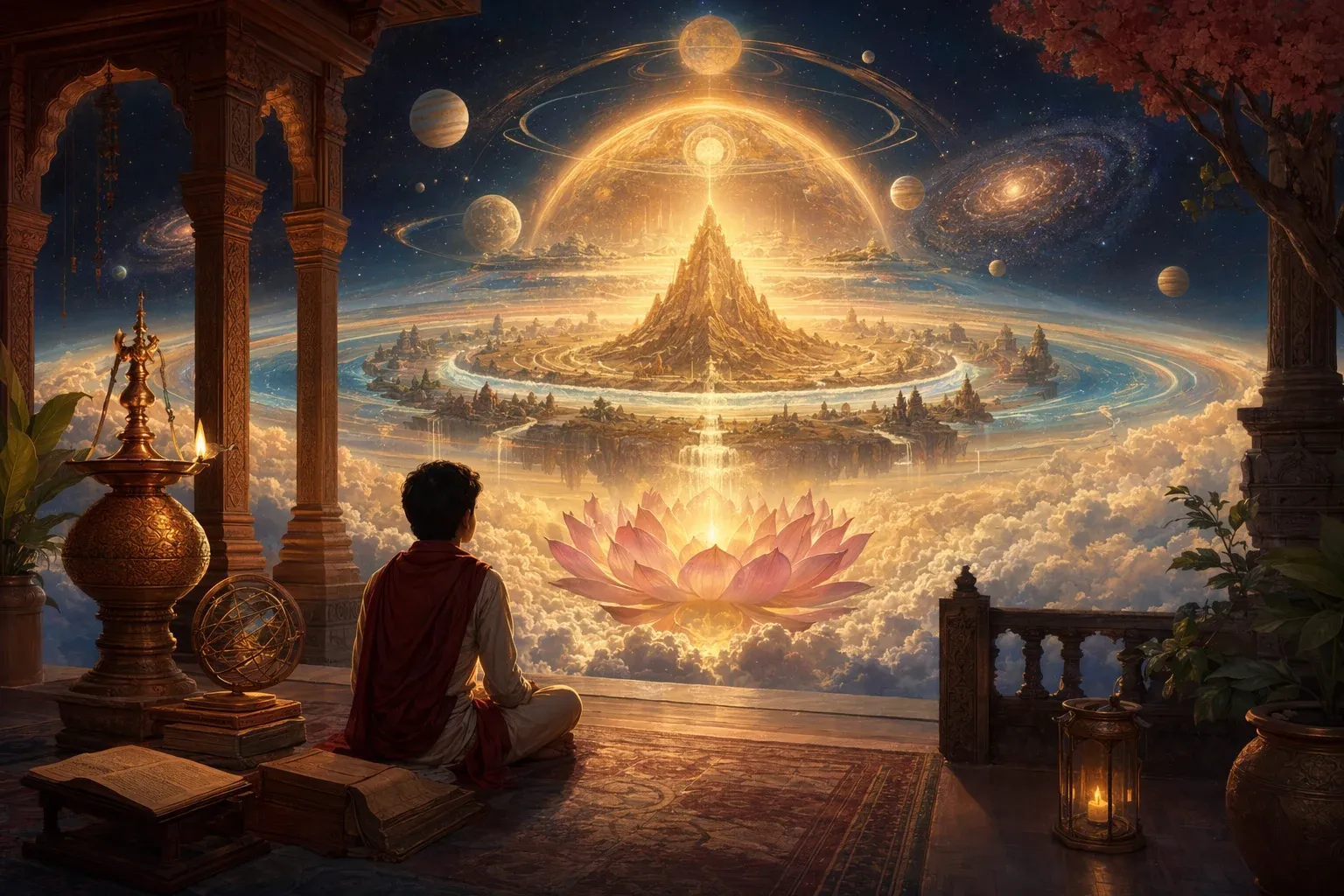
Hindu cosmology is the Hindu way of imagining and explaining the universe: where the world comes from, how time moves, what kinds of beings exist, and how human life fits inside a much larger cosmic order. For a beginner, the easiest mistake is to treat it like one neat astronomy textbook. It is not that simple. Hindu cosmology appears across the Vedas, Upanishads, epics, Puranas, philosophical schools, temple art, ritual calendars, and local storytelling traditions. These sources do not always speak in one voice, but they share a broad feeling: the universe is meaningful, rhythmic, layered, and connected with dharma.
That is why the topic can feel both beautiful and confusing. One page may speak about Brahma creating beings. Another may describe Purusha, Prakriti, gunas, or the five elements. A temple sculpture may show cosmic mountains, serpents, gods, sages, animals, rivers, and worlds stacked above and below. A calendar may speak of yugas and kalpas lasting far beyond ordinary history. The point is not only to ask, “Where is the universe located?” It is also to ask, “What kind of life should a human being live in such a universe?”
Cosmology Means a Worldview, Not Only a Space Map
The word cosmology simply means an account of the cosmos. In modern science, cosmology studies the origin, structure, and development of the physical universe through observation, mathematics, and testable theories. Hindu cosmology includes physical imagination too, but it is not limited to telescopes and measurements. It also carries religious, symbolic, philosophical, and ethical meaning.
For example, a Puranic story about creation may speak of Brahma, Vishnu, dissolution, or repeated worlds. A Samkhya-style explanation may speak of Purusha, consciousness, and Prakriti, primordial nature. A devotional tradition may understand the cosmos through the grace of Vishnu, Shiva, Devi, or another form of the Divine. These are not identical approaches, yet they all belong to the wider Hindu conversation about existence.
So when someone asks “what is Hindu cosmology?”, a fair beginner answer is this: it is a family of Hindu ideas about the universe, cosmic time, divine order, worlds beyond ordinary perception, and the place of living beings within karma and dharma.
The Universe Feels Rhythmic and Cyclical
One of the most famous features of Hindu cosmology is cyclical time. Many Hindu texts do not present the universe as a one-time event that begins once and ends once. Instead, creation, preservation, dissolution, and re-creation unfold in vast cycles. The Puranic language of yugas, mahayugas, manvantaras, kalpas, and the day and night of Brahma gives this imagination an enormous scale.
This does not mean every Hindu thinker has treated these numbers in the same way. Some readers approach them as sacred time-reckoning. Some see them as symbolic language that humbles the human ego. Some compare them with modern cosmic scale, while careful teachers warn against claiming that ancient texts are simply modern physics in coded form. The safer and more respectful approach is to say that Hindu traditions developed a grand imagination of time long before most people were used to thinking beyond a few generations.
For daily life, the deeper message is easy to understand. Human life is short, but actions matter. Civilisations rise and fall, but dharma remains worth pursuing. Even if time is vast, a single choice can still carry moral weight.
Lokas Show a Layered Cosmos
Hindu cosmology often speaks of lokas. A loka can be understood as a world, realm, plane, or sphere of experience. Common lists mention realms such as Bhuloka, the earthly world; Bhuvarloka; Svarloka or Svarga; Maharloka; Janaloka; Tapoloka; and Satyaloka or Brahmaloka. Other traditions speak of lower worlds such as Atala, Vitala, Sutala, Talatala, Mahatala, Rasatala, and Patala. These names appear in different ways across texts and teaching lineages.
A beginner should not imagine that every chart on the internet is a final official map. Diagrams are useful, but they simplify. Lokas can be read as sacred geography, as symbolic teaching, as states of experience, or as part of Puranic narrative. In temples and storytelling, this layered universe helps people picture the moral and spiritual structure of existence: gods, sages, humans, ancestors, animals, serpentine nagas, asuras, and many other beings occupy a universe bigger than the human street outside our house.
This is one reason Hindu cosmology has remained culturally powerful. It gives imagination a home. It says the visible world is important, but not the whole of reality.
Creation Is Told Through Many Sacred Languages
There is no single creation story that exhausts Hindu cosmology. The Rig Veda’s Nasadiya Sukta famously wonders about creation with poetic uncertainty. Some Puranic passages speak of Narayana, Brahma, lotus imagery, cosmic waters, and repeated creation. Samkhya-influenced explanations discuss the unfolding of elements from Prakriti. Vedantic traditions may read the cosmos through Brahman, maya, and consciousness. Devotional communities may place their chosen deity at the heart of cosmic meaning.
This variety is not a weakness. It reflects the Hindu habit of allowing many levels of explanation. A child may first learn a story. A student may later study Sanskrit terms. A devotee may see the same universe through bhakti. A philosopher may ask what is ultimately real. A historian may ask when particular ideas appear in texts. These approaches can sit near each other without becoming the same thing.
Dharma Connects the Cosmos to Human Life
Hindu cosmology is not only about distant worlds. It shapes how people understand duty, order, and responsibility. Dharma is often described as that which upholds: the moral, social, ritual, and cosmic order that keeps life from collapsing into chaos. In a cosmos governed by karma, actions are not isolated. They leave impressions, create consequences, and bind beings to cycles of birth and death until liberation is sought.
This is why stories of gods, sages, kings, and ordinary people are often cosmic stories too. When a king ignores dharma, the kingdom suffers. When a sage performs tapas, worlds tremble. When a devotee acts with humility, divine grace enters everyday life. Whether one reads these literally, symbolically, or devotionally, the pattern is clear: the human and the cosmic are linked.
A Simple Way to Begin
Start with four anchors. First, Hindu cosmology imagines vast cycles of time. Second, it describes many lokas or realms, not just the visible earth. Third, it gives multiple creation accounts, depending on text and tradition. Fourth, it connects the structure of the universe with karma, dharma, and spiritual liberation.
From there, read slowly. Do not force every Sanskrit word into one English equivalent. Do not turn every sacred image into a scientific claim. Do not assume every Hindu community explains the cosmos in exactly the same way. A village storyteller, a Vedanta teacher, a temple priest, an Indologist, and a modern astronomy student may each notice something different.
Questions People Usually Have
Is Hindu cosmology the same as astronomy?
No. It includes ideas about space and time, but it is also religious, philosophical, symbolic, and ethical. Astronomy studies celestial objects through observation; Hindu cosmology belongs to a wider sacred worldview.
Does Hindu cosmology have only one version?
No. Vedic hymns, Puranic texts, philosophical schools, temple traditions, and regional storytelling can present different images of the cosmos. It is better to speak of Hindu cosmologies within a broad shared culture.
Why should beginners care about it?
Because it opens a doorway into how Hindu traditions think about time, life, responsibility, divinity, and liberation. Even if some details feel unfamiliar, the core question is very human: how do we live wisely inside a universe much larger than ourselves?