
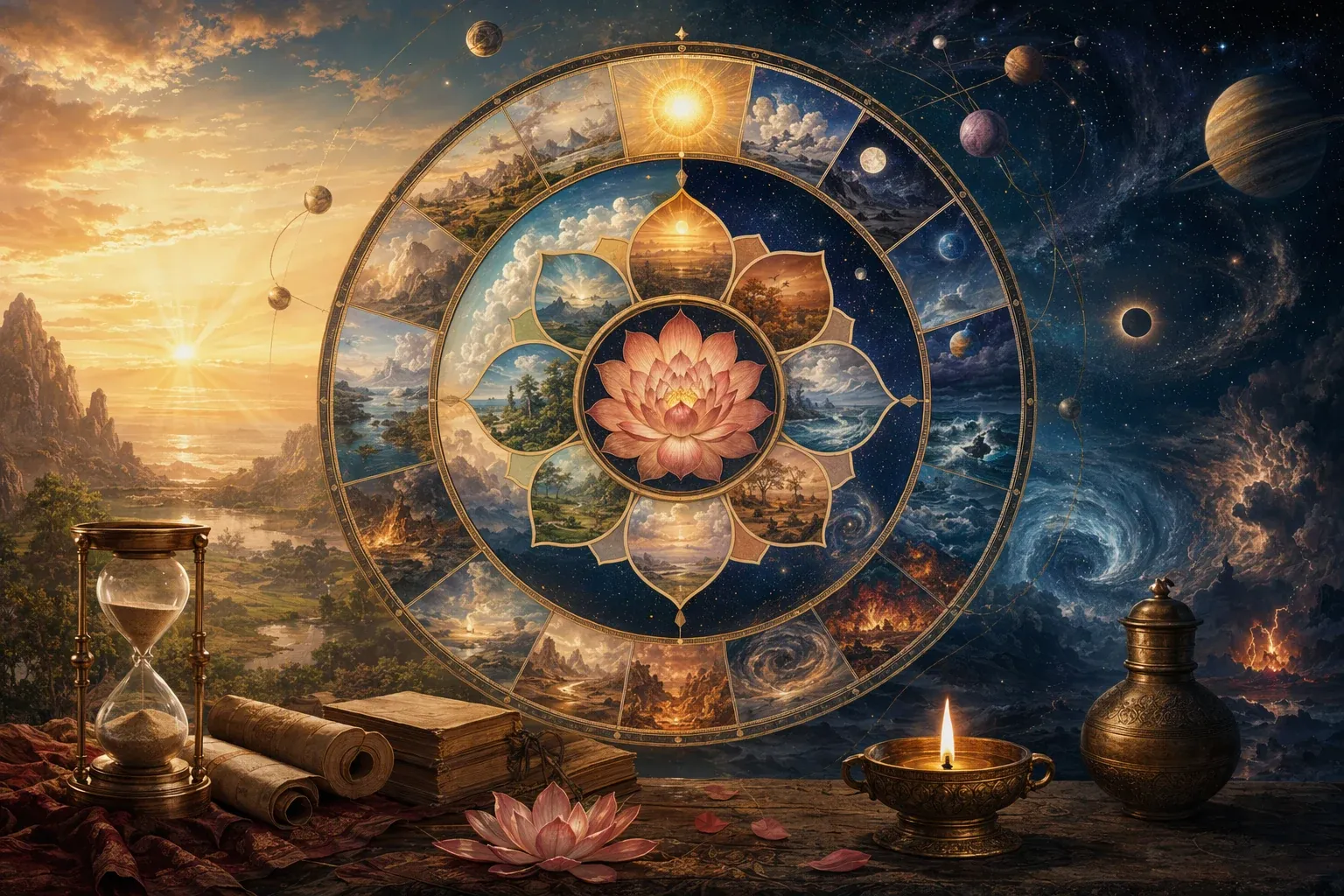
“How old is Hindu cosmology?” sounds like one question, but it actually has two different meanings. First, we can ask how old the Hindu ideas about the universe are as a historical tradition. That leads us into Vedic hymns, the epics, Puranas, philosophical schools, and centuries of interpretation. Second, we can ask how old the universe is within Hindu cosmology itself. That leads us into yugas, mahayugas, manvantaras, kalpas, and time spans so large that ordinary history feels tiny.
Both questions are useful, but they must be kept separate. The historical age of a text is not the same as the cosmic age described inside the text. A poem can be composed in one period while speaking about billions or trillions of years. A Purana can preserve older ideas, reshape them, and teach through sacred numbers. Careful reading protects us from two mistakes: reducing everything to myth with no respect, or claiming unsupported “ancient science proved everything” headlines.
The Historical Question: When Did These Ideas Develop?
Hindu cosmic thinking is very old, but it did not appear in one finished textbook on a single day. Early Vedic literature already contains deep questions about creation, order, gods, sacrifice, and the structure of reality. The famous Nasadiya Sukta of the Rig Veda is especially striking because it wonders about the beginning with a rare kind of humility: perhaps even the highest overseer knows, or perhaps not. That poetic openness is part of the Hindu inheritance.
Later, the Upanishads explored the relation between the self, Brahman, consciousness, and ultimate reality. The epics and Puranas expanded cosmic imagination through stories, genealogies, worlds, cycles, gods, sages, and dissolutions. Philosophical systems such as Samkhya, Vedanta, Yoga, Nyaya, and others gave different tools for thinking about matter, consciousness, causation, and liberation.
So, historically, Hindu cosmology is not one date. It is a long conversation. Some roots go back to early Sanskrit religious culture. Many popular details about yugas, kalpas, Brahma’s day, and repeated creation are strongly associated with epic-Puranic and later textual development. A beginner should be comfortable saying: the tradition is ancient, layered, and evolving.
The Cosmic Question: How Time Works Inside the Tradition
Inside many Hindu cosmological accounts, time is cyclical. The universe does not simply begin once and move in a straight line to a single ending. Instead, worlds appear, continue, dissolve, and appear again. This pattern is often connected with the roles of creation, preservation, and dissolution, and with deities such as Brahma, Vishnu, and Shiva in different traditions.
The yuga system is the most familiar entry point. A full cycle of four yugas is called a mahayuga or chaturyuga. The four yugas are Satya or Krita Yuga, Treta Yuga, Dvapara Yuga, and Kali Yuga. In the common Puranic reckoning, their lengths decline in a 4:3:2:1 pattern, with transitional dawn and dusk periods included in traditional calculations. The total mahayuga is usually given as 4.32 million human years.
Kali Yuga, the current age in many Hindu traditional accounts, is described as a period of decline in dharma, confusion, conflict, and spiritual difficulty. Yet it is not only a reason for despair. Many bhakti traditions also say that sincere devotion, nama-japa, satsang, and humility are especially meaningful in difficult times.
From Mahayuga to Kalpa
The numbers become even larger after the mahayuga. Traditional Puranic time reckoning often says that one thousand mahayugas form one day of Brahma, known as a kalpa. Since one mahayuga is 4.32 million years, a day of Brahma is 4.32 billion years. A night of Brahma lasts the same length. At the end of such a day, a dissolution occurs, and after the night, creation begins again.
The Vishnu Purana and related Puranic traditions also describe manvantaras, periods connected with Manus, the progenitors or law-givers of humanity. Fourteen Manus are associated with one day of Brahma in common reckoning. These time systems are not small decorative details. They show that Hindu cosmology thinks in vast rhythms: days and nights, creation and rest, manifestation and withdrawal.
Beyond this, a year of Brahma and the lifetime of Brahma expand the scale further. Traditional numbers can reach into trillions of years. Whether a reader treats these literally, symbolically, devotionally, or philosophically, the effect is powerful. Human pride becomes smaller. The cosmos becomes majestic. Dharma becomes something to practise without pretending that our short lifespan is the centre of all existence.
What the Yuga Pattern Teaches
The yuga idea is not only about counting years. It also carries a moral imagination. Satya Yuga is remembered as an age of truth and fullness of dharma. Treta Yuga sees some decline. Dvapara Yuga sees further decline. Kali Yuga is the most difficult, with dharma often pictured as standing on one leg instead of four. This image makes ethics visual. Society is not merely advancing in a straight line; it can also forget wisdom.
That does not mean every person in Kali Yuga is bad, or that every ancient period was perfect in a simple historical sense. Sacred time is teaching through pattern. It asks us to notice how greed, anger, dishonesty, and spiritual laziness weaken the world. It also asks us to recognise that even in a dark age, personal effort matters. A small lamp is most valuable when the room is dark.
Tradition, Symbol and History Should Not Be Mixed Carelessly
When discussing ancient cosmology today, two kinds of confusion are common. One is dismissive: “These numbers are impossible, so there is nothing to learn.” The other is overexcited: “These numbers prove that ancient people had the exact same science as modern cosmologists.” Both approaches are too shallow.
A better approach is layered. Traditional believers may honour the numbers as sacred truth. Philosophical readers may see them as a way to think about recurring manifestation. Historians may ask how these ideas developed in Sanskrit literature and religious communities. Scientists may study the physical universe through a different method. These approaches do not need to be mashed into one slogan.
Hindu cosmology deserves respect on its own terms. It does not need fake claims to be meaningful. Its greatness lies in its ability to make time feel morally, spiritually, and imaginatively vast.
A Beginner Timeline Without Overclaiming
If you want a simple timeline, think like this. The earliest Sanskrit religious texts contain creation questions and cosmic order ideas. Later philosophical and ritual traditions deepen the discussion. The epics and Puranas give many of the grand narrative forms that people now associate with Hindu cosmology: yugas, kalpas, Brahma’s day, lokas, repeated creation, and dissolution. Over centuries, teachers, commentators, temple artists, storytellers, and communities kept interpreting these ideas.
This is enough for a beginner. You do not need to memorise every date before appreciating the vision. Just remember the difference between historical development and internal cosmic time. One belongs to the study of texts and traditions. The other belongs to the universe imagined within those traditions.
Questions People Usually Have
Is Hindu cosmology billions of years old?
The textual tradition itself is not billions of years old in the historical sense. But many Hindu cosmological systems describe cosmic cycles lasting millions, billions, and even trillions of years.
What is a kalpa in simple words?
A kalpa is commonly explained as a day of Brahma, lasting 4.32 billion human years in Puranic reckoning. It is followed by a night of Brahma of equal duration.
Are yugas literal or symbolic?
Hindu readers differ. Some accept the traditional numbers literally, some read them symbolically, and some study them historically. The safest beginner approach is to understand the traditional model first, then explore interpretations carefully.