What is the Sri Yantra?
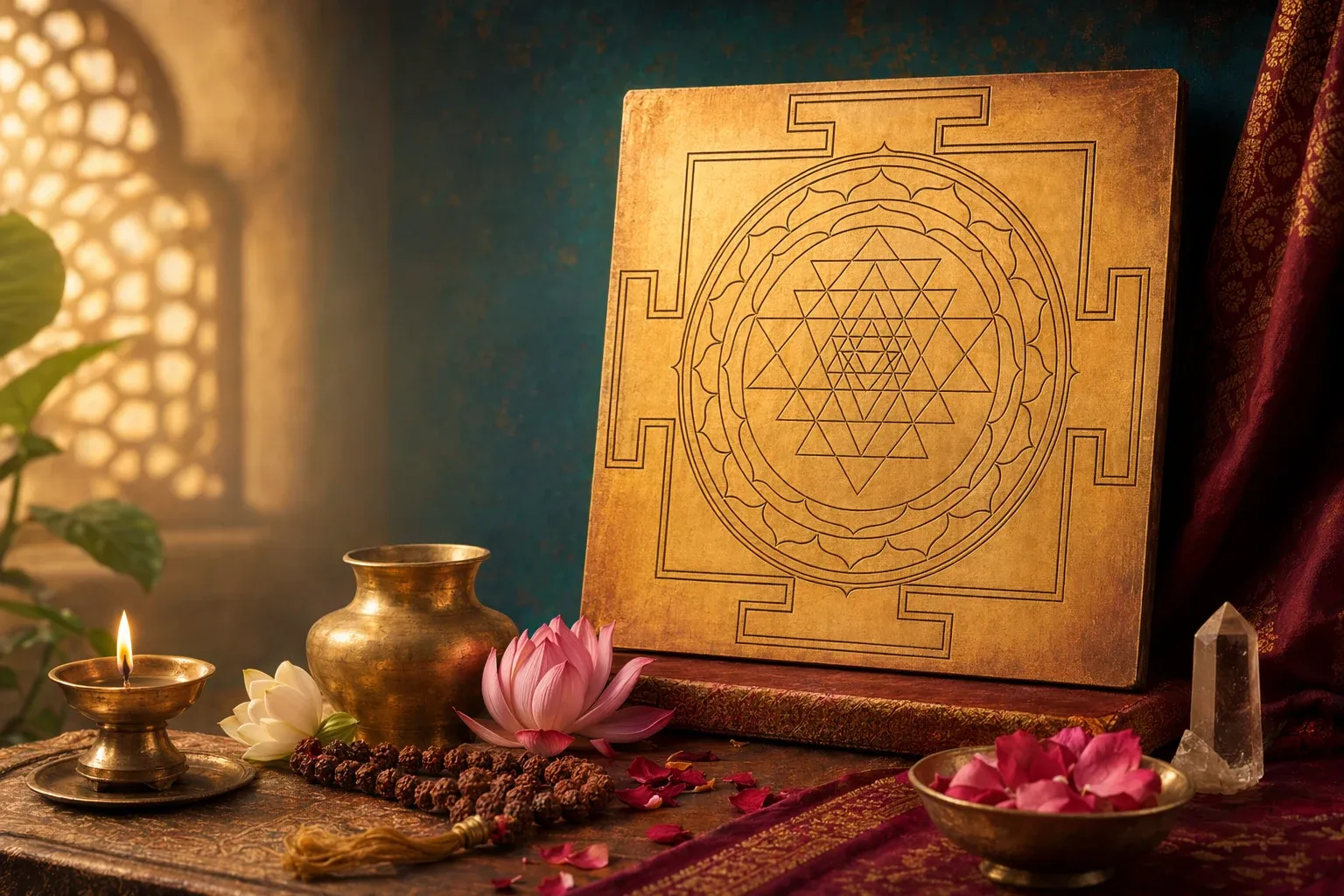
The Sri Yantra, also called the Shri Yantra or Shri Chakra, is one of the most revered sacred diagrams in Hindu tradition. It is especially associated with Sri Vidya, the worship of the Divine Mother as Lalita Tripurasundari, though its beauty and symbolism have also drawn wider interest. The diagram is famous for its interlocking triangles, lotus rings, outer square, and central bindu.
“Sri” suggests radiance, auspiciousness, grace, and prosperity in a deep spiritual sense. The Sri Yantra is therefore not merely a sign of material abundance. It points toward the presence of divine beauty, order, consciousness, and bliss. In traditional settings, it may be worshipped with mantra, offerings, and careful ritual, often under guidance.
The central bindu
At the heart of the Sri Yantra is the bindu, the central point. This point is often understood as the seat of the supreme deity principle, the source from which the entire diagram unfolds. In meditation, the bindu gathers the mind inward. It is visually tiny, yet symbolically vast.
The bindu also prevents the diagram from becoming only a maze of lines. It gives everything a center. The practitioner can move from complexity to stillness, from many forms to one point, from outer attention to inner awareness.
The nine interlocking triangles
The most distinctive feature of the Sri Yantra is its set of nine main triangles. Four are often described as upward-facing and associated with Shiva, while five are downward-facing and associated with Shakti. Their interpenetration expresses the inseparability of consciousness and energy, stillness and manifestation, transcendent and immanent aspects of reality.
These triangles create a network of smaller triangles, traditionally counted as forty-three. The exact drawing is famously delicate; a small error in line placement can change the intersections. This precision has fascinated artists, mathematicians, and practitioners alike. Yet the devotional meaning is more important than technical admiration. The geometry serves contemplation.
Lotus rings and outer enclosure
Around the triangular center are lotus petals, commonly shown as rings of eight and sixteen petals. The lotus carries meanings of purity, unfolding, beauty, and divine presence. These rings soften the sharpness of the inner triangles and create a gradual movement from outer worship toward inward concentration.
The outer square, often with four gates, forms the boundary of the sacred diagram. It can be read as a symbolic temple plan. The practitioner does not jump straight to the bindu; attention enters through a protected, ordered space.
For a broader explanation of these shapes, see `yantra-symbols-shapes-sacred-geometry-explained`.
Sri Yantra and Sri Vidya
In Sri Vidya traditions, the Sri Yantra is not separate from mantra, deity, and worship. It is a visual body of the goddess, a map of spiritual ascent, and a focus for ritual offering. Different lineages explain its layers, enclosures, and worship sequences in specific ways. Some practices are public and devotional; others require initiation.
This matters because modern discussions sometimes detach the Sri Yantra from its roots and treat it as a universal “energy symbol.” That may make it appear easy to consume, but it loses much of the tradition’s dignity. A respectful beginner can admire and meditate with humility, while recognizing that deeper ritual use belongs to living lineages.
A brief historical view
Yantra worship has ancient and medieval roots within Hindu tantric and temple traditions. The Sri Yantra became especially important in Shakta worship and Sri Vidya systems. Texts, oral teachings, temple practices, and household lineages have all contributed to how it is understood.
It is difficult to reduce its history to a single date or author. Sacred diagrams often develop through layered use: ritual manuals, teacher lineages, regional traditions, and devotional communities preserve and refine them. The Sri Yantra’s endurance comes from this living continuity, not only from its visual elegance.
Why the Sri Yantra matters today
The Sri Yantra continues to matter because it speaks to several human needs at once. It offers beauty to the eyes, structure to the mind, devotion to the heart, and metaphysical depth to the intellect. Its center and complexity mirror a common spiritual experience: life feels multiple and intricate, yet practice points toward a deeper unity.
For householders, it may represent auspiciousness and the grace of the Divine Mother. For meditators, it may offer a powerful visual anchor. For scholars and artists, it demonstrates the sophistication of Hindu symbolic design. Each approach can be meaningful if it remains respectful.
Meditating with the Sri Yantra
Beginners should keep Sri Yantra meditation gentle. Place the image cleanly, sit comfortably, and look first at the whole diagram. Then let attention move slowly inward through the square, petals, triangles, and bindu. If the design feels too intense, shorten the session or use a simpler yantra first.
Do not assume that buying a Sri Yantra automatically changes fate. Traditional practice emphasizes purity of intention, discipline, devotion, and often guidance. The diagram is a support for relationship with the sacred, not a shortcut around ethical living.
Common forms: flat and three-dimensional
The Sri Yantra appears as a flat drawing, a metal plate, a framed image, or a three-dimensional form known as Meru or Maha Meru. Three-dimensional forms are especially associated with temple-like worship and may require more careful handling. A household should choose according to its capacity for respectful care.
If you are unsure, a simple clean image used for meditation is better than an elaborate object neglected on a shelf. For choosing and caring for a yantra, see `how-to-make-choose-consecrate-yantra-at-home`.
FAQ
Is Sri Yantra only for wealth?
No. Although Sri includes auspiciousness and prosperity, the Sri Yantra is far deeper than a wealth charm. It is connected with the Divine Mother, spiritual beauty, order, and realization.
Can anyone keep a Sri Yantra at home?
Many people do, but it should be kept respectfully. Formal worship practices may vary by family, teacher, or lineage. If in doubt, keep the practice simple and reverent.
Is Shri Yantra different from Sri Yantra?
They usually refer to the same sacred diagram. “Sri” and “Shri” are different transliterations of the same Sanskrit honorific.
Why is it so geometrically complex?
The complexity expresses layered manifestation around the divine center. It also trains attention to move from multiplicity toward stillness. For meditation basics, read `yantra-for-meditation-beginner-guide`.