
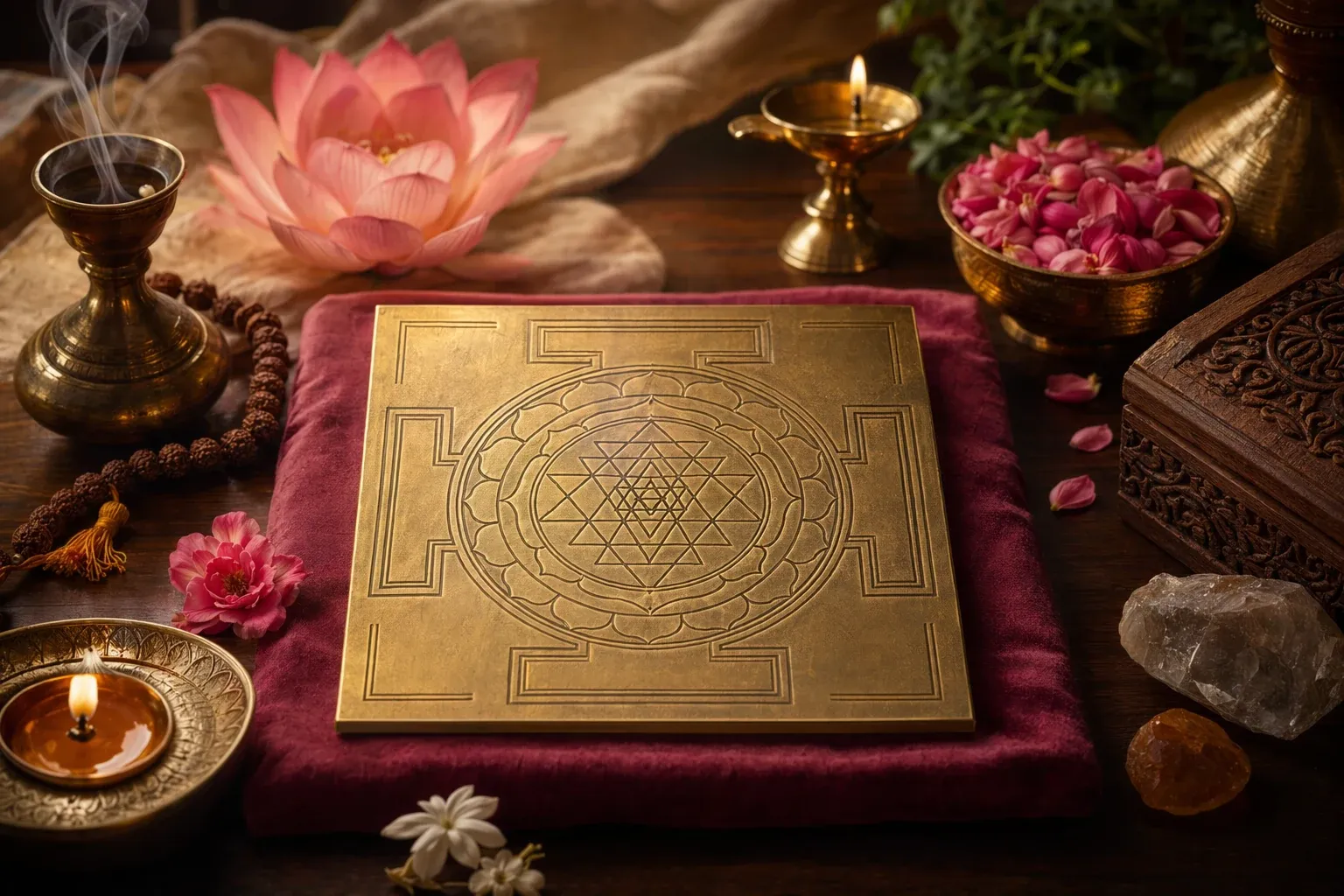
A yantra is a sacred geometric diagram used in Hindu traditions as a visual support for worship, meditation, concentration, and symbolic understanding. In simple language, it is a meaningful pattern: lines, triangles, circles, lotus forms, squares, and a central point arranged so the eye and mind can focus on a deeper idea.
Simple answer
The word is often explained from Sanskrit roots connected with an instrument, device, or support. That does not mean a yantra is a machine in the modern sense. It means the diagram functions as a tool for attention, devotion, and sacred mapping.
A yantra may be drawn on paper, engraved on metal, installed in a shrine, used in meditation, seen in temple culture, or studied as sacred art. Its purpose depends on the tradition and context.
Why context matters
A yantra should be read as sacred visual language, not as a decorative pattern alone. Its meaning comes from shape, mantra, deity association, ritual use, family tradition, teacher guidance, and the intention of the person using it. That is why two drawings that look similar online may not carry the same meaning in practice.
This matters because yantras often travel across many spaces: temple worship, home puja, meditation practice, sacred art, astrology shops, online images, and modern decor. A beginner does not need to master every detail immediately, but should avoid turning a living symbol into a superstition or aesthetic trend.
What makes a yantra different from ordinary geometry?
Ordinary geometry can be beautiful, balanced, and mathematically interesting. A yantra adds sacred intention and inherited meaning. The shapes are not random decoration; they usually point toward a deity, cosmic principle, mantra, or contemplative idea. The same triangle or circle can carry different meaning depending on the yantra and the tradition around it.
Where do people see yantras?
Beginners may notice yantras in home puja spaces, temples, astrology shops, meditation rooms, copper plates, wall art, books on Hindu symbols, and digital images. Some are used devotionally, some educationally, and some commercially. The respectful learner asks which setting they are looking at before making claims.
Why are yantras important?
Yantras matter because they show how Indian traditions often teach through image, sound, body, ritual, and story together. A mantra may be heard, a deity may be worshipped, a diagram may be seen, and the mind may be trained to return to one centre. The yantra becomes a bridge between visual form and inner attention.
How should a beginner approach one?
Start with curiosity and humility. Learn the name, the broad tradition, the deity or idea associated with it, and whether it is meant for worship, meditation, study, or decoration. Avoid treating sacred diagrams as lucky stickers or instant-problem solvers.
How beginners can learn respectfully
- Learn the name of the yantra and the broad tradition connected with it.
- Ask whether it is being used for worship, meditation, study, art, or home decor.
- Avoid sellers or posts that promise guaranteed money, instant healing, or fear-based consequences.
- Keep sacred diagrams clean and respectfully placed if you bring them into your home.
- For ritual use, follow family tradition or a trusted teacher instead of random instructions.
A good beginner approach is slow and curious. First understand the visual form. Then learn the cultural setting. Only after that should you think about practice details. This keeps the learning grounded and prevents overconfidence.
Common mistakes to avoid
- Calling every geometric pattern a yantra without checking context.
- Assuming one internet chart gives the final meaning of every shape.
- Buying a yantra out of fear or pressure.
- Using sacred symbols as jokes, costume props, or careless decoration.
- Treating devotion as a shortcut that replaces effort, ethics, study, or responsibility.
A simple way to read a yantra
When you see a yantra, begin from the outside and move inward. Notice the boundary first: does it frame the design like a sacred space? Then notice repeated shapes, petals, triangles, circles, and symmetry. Finally, bring attention to the centre point. This outside-to-inside reading helps beginners see the diagram as an ordered journey rather than a confusing pattern.
Next, ask what the yantra is connected with. Is it named for a deity, a mantra, a meditation method, a temple tradition, a home practice, or a general sacred-geometry lesson? The answer changes how carefully it should be handled. A study drawing, a framed devotional image, and a consecrated ritual object may look similar, but they are not treated in exactly the same way.
Questions beginners often ask
Is every yantra Hindu?
The word yantra is strongly associated with Indian traditions, especially Hindu practice, but related sacred diagrams and mandala-like forms also appear across wider South Asian religious art. In a Hindu context, always look for the specific deity, mantra, and tradition before making claims.
Can a yantra be used only as art?
Some people display yantra-inspired art because they appreciate the geometry. That can be done respectfully, but it is still wise to learn what the symbol means and avoid using sacred forms in mocking, careless, or inappropriate settings.
Do I need initiation to learn about yantras?
You do not need initiation to learn basic cultural meaning, art history, or respectful vocabulary. Formal ritual use is different. For advanced worship, mantra practice, or consecration, follow a qualified teacher or family tradition.
Safe and balanced expectations
This guide explains cultural and spiritual meaning, not guaranteed results. Yantras are often connected with devotion, concentration, blessing, protection, prosperity, learning, or wellbeing, but responsible learning avoids promises such as instant wealth, automatic healing, or fear-based rules. If a practice feels confusing, ask a trusted elder, family priest, teacher, or qualified guide instead of relying only on viral claims.
For young readers especially, the healthiest understanding is balanced: respect the tradition, notice the beauty, learn the meaning, and avoid dramatic claims. A yantra can be sacred, meaningful, and helpful for focus without being turned into a magic button.
Helpful next reads
For more background, read Hindu symbols for beginners and Sanskrit for beginners. These Bhaktilipi guides give public context around symbols, Sanskrit, mantras, yoga, or related Hindu traditions.
Final takeaway
A yantra is best approached as a sacred visual support: beautiful, ordered, symbolic, and rooted in practice. Whether you are seeing it in a temple, a home shrine, a meditation room, or a book, the respectful question is not only “what does this shape mean?” but also “what tradition, intention, and practice give this shape life?”