
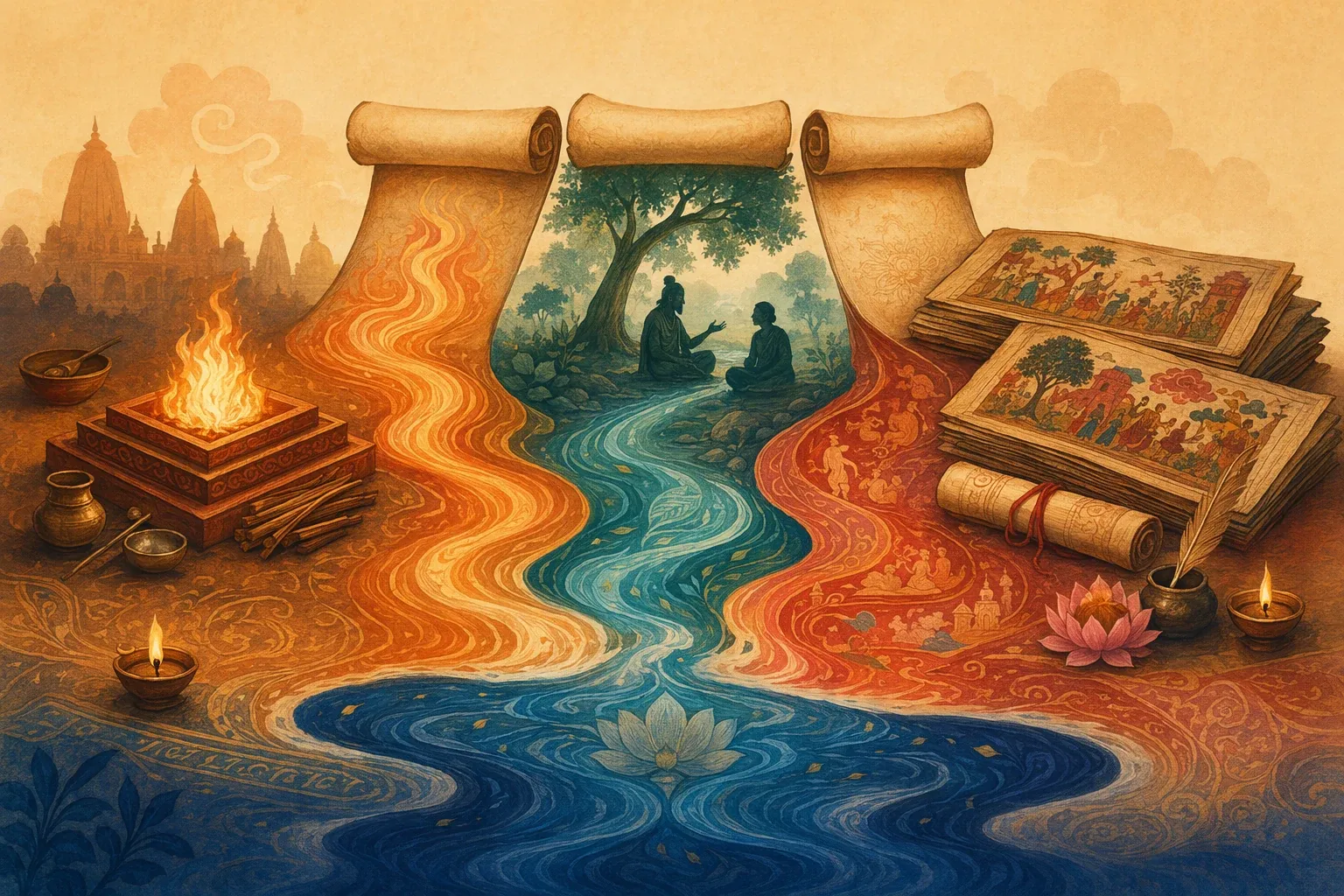
If you searched for “puranas and vedas”, this guide is for you. We will keep it simple, respectful, and useful for beginners.
Quick answer
The Vedas are regarded in Hindu tradition as the foundational Shruti, or “heard” revelation. The Upanishads are part of the Vedic world and explore deep questions about the Self, ultimate reality, knowledge, and liberation. The Puranas are Smriti texts that teach through stories, devotion, sacred history, cosmology, and cultural memory.
A simple way to remember it: Vedas are sacred foundations, Upanishads are philosophical depth, and Puranas are story-rich explanations that bring dharma and devotion into everyday imagination.
Vedas and Shruti
The Vedas are among the most ancient sacred texts of Hindu tradition. They include hymns, ritual material, chants, and philosophical portions. In many Hindu traditions, they hold the highest scriptural status because they are Shruti.
Shruti means “that which is heard.” This points to a sacred mode of transmission rather than ordinary authorship. The Vedas were preserved with great care through oral recitation and teacher-student lineages.
Upanishads and philosophy
The Upanishads are connected with the Vedas and often focus on questions like: Who am I? What is Brahman? What is Atman? What is liberation? Why does knowledge matter? They are central to Vedanta traditions.
Their style is usually more philosophical than story-heavy, though they also use dialogues, examples, and memorable images. For many readers, the Upanishads feel like deep spiritual inquiry.
Puranas and story-based teaching
The Puranas explain dharma, bhakti, cosmology, avatars, sages, kings, pilgrimage, and sacred geography through narrative. They speak to the imagination, not only the intellect. This made them powerful for public storytelling and devotional culture.
In many homes, people may know Puranic stories before they know the technical difference between Shruti and Smriti. That shows how deeply the Puranas entered popular culture.
Are Puranas part of the Vedas?
Puranas are not usually classified as Vedas in the strict Shruti sense. They are generally placed under Smriti, meaning remembered tradition. But this does not mean they are unimportant. Smriti texts shaped how communities understood and practiced dharma.
The relationship is not competition. Puranas often explain, expand, retell, or popularize ideas connected with the wider Hindu sacred universe.
How they work together
A student may approach the Vedas with reverence for sacred sound, the Upanishads for philosophical inquiry, and the Puranas for stories that make values memorable. Each has a role.
For beginners, the healthiest approach is not “which text should I reject?” but “what kind of teaching is this text offering?” That question keeps learning respectful and clear.