
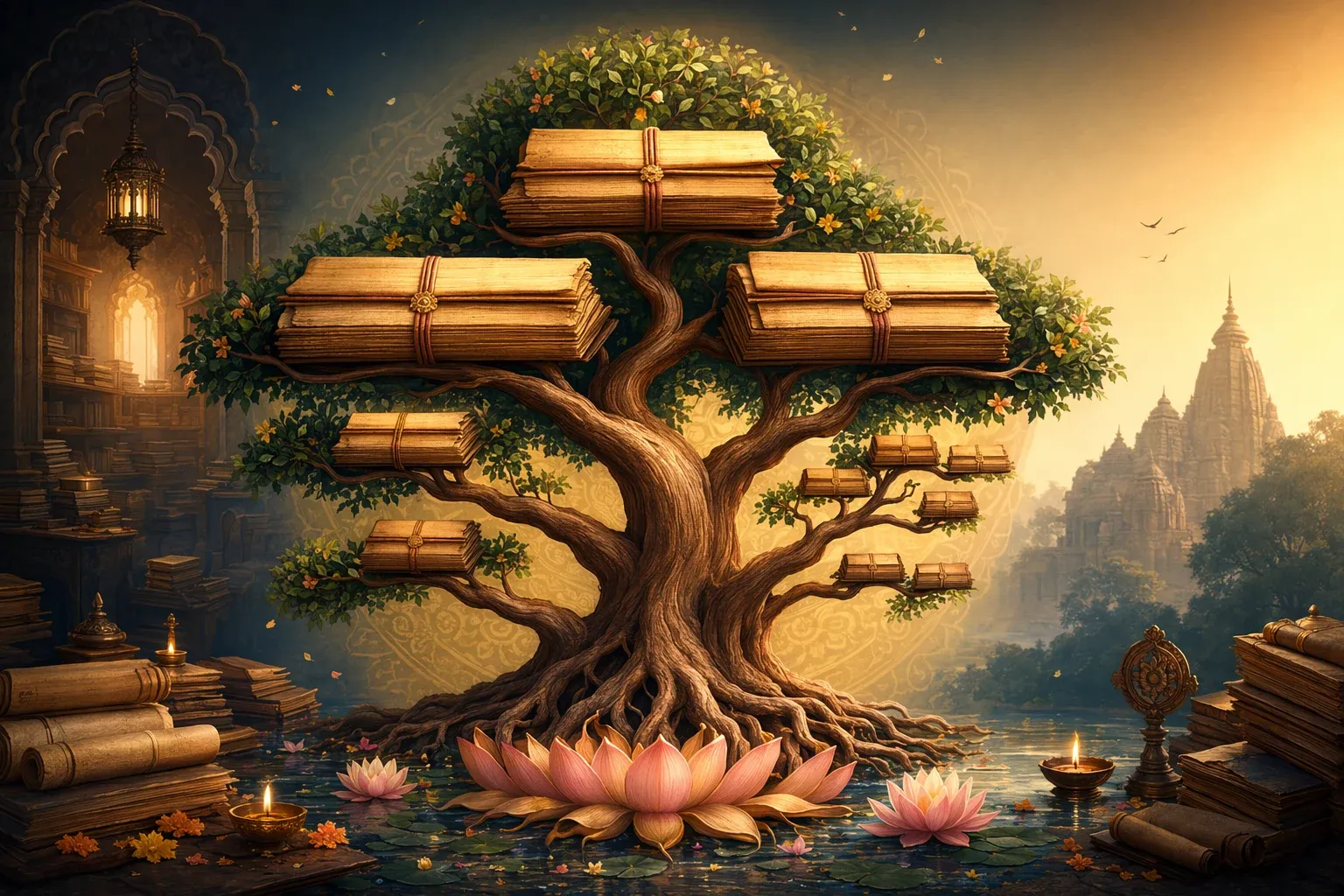
If you searched for “types of puranas”, this guide is for you. We will keep it simple, respectful, and useful for beginners.
Quick answer
Puranas are often grouped into Mahapuranas and Upapuranas. Mahapuranas are the 18 major Puranas most people hear about. Upapuranas are additional Puranic texts that may be important in specific traditions, regions, or devotional communities.
There are also traditional ways of classifying Puranas by deity focus, qualities, or subject matter. But beginners should not expect one perfect chart that every teacher, edition, or tradition uses in exactly the same way.
What does Mahapurana mean?
Maha means great, so Mahapurana means a great or major Purana. The standard list of 18 Mahapuranas became the best-known way to introduce Puranic literature. These texts cover creation, cosmic cycles, deities, avatars, stories, pilgrimage places, vows, rituals, genealogies, and dharma lessons.
A Mahapurana is not just a “story book.” It is a layered text, often containing devotional, cultural, cosmological, and social material. Some portions are easy for beginners; other portions need context.
What does Upapurana mean?
Upa means near, subsidiary, or secondary. Upapuranas are not usually part of the famous 18-name Mahapurana list, but they can still be meaningful. They may preserve regional traditions, specific deity worship, local sacred geography, or community practices.
Calling something an Upapurana should not make us dismiss it. In Indian traditions, a text can be locally loved even if it is not the first text named in a school chart.
Other classification ideas
Some traditional sources classify Puranas according to qualities such as sattva, rajas, and tamas, or by association with Vishnu, Brahma, or Shiva. Others may group them by subject focus: cosmology, pilgrimage, vrata, devotion, genealogy, or stories of particular deities.
These systems are teaching tools. They help students notice patterns, but they do not always explain every chapter neatly. A long Purana can contain many voices and themes.
Why classification is not always fixed
Puranic texts travelled through oral recitation, manuscript copying, local storytelling, and sectarian devotion. Over time, different communities preserved and emphasized different materials. That is one reason charts and lists may vary.
For a beginner, this should reduce anxiety. If two sources classify a Purana differently, do not immediately assume one is fake. Ask what method each source is using.
Beginner takeaway
Think of Mahapuranas as the major, widely recognized Puranas, and Upapuranas as additional Puranic texts that enrich the tradition. Classification helps, but it is not the whole story.
The best way to learn is to combine structure with curiosity: know the basic categories, then explore stories, values, and cultural context without forcing every text into a tiny box.