
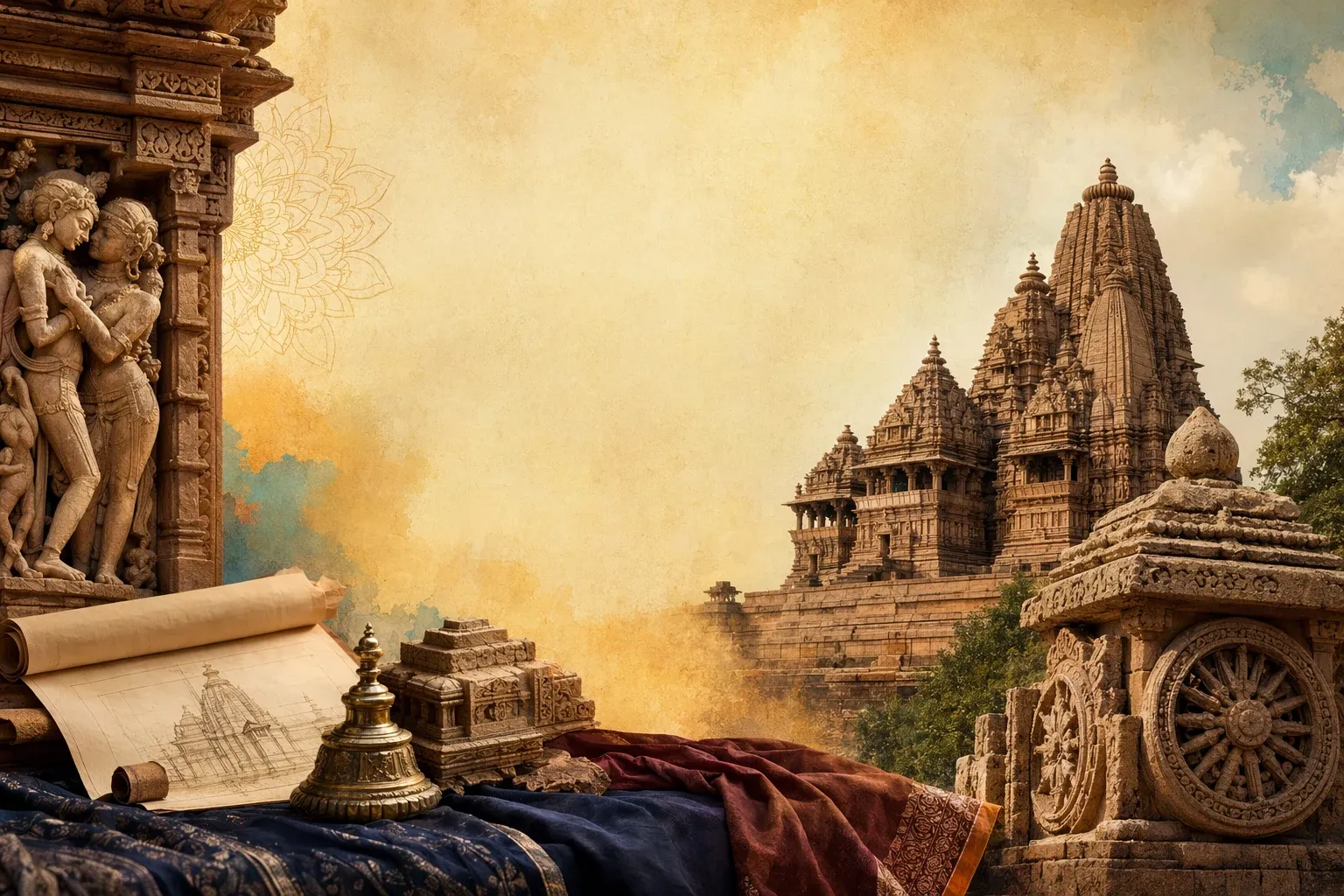
Khajuraho is often reduced to one subject: its erotic sculptures. That is the easiest way to recognise the site, but it is not the best way to understand it. The temples of Khajuraho are among the finest examples of medieval North Indian temple architecture. Their real power comes from the way stone, plan, sculpture, height, rhythm, and sacred storytelling work together.
The Khajuraho Group of Monuments stands in present-day Madhya Pradesh and is linked with the Chandela dynasty. Most of the major temples were built between about the 10th and early 11th centuries. Historical accounts say the area once had many more temples than survive today. Around 25 remain from a larger sacred landscape. These temples include Hindu and Jain monuments, showing that Khajuraho was not a single-shrine site but a planned cultural world.
The Chandela setting
The Chandelas ruled in the Bundelkhand region, with important centres such as Mahoba and Kalinjar nearby. Their temple building at Khajuraho expressed devotion, royal confidence, artistic ambition, and regional identity. Temples such as Lakshmana, Vishvanatha, Kandariya Mahadeva, Chitragupta, Parsvanatha, Vamana, Javari, and Duladeo are not random tourist stops. They belong to a larger programme of sacred architecture developed over generations.
A beginner should remember that Khajuraho is not one temple. It is a group, usually discussed in Western, Eastern, and Southern clusters. The Western group is the most famous because it includes major monuments such as Lakshmana and Kandariya Mahadeva. The Eastern group includes important Jain temples like Parsvanatha, along with Hindu shrines. This spread helps us see Khajuraho as a religious and artistic landscape, not merely a sculpture gallery.
Nagara architecture at Khajuraho
Khajuraho temples belong broadly to the Nagara tradition of North Indian temple architecture. In simple words, Nagara temples usually have a sanctum crowned by a curving tower called a shikhara. The temple plan often includes a sequence of spaces: entrance porch, halls or mandapas, sometimes a vestibule, and the sanctum or garbhagriha. At Khajuraho, these parts are arranged with great confidence, so the visitor feels pulled inward and upward.
The temples often stand on high platforms. This raises the sacred structure above the surrounding ground and gives space for circumambulation. The platform also changes how the temple is seen. From a distance, the building rises like a mountain. As you come closer, the walls break into projections and recesses, creating shadow, movement, and many surfaces for sculpture. The result is not a flat wall but a living skin of stone.
The mountain effect
One of the most beautiful features of Khajuraho architecture is the way smaller spires gather around the main shikhara. The effect is like a mountain range climbing toward a peak. Kandariya Mahadeva, the largest and most celebrated temple at the site, makes this especially clear. Its clustered tower form gives a sense of rising energy, as if the whole temple is moving toward the sky.
This mountain idea is important in Hindu temple symbolism. The temple is often interpreted as a sacred mountain, a meeting point between earth and the divine. The sanctum is the still centre. The tower above it marks the upward axis. The surrounding spires, halls, and sculptural bands help the eye move from outer world to inner presence. Even before one studies every deity or carving, the architecture teaches this movement.
Sculpture as part of the building
Khajuraho’s sculptures are famous, but they should not be separated from the architecture. They are not pasted onto the building as decoration after the real work is done. They are built into the rhythm of the walls. Deities, apsaras, guardians, musicians, couples, animals, dancers, warriors, and scenes of daily life fill the outer surfaces. The temple becomes a whole cosmos in stone.
The erotic panels are a small but memorable part of this larger sculptural world. They have been interpreted in many ways: as symbols of fertility, auspiciousness, worldly life, tantric ideas, or the full range of human experience outside the sanctum. A careful description should not pretend that there is only one final explanation. What is clear is that Khajuraho does not treat spirituality as empty of life. The sacred centre is approached through a world that includes beauty, desire, music, strength, grace, and ordinary human presence.
Key temples to notice
Lakshmana Temple is one of the important early monuments at Khajuraho and is dedicated to Vishnu in his Vaikuntha form. It helps beginners see the mature grammar of platform, sanctum, mandapas, and sculptural bands. Kandariya Mahadeva, dedicated to Shiva, shows the grand peak of the style with its soaring tower and dense sculpture. Vishvanatha Temple also belongs to the Shaiva world and carries strong architectural presence.
Chitragupta Temple is associated with Surya, the Sun, while the Jain temples such as Parsvanatha show that Khajuraho’s sacred geography included more than one religious community. This diversity is important. The site is not only a Hindu monument group with a single story; it is a medieval landscape where Hindu and Jain traditions found expression through related architectural language.
Why the layout matters
Many Khajuraho temples are entered from the east, though local variations exist. The visitor climbs the platform, passes through the porch and halls, and moves toward the sanctum. The journey is gradual. Light shifts, ceiling height changes, carvings surround the path, and the body becomes aware of transition. This is one reason temple architecture cannot be fully understood from photographs alone.
The plan also creates a relationship between outside and inside. The outside is full of visible life and movement. The inner sanctum is darker, quieter, and more focused. This contrast is not accidental. It helps express the movement from the many forms of the world toward the concentrated presence of the deity.
Tradition, interpretation, and evidence
Devotees may experience Khajuraho through darshan, deity, and sacred memory. Art historians study the Chandelas, inscriptions, sculptural programmes, regional style, and comparisons with other Nagara temples. Travellers often first encounter the site through its visual impact. All these approaches can be valid if they are kept honest.
What we should avoid is the lazy claim that Khajuraho is only about erotic art. That view shrinks one of India’s great architectural achievements into a headline. Khajuraho is about temple form, Chandela imagination, sacred mountain symbolism, sculptural storytelling, and the relationship between worldly life and inner focus. The famous sculptures matter, but they make the most sense when we see the temple as a complete sacred building.
A simple way to remember Khajuraho
Think of Khajuraho in three layers. First, the historical layer: Chandela-era temples in central India, built mainly between the 10th and 11th centuries. Second, the architectural layer: high platforms, Nagara shikharas, mandapas, sanctums, and mountain-like composition. Third, the artistic layer: a rich sculptural world that includes gods, goddesses, dancers, everyday life, couples, and cosmic imagination.
When these layers come together, Khajuraho becomes much more than a “famous sculpture” destination. It becomes a lesson in how Indian temple architecture can turn stone into movement, devotion into space, and a whole vision of life into a sacred form.