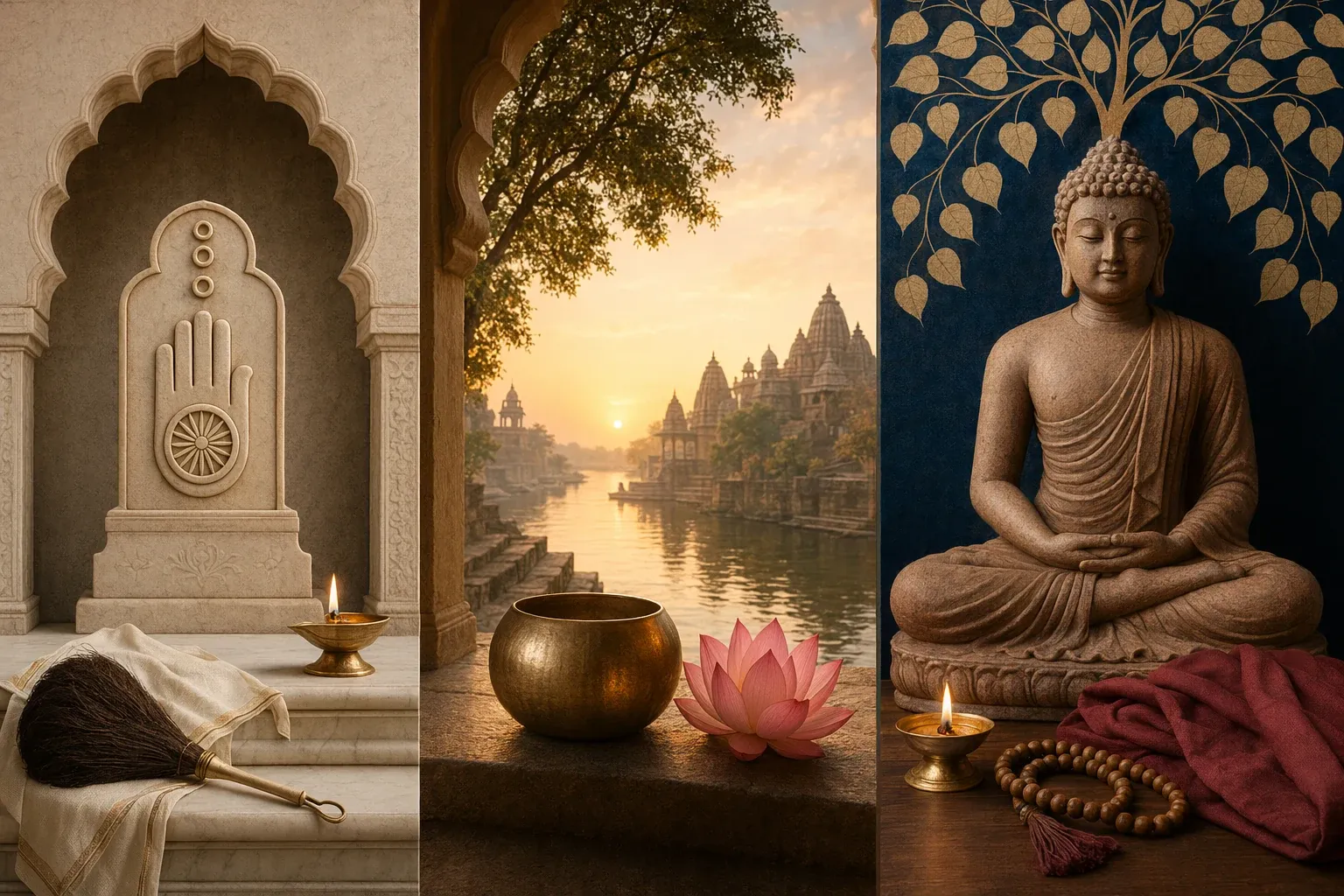
Jainism and Buddhism are often compared because both became historically visible in ancient India around the age of Mahavira and the Buddha. Both questioned ordinary attachment, took karma and rebirth seriously, valued renunciation, built monastic communities, and offered a path toward freedom from suffering or bondage.
They are similar enough to compare, but different enough that we should not treat them as the same tradition. Their views of soul, karma, liberation, discipline, and later history are deeply distinct.
Why people compare them
Both Jainism and Buddhism arose in the wider shramana world of ancient India. This was a culture of seekers, monks, nuns, forest wanderers, debate, meditation, austerity, and questions about how to escape the cycle of birth and death. Both traditions created communities beyond household life and challenged people to look beyond pleasure, status, and ritual habit.
Both are also non-Vedic in the sense that they do not place the Vedas at the centre of authority the way many Hindu traditions do. That is one reason school books often study them together.
Shared ideas
Both traditions value discipline, compassion, ethical conduct, non-attachment, and liberation. Both have monks and nuns. Both inspired art, pilgrimage, teaching lineages, debate, festivals, and international attention. Both also influenced wider Indian ideas about non-violence, restraint, and spiritual seriousness.
The public memory of Mahavira and the Buddha is sometimes joined in modern festival calendars and educational writing. For one example of shared public remembrance, see our article on Mahavir Jayanti and Buddha Purnima observances.
Difference in soul
This is one of the biggest differences. Jainism teaches that souls, or jivas, are real and eternal. Liberation means the soul becomes free from karmic bondage and exists in its pure perfected state. Buddhism generally teaches anatta, or no permanent self, though Buddhist schools explain this in different philosophical ways.
So even when both traditions speak about liberation, they do not mean exactly the same thing. Jain liberation is the soul’s freedom from karma; Buddhist awakening is freedom from ignorance, craving, and the mistaken clinging to a permanent self.
Difference in karma and practice
Jainism has a very detailed understanding of karma as subtle bondage connected with the soul. It places extraordinary emphasis on ahimsa, vows, austerity, careful conduct, and reducing harm to living beings. The strictness of practice differs between monks, nuns, and householders, but the ideal is very demanding.
Buddhism also teaches karma and ethical conduct, but its path is framed through teachings such as the Four Noble Truths, the Noble Eightfold Path, mindfulness, wisdom, compassion, and meditation. Different Buddhist traditions developed many forms, from Theravada to Mahayana and Vajrayana. Our article on awakening across Buddhist traditions gives a broader Buddhist context.
Who came first: Buddha or Mahavira?
They lived in roughly the same ancient Indian period, though exact dates are discussed by scholars and traditions. Instead of turning the question into a competition, it is better to see both as great teachers in a shared age of intense spiritual questioning.
Monks, nuns, and householders
Both traditions developed monastic communities, but the relationship between renouncers and householders is important. Monks and nuns preserve demanding ideals of discipline, study, meditation, and restraint. Householders support them and practise adapted forms of ethics while managing family and work. This creates a full community, not only a philosophy for isolated seekers.
In Jainism, the difference between ascetic and lay practice is especially visible in food, movement, possessions, and vows. In Buddhism, monastic codes, meditation, teaching, and lay merit developed differently across countries and schools. Comparing lived communities is often clearer than comparing only abstract terms.
Liberation is not the same word with the same meaning
Both traditions speak about freedom from bondage or suffering, but the inner logic differs. Jainism describes a soul becoming free of karmic matter and rising to its liberated state. Buddhism describes awakening through the ending of ignorance and craving, without accepting a permanent self in the same way.
This difference is not a small footnote. It shapes practice, meditation, ethics, philosophy, and how each tradition imagines the final goal. Similar vocabulary can hide deep contrast, so a good comparison should slow down here.
Ahimsa and the middle path
Jainism is especially famous for uncompromising ahimsa and careful avoidance of harm. Buddhism is famous for the Middle Way, compassion, mindfulness, and freedom from craving. Both value ethical conduct, but their tone differs: Jain discipline often feels sharper and more rule-oriented, while Buddhist explanations often emphasize mental training and the ending of craving.
This is a general beginner comparison, not a judgement. Jain and Buddhist communities are internally diverse, and both include devotional, philosophical, monastic, and lay dimensions. The point is to notice each tradition’s distinctive grammar rather than flattening them into one “ancient Indian spirituality”.
A helpful memory trick is this: Jainism protects the idea of an eternal soul seeking release from karmic bondage; Buddhism questions the permanent self and focuses on awakening from craving and ignorance. Both are profound, but they solve the human problem through different maps.
What beginners should remember
To understand the wider language of Indian action and consequence, our karma guide is useful background, even though Jain and Buddhist explanations are not identical.
Jainism and Buddhism share ancient Indian context, renunciation, ethics, karma, and liberation-seeking. But Jainism teaches an eternal soul and a highly detailed karma-bondage path, while Buddhism is famous for no-self teaching and its own path of awakening. Comparing them respectfully helps us see how rich ancient Indian philosophy really was.