
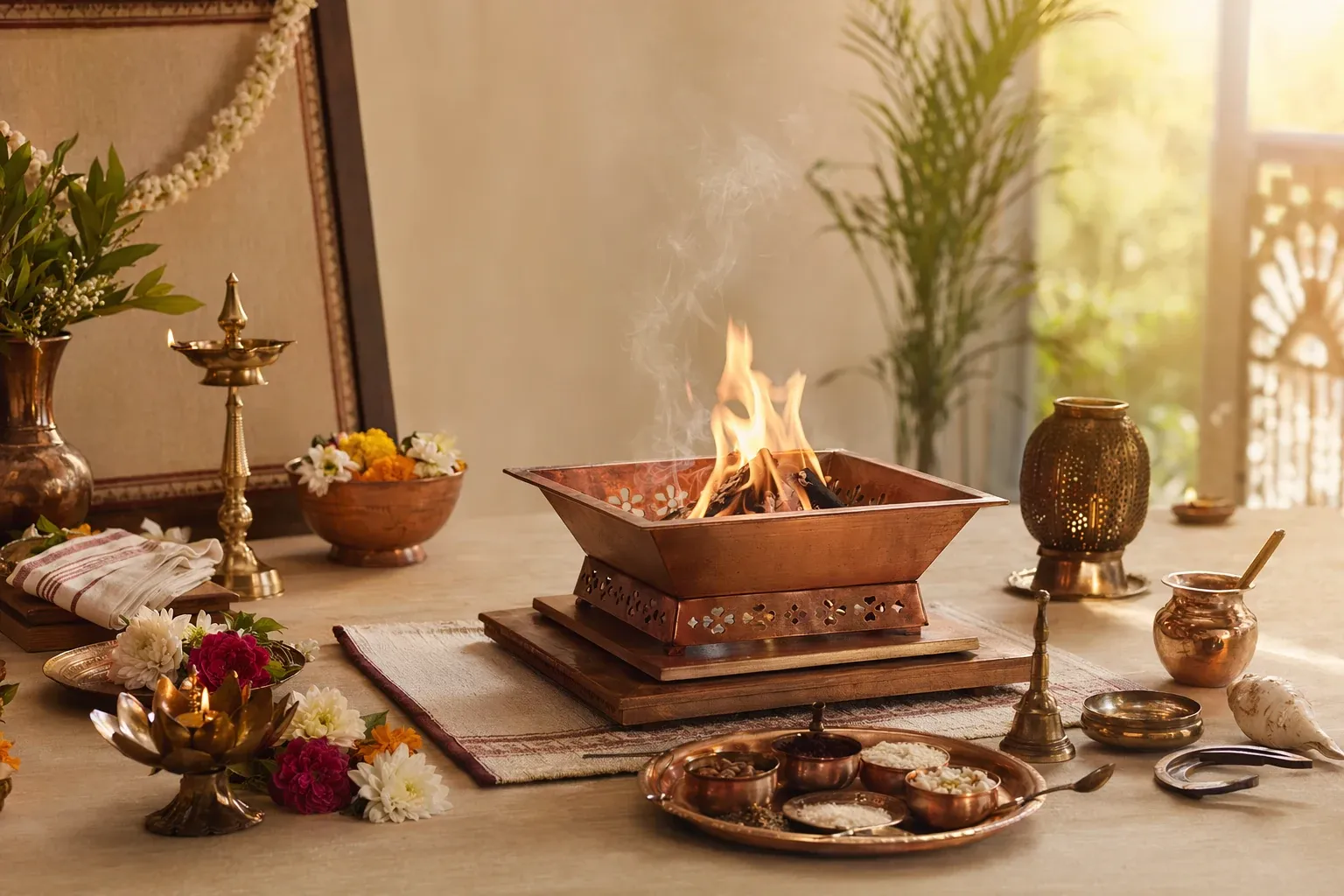
A home yajna or havan should be approached with respect, safety, and guidance. Sacred fire is not a casual experiment, and beginners should be careful about materials, ventilation, children, pets, smoke, and local rules.
This guide gives a safe educational overview of how a simple home practice is usually structured, while making clear where elders, priests, or qualified guidance matter.
Simple answer
A simple home yajna should be learned respectfully, kept safe, and done with guidance instead of treating sacred fire as a casual experiment.
In Hindu tradition, yajna usually means an offering made with reverence. Many yajnas use fire, mantras, and offerings, but the deeper idea is disciplined giving: offering something valuable with gratitude, responsibility, and a wish for harmony.
People often arrive at this topic through related phrases such as how to perform a simple yagna at home safely, how to do yagna, how to perform yagna at home, how to pronounce yagna. The important thing is to understand the idea clearly, not just memorize a translation.
Why the idea matters
For young readers, yajna is easiest to understand as sacred reciprocity: humans receive from nature, ancestors, teachers, family, society, and the divine, so they respond through gratitude, restraint, service, and offering.
Yajna should not be reduced to smoke, spectacle, or quick results. Different families, regions, temples, and lineages may follow different procedures, so practical details are best learned from a trusted priest, elder, or tradition-aware guide.
A beginner should not treat fire ritual like a DIY performance copied from random clips. Use a small, safe setup, keep water or sand nearby, avoid synthetic materials, ensure ventilation, and learn mantras and procedure from a reliable source.
If a family has a priest or elder, follow their guidance. If health conditions, smoke sensitivity, rented housing rules, or fire restrictions are present, choose prayer, lamp worship, study, charity, or another safer expression of devotion.
Before you begin: intention and respect
A beginner should not treat fire ritual like a DIY performance copied from random clips. Use a small, safe setup, keep water or sand nearby, avoid synthetic materials, ensure ventilation, and learn mantras and procedure from a reliable source.
For yajna topics, always separate symbol from superstition. Fire, offerings, mantras, and materials have meaning, but the heart of the practice is reverence, disciplined giving, and responsibility.
Safety first: fire, ventilation, children, materials
If a family has a priest or elder, follow their guidance. If health conditions, smoke sensitivity, rented housing rules, or fire restrictions are present, choose prayer, lamp worship, study, charity, or another safer expression of devotion.
For yajna topics, always separate symbol from superstition. Fire, offerings, mantras, and materials have meaning, but the heart of the practice is reverence, disciplined giving, and responsibility.
Simple structure of a home havan/yajna
This part matters because “Simple structure of a home havan/yajna” is usually where beginners get confused. A simple way to read it is to connect the word with its purpose, its traditional context, and its everyday lesson.
For yajna topics, always separate symbol from superstition. Fire, offerings, mantras, and materials have meaning, but the heart of the practice is reverence, disciplined giving, and responsibility.
When a priest or elder is appropriate
This part matters because “When a priest or elder is appropriate” is usually where beginners get confused. A simple way to read it is to connect the word with its purpose, its traditional context, and its everyday lesson.
For yajna topics, always separate symbol from superstition. Fire, offerings, mantras, and materials have meaning, but the heart of the practice is reverence, disciplined giving, and responsibility.
Common beginner mistakes to avoid
This part matters because “Common beginner mistakes to avoid” is usually where beginners get confused. A simple way to read it is to connect the word with its purpose, its traditional context, and its everyday lesson.
For yajna topics, always separate symbol from superstition. Fire, offerings, mantras, and materials have meaning, but the heart of the practice is reverence, disciplined giving, and responsibility.
Common misunderstandings
- Yajna is not only “putting things into fire”; it is a disciplined offering.
- Bigger ritual does not automatically mean deeper devotion.
- Regional words such as havan, homa, and homam need context.
- Sacred practice should never ignore health, safety, or environmental care.
Simple answers to common questions
How to perform a simple yagna at home safely?
Yajna should not be reduced to smoke, spectacle, or quick results. Different families, regions, temples, and lineages may follow different procedures, so practical details are best learned from a trusted priest, elder, or tradition-aware guide.
How to perform yagna at home?
Yajna should not be reduced to smoke, spectacle, or quick results. Different families, regions, temples, and lineages may follow different procedures, so practical details are best learned from a trusted priest, elder, or tradition-aware guide.
How to do yagna?
Yajna should not be reduced to smoke, spectacle, or quick results. Different families, regions, temples, and lineages may follow different procedures, so practical details are best learned from a trusted priest, elder, or tradition-aware guide.
The next sections add plain-language context so the article is more useful as a complete beginner guide.
A beginner-friendly way to read this
This guide is mainly about How to Perform a Simple Yajna at Home Safely: Beginner Guide and Boundaries. The useful way to read it is not as a final verdict, but as a beginner-friendly map: learn the key idea, notice the context, and then connect it with the wider Indian cultural world. Important terms in this article include Perform, Yajna, Home, Safely, Boundaries. The central angle is: Give a safe, respectful, non-prescriptive overview: preparation, intention, cleanliness, adult supervision, fire safety, ventilation, and when to ask family elders/priest. Avoid pretending to replace parampara or qualified ritual guidance.
Yajna is often translated too quickly as fire ritual, but the idea is wider: offering, discipline, sacred action, intention, mantra, community, and the symbolic role of Agni. For beginners, it helps to separate everyday family practice from large scriptural or royal rituals described in stories.
What to remember
Modern readers should be careful with safety and context. Fire rituals involve smoke, materials, mantras, local custom, and sometimes trained priests. A respectful article should not encourage risky imitation, commercial fear, or superstition. It should explain the meaning while reminding readers to follow local guidance and practical safety.
A good memory trick is to connect the idea with three layers: the word itself, the lived practice around it, and the value it points toward. That method keeps the article practical for students while still respecting the tradition behind it.
The cultural value of yajna is the idea that action can be offered with responsibility. Whether the article discusses the Bhagavad Gita, homam, havan, or famous yajnas, the deeper thread is disciplined karma rather than spectacle.
Where to go next
For a wider base before going deeper, read our Yajna meaning guide. It gives the surrounding context so this article feels less isolated.
Common misunderstandings to avoid
A common mistake is to treat How to Perform a Simple Yajna at Home Safely: Beginner Guide and Boundaries as only one sentence or one social-media definition. In reality, Yajna tradition topics usually carry many layers: language, practice, regional memory, family tradition, teacher explanation, and modern interpretation. A beginner guide should simplify the entry point, but it should not erase that depth.
Another mistake is to assume that one version explains every community. Indian traditions often travel through many regions and languages, so examples may differ. That does not make the topic confused; it means the tradition is alive and has been remembered in more than one way.
The safest reading habit is to keep the main idea clear and hold details gently. Start with what the word means, then notice where it appears, who practices or discusses it, and what value it is trying to teach. This makes How to Perform a Simple Yajna at Home Safely: Beginner Guide and Boundaries easier to remember without forcing a narrow answer.
Why this matters today
This topic still matters because young readers are meeting Indian culture through school, family stories, social media, travel, music, health conversations, and festival posts. Without context, the same idea can look either too mysterious or too casual. A clear explanation helps readers respect the subject without feeling lost.
For Bhaktilipi readers, the practical value is not just information. The goal is better cultural literacy: knowing enough to ask good questions, avoid lazy stereotypes, and recognise why earlier generations preserved these ideas through stories, songs, rituals, debates, art, and daily habits.
Good learning also means knowing the limits of a short article. This guide gives a reliable starting point, but deeper study can come from teachers, trusted books, temple or community elders, museums, performances, and careful reading of primary traditions where possible.
Simple takeaway
If you remember only one thing, remember this: How to Perform a Simple Yajna at Home Safely: Beginner Guide and Boundaries becomes meaningful when the definition, the cultural setting, and the human purpose are read together. That balanced view protects the topic from both blind rejection and blind romanticisation.
Use this article as a first map. Revisit the key words, compare them with real examples, and keep learning patiently. Dharma-oriented learning is not about collecting facts quickly; it is about understanding what those facts ask us to value and practice.
Related Bhaktilipi guides
For related reading, start with our Yajna beginner guide, then explore Pancha Maha Yajna and the yajna samagri guide.