
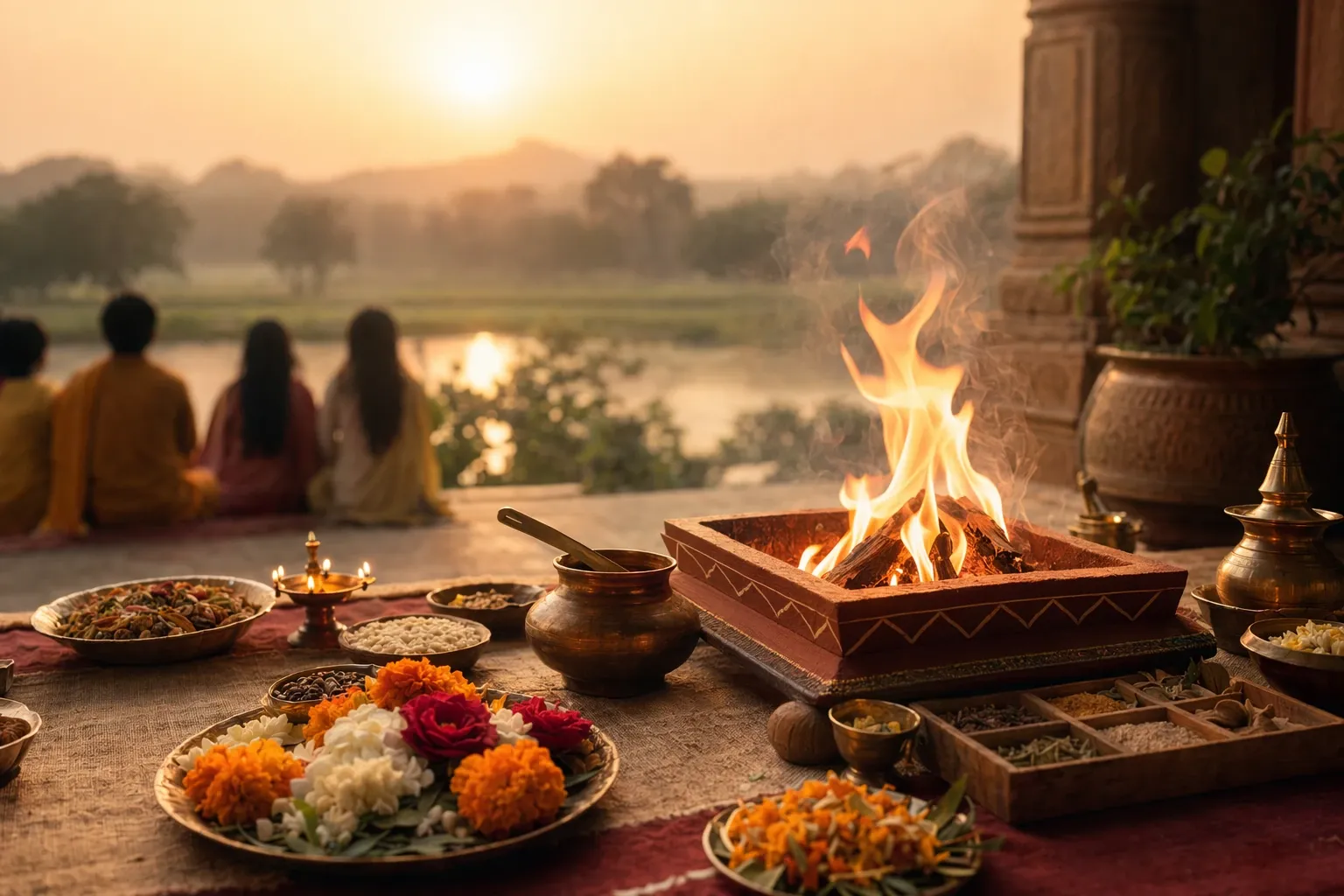
Yajna is one of the oldest and most meaningful ideas in Hindu tradition. Many people picture a sacred fire, a priest chanting mantras, offerings placed into the flames, and family members sitting around with folded hands. That picture is important, but yajna is also bigger than the visible ritual.
At a simple level, yajna means a sacred offering. In Vedic tradition, it is closely connected with fire, mantra, Agni, and the relationship between humans, deities, nature, and cosmic order. At a deeper level, yajna teaches that life becomes meaningful when we give, not only when we take.
What happens in a Yajna?
A traditional fire yajna usually involves a prepared fire altar or kund, mantras, offerings such as ghee or samagri, and a trained priest or knowledgeable guide depending on the ritual. Agni, the sacred fire, is understood as the carrier of offerings to the deities.
If you are new to Vedic background, start with our Vedas beginner guide and then read about Vedic mantras for beginners for chanting context.
The exact process varies by purpose, region, family tradition, and text. A small home havan is not the same as a large Vedic ritual. Beginners should avoid pretending that one online checklist covers every tradition.
Yajna, havan, homa, and puja
People often use words like yajna, yagna, havan, homa, and puja together. They overlap, but they are not always identical. Puja usually refers to worship through offerings such as flowers, lamps, food, water, and mantra before a deity. Havan or homa usually refers to fire offerings. Yajna can refer to fire ritual, but also to a wider principle of sacred offering.
In everyday speech, families may use these words flexibly. That is normal. The key is to understand the spirit: reverence, offering, mantra, discipline, and connection with the sacred.
Tradition, interpretation, and history
In tradition, yajna is central to the Vedic world. The Vedas contain many hymns and ritual contexts connected with offering, Agni, and cosmic order. Yajna was not seen as random burning; it was a disciplined sacred act connected with rita, duty, gratitude, and harmony.
In interpretation, yajna can be understood both outwardly and inwardly. The outer ritual uses fire and offerings. The inner meaning asks: what am I offering? Ego, laziness, greed, anger, time, service, attention, and selfishness can also become offerings when life is lived with discipline.
Historically, yajna traditions changed across time. Large royal rituals, domestic rites, temple cultures, bhakti practices, and modern family ceremonies all shaped how people understand sacred offering today.
Yajna in the Bhagavad Gita
The Bhagavad Gita expands the idea of yajna beautifully. It speaks of different forms of offering and teaches that action done with the right spirit can become yajna. This means yajna is not only about ritual performance; it is also about transforming ordinary action into selfless duty.
For young readers, this is powerful. Studying sincerely, serving family, helping society, controlling harmful impulses, and using talent for good can all carry the spirit of yajna when done without selfish obsession.
Safety and respect
Fire rituals require care. Do not perform large or complex rituals without proper guidance. Keep fire safety in mind, use appropriate materials, ensure ventilation, and respect local rules. If a family has a priest or elder tradition, follow that guidance rather than random internet instructions.
Also avoid exaggerated claims. Yajna may be spiritually meaningful and culturally beautiful, but it should not be marketed as a guaranteed cure for disease or a replacement for professional help. Respectful faith does not need fake promises.
Why Yajna still matters
Yajna reminds us that receiving and giving must stay balanced. We receive air, food, sunlight, family care, language, culture, and knowledge. A life of only taking becomes heavy. A life of offering becomes lighter.
The sacred fire is a visible teacher. It transforms what is offered into light and warmth. In the same way, when we offer ego, effort, and love into the work of dharma, ordinary life can become sacred. That is the living heart of yajna.
Common beginner mistakes
One mistake is focusing only on the smoke and missing the discipline. A yajna is not powerful because things are burned randomly. It is meaningful because mantra, intention, offering, order, and reverence come together. Without that spirit, the outer action becomes empty.
Another mistake is assuming bigger is always better. A small, sincere family ritual done safely and respectfully may be more meaningful than a grand event performed for show. The inner quality of offering matters deeply.
A simple way to live the idea
Even if you are not performing a fire ritual, you can practise the spirit of yajna. Offer time to study, help at home without drama, share food, reduce waste, speak truthfully, and dedicate your work to something larger than ego. This makes the idea practical.
When you later sit near a sacred fire, the symbolism will feel clearer. The flame receives, transforms, and rises. Human effort can do the same when it is offered with clarity, gratitude, and dharma.
Learning without reducing it
Beginners should learn the vocabulary slowly: Agni, mantra, ahuti, samagri, kund, sankalpa, and prasad. Each word opens a part of the ritual world. But vocabulary alone is not understanding. The mood of reverence matters just as much.
Yajna also teaches ecology of gratitude. We depend on earth, water, fire, air, space, ancestors, teachers, family, and society. Offering reminds us that life is relational. We are not isolated consumers; we are participants in a larger order.
That is why the idea remains relevant even for someone learning from a city apartment. Whenever you turn selfish action into sincere offering, the meaning of yajna has begun to enter your life.