
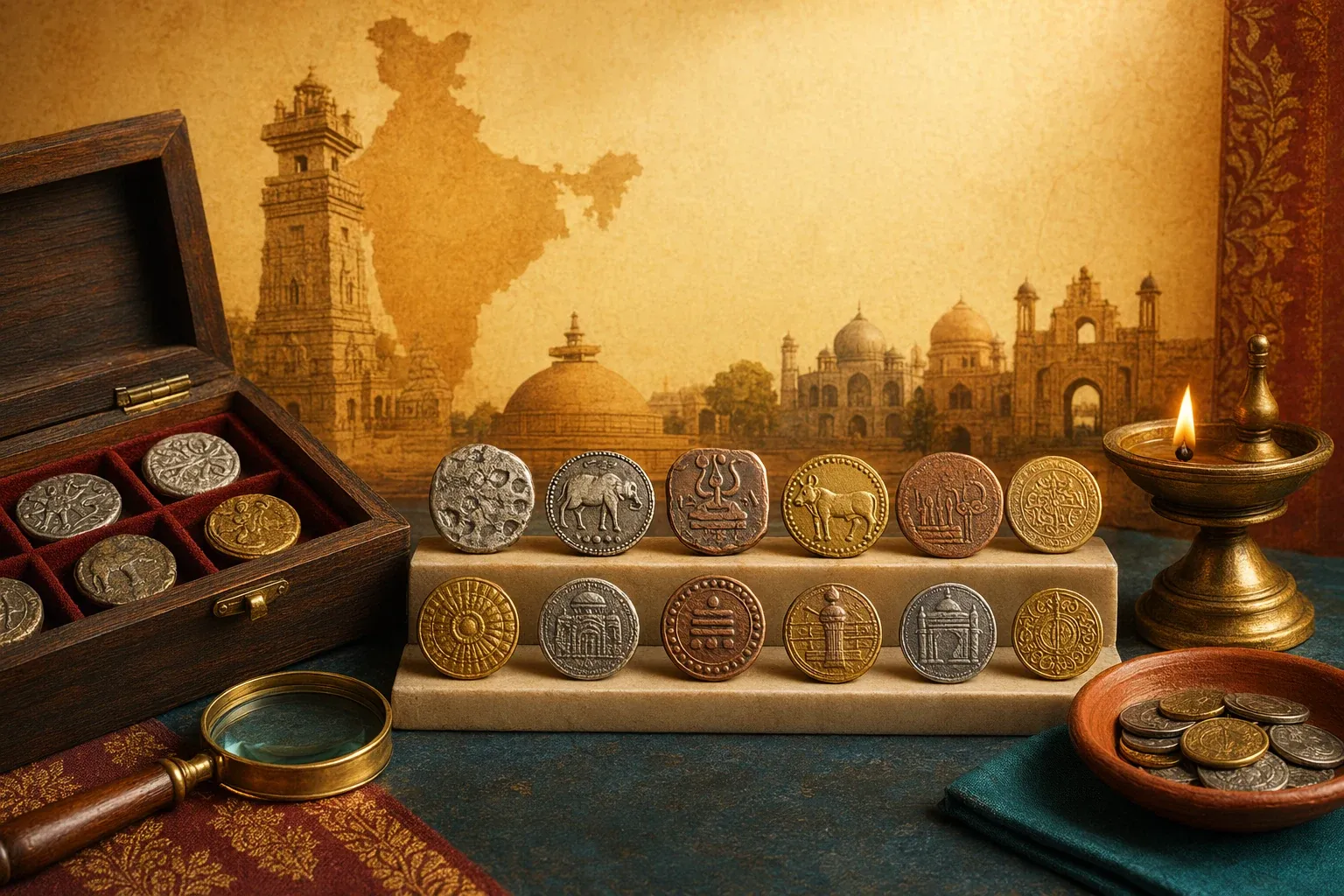
The history of Indian coinage is not one straight line. It is a long, layered story shaped by trade routes, kingdoms, regional economies, scripts, metals, empires and modern law. Coins changed because society changed. A punch-marked silver coin, a gold coin of a powerful dynasty, a Mughal rupee, a princely-state issue and a modern Indian coin all belong to different worlds, yet they share one purpose: trusted exchange backed by authority.
For beginners, the easiest way to understand Indian coinage is through broad periods. Exact dates can vary by region, and many systems overlapped. Still, a simple timeline helps us see how money moved from marked metal pieces to standardised modern currency.
Early and ancient coinage
Among the earliest famous Indian coins are punch-marked coins. Instead of a single stamped design, many carried multiple marks or symbols. They show that people were using metal objects in organised exchange long before modern coin shapes became familiar. These coins are important because they connect trade, administration and early urban life.
Later ancient coinage became more varied. Indo-Greek, Kushana, Satavahana, Gupta and many regional issues show rulers, deities, animals, scripts and symbols. Some coins tell us about cultural contact across Central Asia, northwest India, the Deccan and the Gangetic plains. Others show how local powers expressed authority in their own visual language.
Medieval, Sultanate and Mughal periods
Medieval coinage brought new political and artistic styles. Delhi Sultanate coins often used Islamic calligraphy and titles. Regional kingdoms continued to issue coins in different metals and scripts. In some areas, temple economies, trade guilds and coastal exchange influenced what circulated and how coins were understood.
Mughal coinage is especially famous for its quality, calligraphy and imperial messaging. The rupee became a strong monetary idea, and coins carried names, titles, dates and mints. Mughal coins also remind us that currency was not only about shopping; it was a public sign of sovereignty. A ruler’s name on a coin announced who claimed authority.
Colonial and princely-state coinage
The colonial period changed coinage through standardisation, machine minting and the political reach of the East India Company and later the British Crown. Designs shifted as power shifted. Portraits, English legends, Indian scripts, denominations and mint marks became part of a more regulated currency system.
At the same time, princely states and regional issues add complexity. India was not a single coinage story in every district at every moment. Collectors and historians must pay attention to place, date, ruler, mint and denomination rather than assuming one national pattern before independence.
Modern Indian coins
After independence, Indian coinage moved into a national system shaped by the Republic of India, decimalisation, changing metals and changing public needs. Modern coins carry national symbols, denominations, years, mint marks and sometimes commemorative themes. Their designs may feel ordinary now, but they record the values and priorities of their time.
The big lesson is that coins are historical evidence only when read in context. A coin can show authority, trade, metal supply, technology and identity. It cannot explain an entire period alone. Read coins beside inscriptions, ports, monuments, texts and archaeology, and the history becomes richer and safer.
Learning Indian coins responsibly
The responsible way to learn Indian coins is to treat each coin as evidence before treating it as treasure. A coin may be financially valuable, but its first value is informational: it can show language, authority, exchange, technology, belief, design taste and public memory. This habit keeps the subject interesting without turning it into hype.
Beginners should also remember that India’s coin history is regional and layered. A coin from one region, dynasty or century may follow a very different standard from another. Do not force every coin into one national timeline. Ask where it may have circulated, who issued it, what language or symbol it carries, and what other evidence supports that reading.
Good coin study is slow. Make a small record for every coin you examine: photographs of both sides, weight, diameter, visible date, script, symbol, metal colour, mint mark, edge and condition. If the coin belongs to your family, add the family memory separately and label it as memory, not proof. This protects both emotion and evidence.
It is also important to avoid harmful habits. Do not clean old coins, do not scratch them for metal testing, do not believe dramatic price claims without verification, and do not buy objects with suspicious origins. Coins connected to archaeological sites or protected contexts may involve legal and ethical responsibilities. Respect for heritage matters more than quick ownership.
Finally, connect coins with the wider world around them. Coins become easier to understand when compared with inscriptions, ports, trade routes, scripts, monuments, literature and material culture. That wider view helps a beginner see coins not as isolated collectibles, but as small, durable witnesses to Indian history.
A useful first collection can be very simple. Choose a theme such as one denomination across different years, coins from one family box, commemorative issues, or coins that show different scripts and symbols. Arrange them with notes instead of chasing only expensive examples. This makes learning steady and keeps the focus on observation, not speculation.
If you later ask an expert for help, your notes will save time. Clear photographs, measurements and provenance allow a numismatist to compare the coin more responsibly. They also make it easier to separate a genuine uncertainty from a dramatic but unsupported claim. In a subject full of viral rumours, careful documentation is a quiet superpower.
For Bhaktilipi readers, the goal is simple: learn enough to ask better questions. A coin can be enjoyed as design, handled as family memory, studied as evidence, or preserved for future research. When those uses are kept separate, the article topic becomes practical instead of confusing, and the reader leaves with a safer next step.
Where to go next
To connect coins with wider Indian history, you can also read our ancient port of Kuntasi, Kushano-Sasanian history, and Indian inscriptions beginner guide. These links are broader background, not required steps, and they help place coins beside other public historical evidence.