
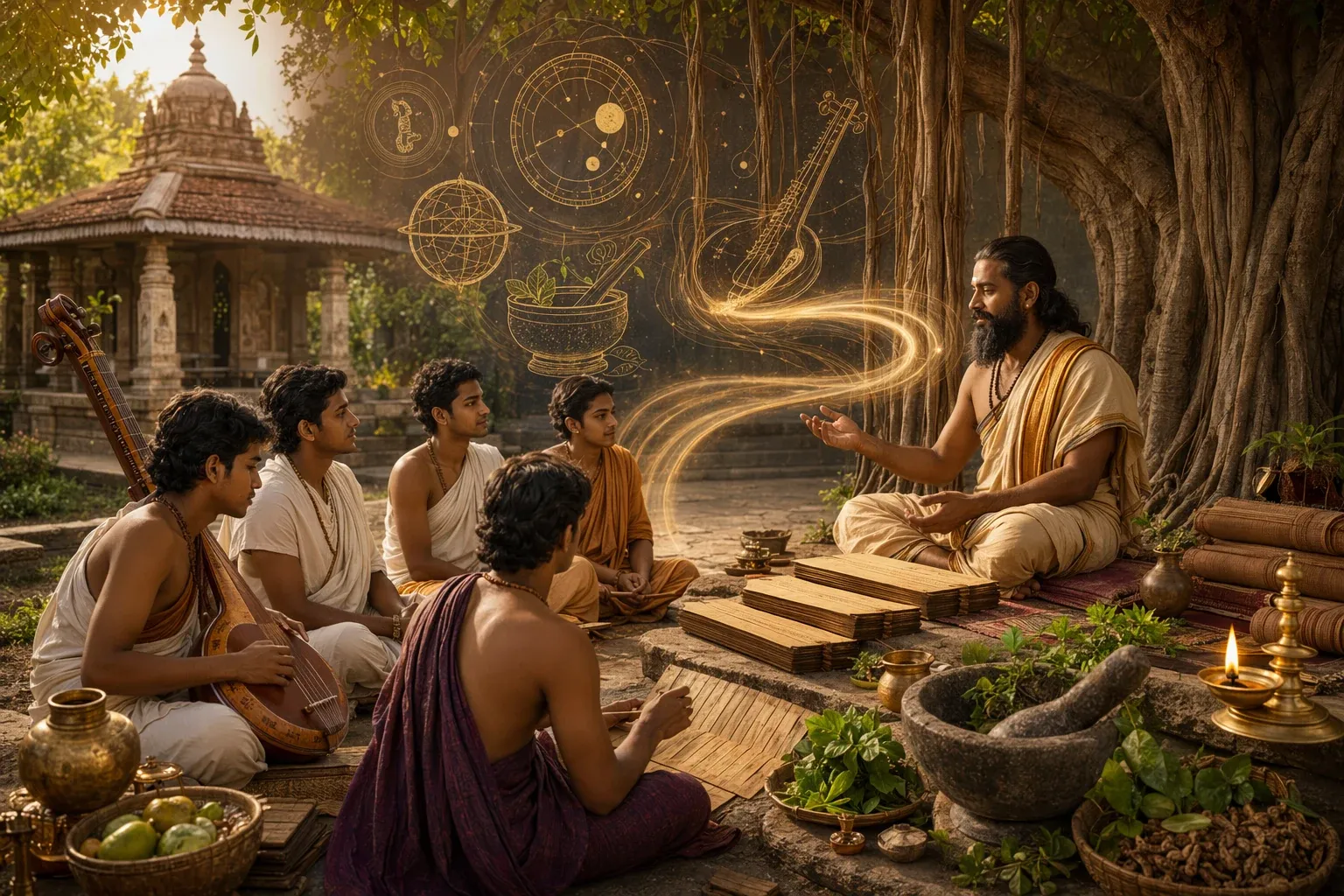
Guru Shishya Parampara has a special place in the Indian Knowledge System because many Indian traditions were preserved through people before they were preserved through institutions. Knowledge moved through voices, hands, memory, practice, debate, ritual, art and daily discipline. The guru did not merely hand over information; the guru trained the shishya to carry knowledge responsibly.
When we speak of the Indian Knowledge System, we are speaking about a wide field: Vedas, Upanishads, grammar, logic, Ayurveda, astronomy, mathematics, temple architecture, yoga, music, dance, crafts and more. These subjects were not taught in one uniform way. Yet many of them depended on close guidance, repetition and lineage. That is where Guru Shishya Parampara becomes important.
Oral memory kept knowledge alive
One of the strongest examples is Vedic chanting. The Vedas were transmitted orally for centuries, with careful attention to sound and sequence. UNESCO’s page on the tradition of Vedic chanting describes detailed recitation techniques used to preserve pronunciation, tonal accents and combinations of speech. This gives us a window into how seriously memory was trained.
Oral transmission was not casual memorisation. It was a technology of the human body and mind. The ear, tongue, breath and attention worked together. A student heard, repeated, corrected and repeated again. In such a system, the guru was like a living quality check. If a sound slipped, the teacher could catch it immediately.
Texts mattered, but practice completed them
India has a vast textual heritage: sutras, shastras, commentaries, kavya, medical treatises, philosophical works and manuals of art. But a text often needs a trained reader. A short sutra may contain a dense idea. A verse may depend on grammar, context and earlier interpretations. A musical notation cannot fully teach the movement of a note. A yoga text cannot watch whether the practitioner is forcing the body.
Guru Shishya Parampara helped connect text with practice. The teacher explained, demonstrated, questioned and corrected. The student learned how to read, how to apply, and when not to overclaim. This is why the tradition belongs not only to religion but also to knowledge culture.
Debate sharpened understanding
The Indian Knowledge System was not only about obedience. Many traditions valued questioning and debate. Upanishadic conversations often move through questions. Philosophical schools argued about self, reality, perception, language and liberation. Buddhist, Jain and Hindu thinkers debated across centuries. Grammar, logic and interpretation developed through disagreement as well as continuity.
In this setting, the guru’s role was not to stop thought. The teacher prepared the student to think carefully. A shishya had to understand definitions, examples, counter-arguments and limits. Respect for the teacher did not remove the need for reasoning. In the best cases, it gave reasoning a disciplined foundation.
Arts and skills used the same living model
The model is easy to see in Indian performing arts. A vocalist learns raga through listening and riyaz. A mridangam or tabla student learns bols, hand technique and tala through repetition. A dancer learns not only steps but posture, expression, rhythm, costume discipline and the emotional meaning of a piece. These cannot be fully absorbed from a list.
Craft traditions also show this living model. A bronze caster, wood carver, weaver, painter or temple artisan learns materials and judgement through doing. The teacher may not explain every detail in a formal lecture. Sometimes the student learns by watching how the master chooses a tool, fixes an error or waits for the right texture. Knowledge sits in the hand as much as in the head.
Ethics gave knowledge a direction
Indian learning often connects knowledge with conduct. A person may know many verses or techniques, but without humility and responsibility that knowledge can become ego. Guru Shishya Parampara tried to shape the learner’s character along with skill. Service, patience, restraint and gratitude were treated as part of education.
This ethical layer matters today. If someone studies Ayurveda, yoga, mantra, temple art or philosophy, they should avoid exaggerated claims and shallow marketing. They should know where a practice comes from, what its limits are, and how to respect the communities that carried it. The guru-shishya model reminds us that knowledge is not just “content”; it has consequences.
Lineage protected variation too
Parampara does not mean every teacher repeats everything mechanically. Lineages preserve, but they also develop. A music gharana may keep a style while allowing individual creativity. A philosophical tradition may comment on an older text for a new audience. A yoga teacher may adapt practice for age, health and capacity. The line continues because each generation receives and responds.
At the same time, lineage provides accountability. A teacher is not floating alone; they stand in relation to earlier teachers, texts and methods. A student can ask: Who taught this? What is the source? How has it been practised? What is interpretation and what is historical evidence? These questions make learning stronger.
A careful view of history
It is tempting to say that all ancient Indian education was one perfect gurukul system. That would be too simple. India had many regions, languages, communities and institutions. Access to knowledge was shaped by social realities, patronage, family occupations, gender, caste and sect. Some traditions were open; some were restricted. Some knowledge travelled widely; some stayed within families or monasteries.
A mature view can honour Guru Shishya Parampara without turning history into a slogan. The tradition helped preserve remarkable knowledge, but it also existed within changing societies. That honesty makes our respect deeper, not weaker.
Questions people ask
What is Guru Shishya Parampara in the Indian Knowledge System?
It is the teacher-student lineage through which Indian knowledge was taught, practised, corrected and passed on across fields such as Vedic chanting, philosophy, arts, yoga and crafts.
What is the concept of Guru-Shishya?
The concept is that knowledge grows through a relationship: the guru guides with responsibility, and the shishya learns through trust, practice, questioning and discipline.
Why was oral learning so important?
Oral learning mattered because sound, rhythm, memory, technique and interpretation often needed direct correction. This was especially important in Vedic recitation and performing arts.
In short, Guru Shishya Parampara is one of the bridges between India’s texts and India’s living knowledge. It shows how memory, practice and ethics can carry culture across generations.