
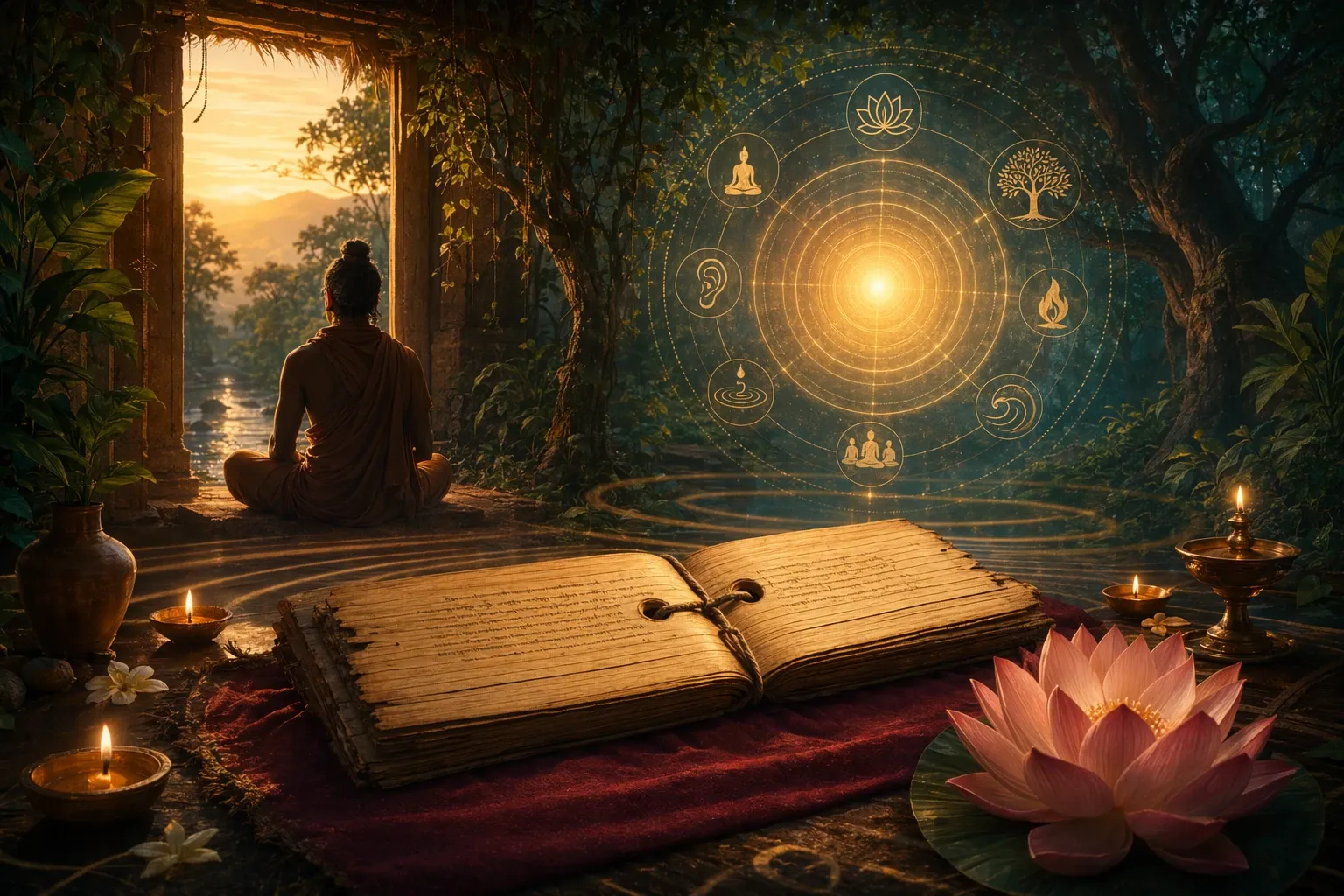
If you searched for 'what are the upanishads', this guide is for you. Bhaktilipi will keep it simple, respectful, and beginner-friendly.
Related search angles behind this guide include: upanishads meaning, upanishads definition, what is upanishads, what is upanishads in hinduism, what are upanishads class 6.
Reader questions answered here: What are the Upanishads?; What is the meaning/definition of Upanishads?; What are Upanishads in Hinduism?.
Quick answer
The Upanishads are ancient Hindu wisdom texts found at the end of the Vedic tradition. They explore questions like: Who am I? What is the deepest reality? What happens when we live with knowledge instead of only habit?
A simple definition is: the Upanishads are philosophical and spiritual teachings that discuss Atman, Brahman, karma, moksha, meditation, and the search for truth. They are not one short book, but a group of texts preserved through teacher-student learning.
What does Upanishad mean?
The word Upanishad is often explained as “sitting down near” a teacher. This points to a learning scene: a student comes close, listens carefully, asks questions, and receives inner knowledge.
Some traditional explanations also connect the word with knowledge that loosens ignorance. For beginners, the safest meaning is not just a dictionary translation. It is the feeling of close, serious, respectful learning.
Where do the Upanishads fit in Hinduism?
The Upanishads are part of Shruti, the highly respected “heard” sacred tradition connected with the Vedas. Many important Upanishads are attached to Vedic schools and are often called Vedanta, meaning the end or culmination of the Vedas.
This does not mean every Hindu reads the Upanishads daily. Hindu life also includes epics, Puranas, temple worship, bhakti, festivals, family customs, and local traditions. But for philosophy, the Upanishads are foundational.
What do they talk about?
The Upanishads ask big questions in compact, poetic ways. They discuss Atman, the inner Self; Brahman, ultimate reality; karma, action and its results; moksha, freedom; and the difference between surface life and deeper wisdom.
They often teach through dialogues, stories, metaphors, and bold sentences. A teacher may use fire, breath, space, sound, food, sleep, or a simple question to point toward a deeper truth.
Why do the Upanishads matter?
The Upanishads shaped Vedanta, yoga philosophy, later Hindu thought, and modern spiritual discussions around the world. Ideas like “the Self is deeper than the body and mind” and “ultimate reality is not limited by one form” became hugely influential.
They also matter because they show ancient India thinking deeply about consciousness, ethics, death, learning, and liberation. This is heritage, but it is also a living invitation to think carefully.
How should beginners approach them?
Do not begin by forcing yourself to understand every Sanskrit word or every philosophical school. Start with a simple overview, then read selected passages with a trustworthy commentary.
Keep humility. The Upanishads are not motivational quotes for social media, and they are not meant for arrogant “I know everything” energy. Read slowly, ask questions, and let the ideas become clearer over time.