
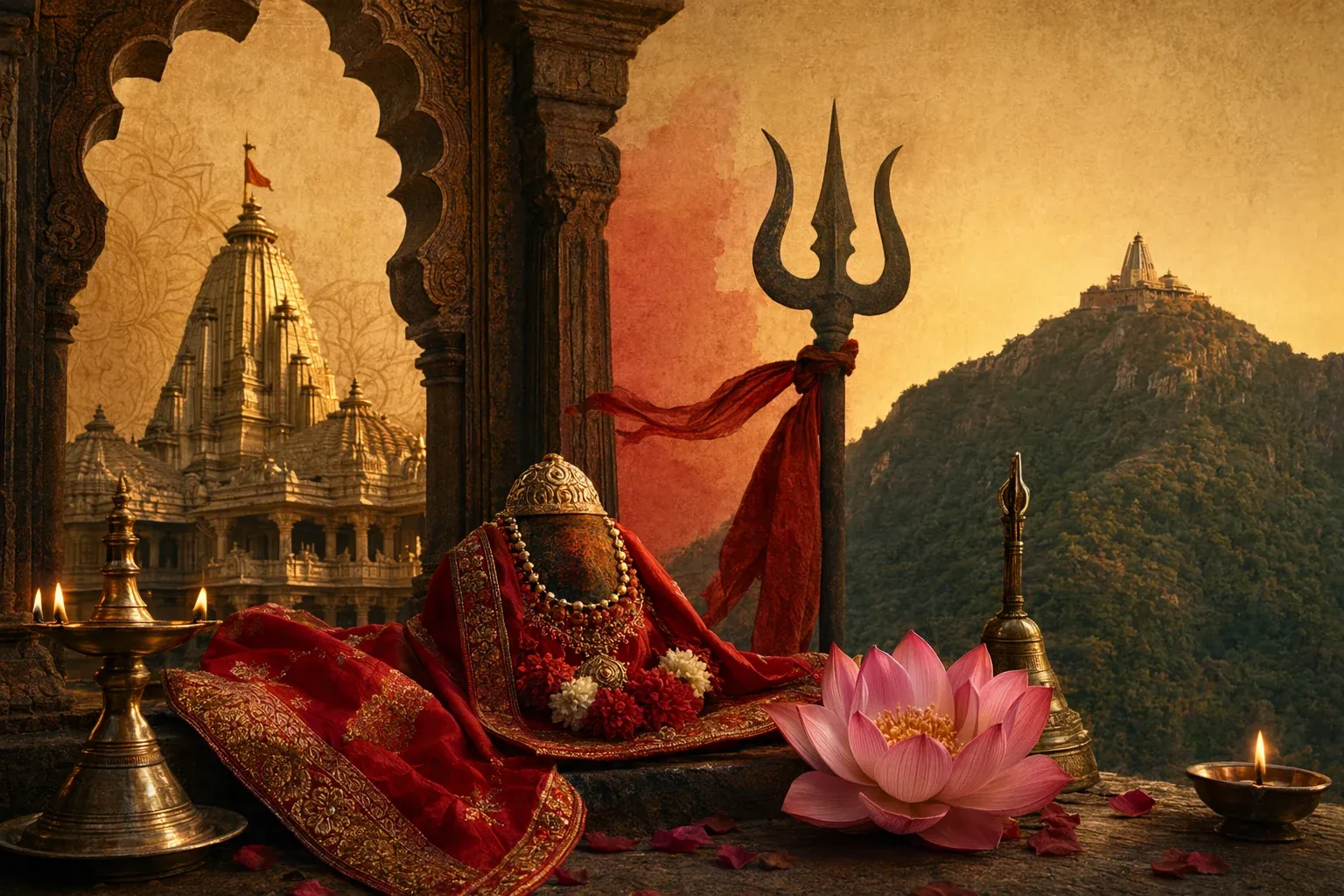
Gujarat’s Shakti Peeth tradition is best understood as a living map of Devi devotion rather than a simple checklist of temple names. Two places come up again and again in Gujarati memory: Ambaji in north Gujarat and Pavagadh near Champaner. Both are connected with powerful forms of the Mother Goddess, both draw large numbers of devotees, and both show how sacred geography, family vows, local songs, and temple practice come together in western India.
For a wider starting point, you may first read Bhaktilipi’s guide to what a Shakti Peeth means and the simple 51 Shakti Peeth list. This Gujarat guide focuses on how the tradition is remembered in a regional setting.
Why Gujarat matters in the Shakti Peeth tradition
Gujarat sits at a cultural crossroads: desert routes, old trading towns, pilgrimage paths, Jain and Hindu temple networks, folk music, Garba, and village goddess worship all meet here. Devi worship in Gujarat is therefore not limited to one temple visit. It appears in Navratri nights, household vows, local shrine stories, wedding customs, protection rituals, and songs that remember the Goddess as mother, queen, warrior, and giver of refuge.
When people ask about Shakti Peeth in Gujarat, they are often looking for a direct answer. Ambaji and Pavagadh are the two names most beginners should know first. The exact traditional details can vary by list, lineage, and local telling, so it is better to learn the broad meaning before arguing over one fixed count. A Shakti Peeth is not only a point on a map; it is a place where memory says the presence of Shakti is especially concentrated.
Ambaji: the northern Gujarat center of devotion
Ambaji, near the Aravalli range and close to the Rajasthan border, is one of Gujarat’s most loved Devi shrines. The temple is associated with Arasuri Amba, and many devotees approach it as a place of motherly protection, fulfilment of vows, and renewal of courage. The shrine is important not because it offers a complicated theology to every visitor, but because it gives a clear emotional language: come with reverence, ask with humility, and return with gratitude.
A striking feature of Ambaji devotion is the importance of the yantra. Many visitors notice that the sanctum’s focus is not a simple public-facing idol in the way some other temples are arranged. This teaches an important point about Shakti worship: the Goddess may be approached through form, symbol, sound, geometry, lamp, cloth, mantra, mountain, and memory. The sacred does not need to be reduced to one visual style.
Ambaji is also linked with Gabbar hill, which many devotees visit as part of the pilgrimage. The hill setting adds a layer of movement: the devotee does not only stand before a shrine, but climbs, pauses, remembers, and returns. That bodily rhythm matters. Pilgrimage often works through steps, heat, dust, waiting, and shared food as much as through doctrine.
Pavagadh and Kalika Mata: Shakti on a hill
Pavagadh is connected with Kalika Mata and the dramatic landscape above Champaner. The hill, the old fort area, and the ascent all shape the experience. Even before a beginner learns every historical detail, the place communicates height, endurance, and protection. The Goddess is encountered as a power above the plain, watching over movement, settlement, danger, and hope.
Pavagadh is also useful for understanding how Shakti shrines often carry layered histories. A temple can be a devotional place, a regional landmark, a memory of old kingdoms, a folk destination, and a modern pilgrimage center at the same time. These meanings do not cancel each other. They make the shrine richer.
For visitors, the key is to avoid treating Pavagadh as only a scenic trip. The hill is beautiful, but the heart of the visit is reverence. Dress modestly, follow queue discipline, avoid careless photography where it is not appropriate, and remember that many people around you may be fulfilling a serious family vow.
Ambaji and Pavagadh are not the same experience
Beginners sometimes group every Devi temple together, but Ambaji and Pavagadh feel different. Ambaji is strongly associated with Amba, the yantra-centered shrine, Gabbar hill, and north Gujarat’s devotional identity. Pavagadh centers on Kalika Mata, a hilltop ascent, and the sacred landscape around Champaner. Both are powerful, yet each teaches a different mood of Shakti.
This difference is important because Gujarat’s Devi tradition is not a flat list. One shrine may emphasize motherly grace, another fierce protection, another village belonging, another royal memory, and another seasonal celebration. The same devotee may visit more than one and feel a different emotion at each place.
How Navratri shapes Gujarat’s understanding of Shakti
No guide to Gujarat’s Shakti Peeth tradition is complete without Navratri. Garba and dandiya are sometimes presented only as dance, but their deeper setting is devotion around the Goddess. The circular movement, lamp imagery, songs, and community gathering all point toward Shakti as the center around which life turns.
This does not mean every Navratri event is equally traditional or equally serious. Modern celebrations vary widely. Still, the cultural memory is strong: Gujarat learns Devi not only through temple architecture, but through rhythm, voice, dress, fasting, food, and shared night-long celebration. Ambaji and Pavagadh sit inside that larger devotional world.
Respectful ways to visit
If you are planning a visit, check current temple timings locally, because crowds, festivals, repairs, and weather can change practical arrangements. Carry water, be patient in queues, and avoid pushing for a rushed darshan. Offerings should be made according to temple rules rather than online assumptions. If you are unsure, ask a local devotee or temple volunteer politely.
Do not expect every priest, guide, or website to explain the same body-part association in the same words. Lists of Shakti Peeths have regional variations. A respectful learner can note those differences without turning the tradition into a debate. The devotional heart is clearer than the arguments: these are places where Shakti is remembered as present, protective, and worthy of reverence.
Simple takeaway
Gujarat’s Shakti Peeth tradition becomes easier to understand when Ambaji and Pavagadh are seen as living centers of devotion, not only as entries in a sacred list. Ambaji teaches the power of Amba, yantra, vow, and northern Gujarat’s pilgrimage memory. Pavagadh teaches the force of Kalika Mata, hill worship, and layered sacred history. Together they show why Shakti worship in Gujarat is both intimate and grand: the Mother is found in the shrine, the hill, the song, the family vow, and the patient journey of the devotee.