
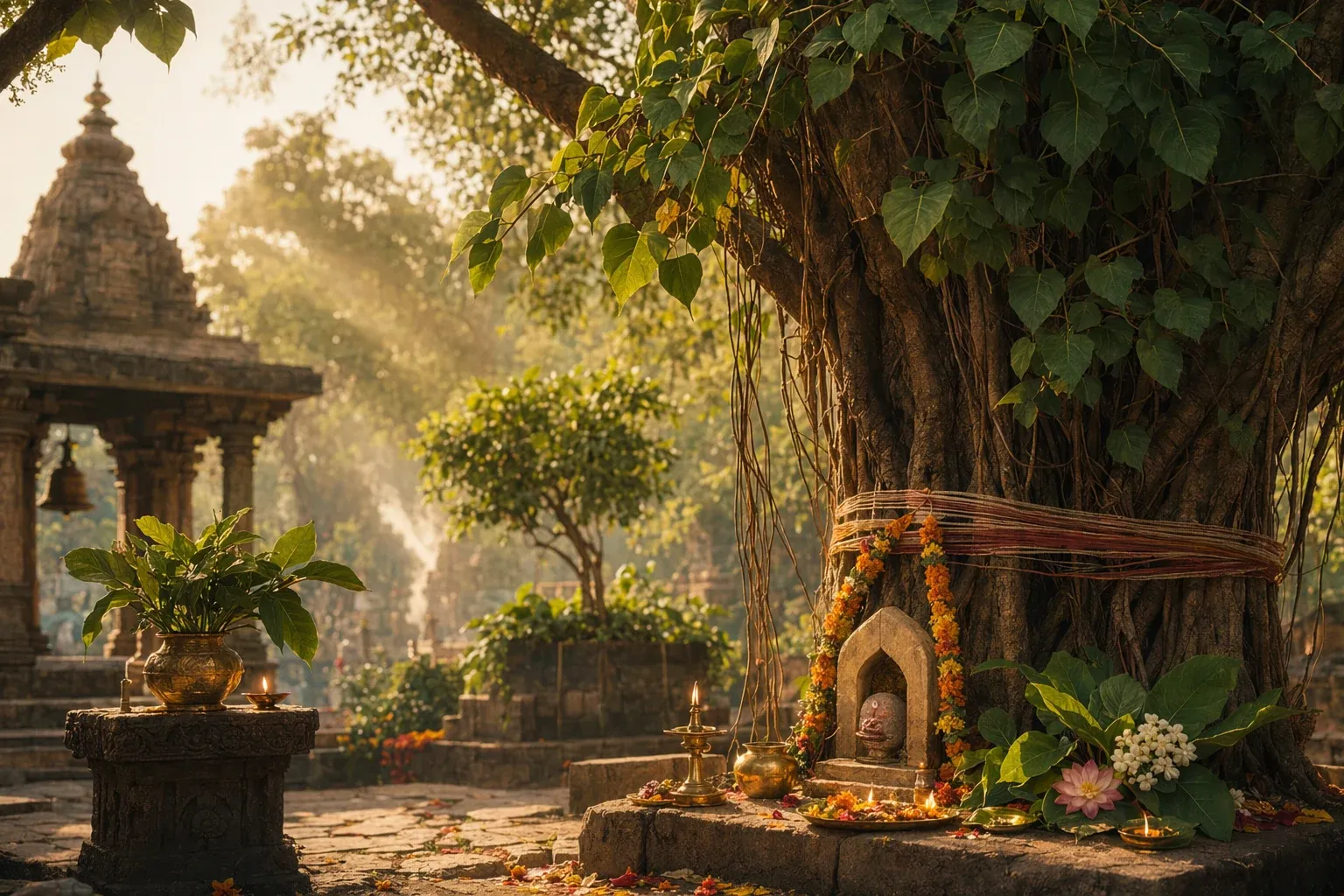
Many people ask for the “five holy trees” of India as if there is one final answer printed somewhere for the whole country. The honest answer is more interesting: India has many sacred-tree traditions, and different regions remember different sets. Still, one popular learning set brings together five trees that appear again and again in temple spaces, home practice, festivals, and ecological memory: Peepal, Banyan, Bilva, Amla, and Ashoka.
This list is useful for beginners because it shows how Indian culture looks at trees. A tree is not respected only as a plant with leaves and roots. It can become a place of shade, a marker of community memory, a symbol in a story, a part of worship, and sometimes a living reminder of dharma: the duty to protect what protects life. But the list should be treated as a doorway, not a rigid rule. Your grandmother’s list, a temple garden’s list, and a school textbook’s list may not match exactly, and that variation is normal.
The five-tree idea is a learning map, not a national canon
Numbered lists are common in Indian learning because they are easy to remember. We remember pancha as “five” in many contexts: five elements, five senses, five sacred offerings, five lamps, and so on. A five-tree list works in the same way. It helps a learner hold a few important examples in the mind without pretending that all of India has only five sacred trees.
The word Panchavati is also part of this larger imagination. In the Ramayana story-world, Panchavati is remembered as a forest place connected with Rama, Sita, and Lakshmana during exile. In modern cultural and environmental language, people may also use panchavati for a small sacred grove or a five-tree plantation. The exact trees named in such plantings can vary. That is why a responsible answer should say “a common five-tree set” rather than “the only five holy trees”.
Peepal, the tree of presence and awakening
Peepal, also called Ashvattha or sacred fig, is one of the most widely recognised sacred trees in India. In Hindu practice it is often associated with continuity, life, and divine presence. In Buddhist memory, the Bodhi Tree at Bodh Gaya is a sacred fig connected with the Buddha’s awakening. These are different traditions, but both show why the tree’s heart-shaped leaves and long life became so powerful in Indian imagination.
You will often see Peepal near temples, village platforms, older wells, and public resting spaces. People may circumambulate it, light lamps near it, or simply sit under its shade. The cultural meaning is not that every leaf performs a miracle. The meaning is that a living tree can become a meeting point between devotion, memory, and everyday human need.
Banyan, the tree that becomes a world
The Banyan or Vat is famous for aerial roots that grow down and become new supports. A single tree can spread like a small forest. That physical form gives it a strong symbolic life. It can suggest shelter, continuity, ancestors, and the way one life supports many others. In many places, banyan platforms became community spaces where elders sat, travellers rested, and village discussions happened.
The Vat Savitri tradition, observed in several regions, links the banyan with the story of Savitri and Satyavan. Devotees remember steadfastness, prayer, and commitment through ritual action around the tree. Historically, the practice has regional forms, and interpretations differ. Some families emphasise marriage and longevity; others also see the banyan as a sign of patience and resilience.
Bilva, the leaf offered to Shiva
Bilva or Bel is strongly associated with Shiva worship. Its trifoliate leaf, often seen as three leaflets joined together, is offered in many Shiva temples. Devotees may connect it with Shiva’s three eyes, the three gunas, or the balancing of body, mind, and spirit. These are devotional interpretations, not laboratory claims, and they vary by teacher and tradition.
Bilva is important because it shows how a tree can enter worship through a simple material object: a leaf. A devotee does not need expensive offerings to express bhakti. A clean leaf, offered with care, becomes meaningful. That simplicity is one reason sacred trees remained close to ordinary people, not only to kings and scholars.
Amla, the tree of nourishment and auspiciousness
Amla, the Indian gooseberry, is known in everyday India as a food and as a plant used in traditional knowledge systems. In sacred-tree lists it often stands for nourishment, health, and auspicious growth. Some communities observe Amla Navami or Akshaya Navami, spending time near the tree and sharing food in a devotional setting.
It is important to avoid turning this into a cure claim. Bhaktilipi’s cultural lens is not “eat this and every problem disappears”. The better point is that Indian tradition often respected useful plants through festivals and stories. When a plant feeds, shades, or supports a community, culture remembers it with gratitude.
Ashoka, the tree of joy and story
Ashoka is remembered in literature, temple art, and popular imagination. The name is often explained as “without sorrow”, which makes it easy to connect with joy, spring, and beauty. In the Ramayana tradition, Sita is remembered in Ashoka-vatika in Lanka, where the tree becomes part of a story of patience, dignity, and hope under pressure.
There is also a practical caution here. In modern nurseries and gardens, the word “Ashoka” is sometimes used loosely for different ornamental trees. The cultural Ashoka of classical references and the common “false ashoka” seen in many cities are not always the same botanical plant. A beginner should learn the cultural story first, then check the plant identity carefully if planting or studying botany.
Why these five still matter
Taken together, these five trees show five different kinds of sacredness. Peepal carries the feeling of presence and awakening. Banyan carries shelter and continuity. Bilva carries offering and Shiva devotion. Amla carries nourishment and auspicious growth. Ashoka carries beauty, memory, and the movement from sorrow toward hope.
This does not mean Neem, Tulsi, Shami, Banana, Kadamba, Palasha, or Sandalwood are less important. They simply belong to other lists and contexts. Neem is closely tied to protection and village life. Tulsi is central in many homes and Vaishnava devotion. Shami is remembered around Dussehra in some regions. Indian sacred-tree culture is a forest, not a single checklist.
A respectful way to remember the answer
If someone asks you, “What are the five holy trees in India?”, the safest answer is: “A common beginner list includes Peepal, Banyan, Bilva, Amla, and Ashoka, but Indian traditions vary by region and community.” That sentence is simple, accurate, and respectful. It gives the learner a starting point without erasing local practice.
The deeper lesson is not that five trees are magically superior to all others. The deeper lesson is that Indian culture often trained people to see nature as relation, not just resource. A tree could be worshipped, protected, named in story, planted near a temple, and remembered by a family for generations. When we keep that attitude alive today, the old list becomes more than trivia. It becomes a quiet reminder to care for the living world that has cared for us.